Crossocheilus latius
Formerly Cyprinus latius Hamilton, 1822 · Cyprinus sada Hamilton, 1822 · Cyprinus gohama Hamilton, 1822 · Gonorhynchus brevis McClelland, 1839 · Gonorhynchus fimbriatus McClelland, 1839 · Gonorhynchus macrosomus McClelland, 1839 · Chondrostoma wattanah Sykes, 1839 · Discognathus adiscus Annandale, 1919 · Crossochilus latius punjabensis Mukerji, 1934
Last revised 2026Edit this page
On this page13 sections
Quick factsEdit
Difficulty8 of 8 measures
- Space
- very large tank
- Water
- flexible
- Temp
- flexible
- Diet
- no meaty foods
- Temperament
- peaceful
- Social
- needs to be in a group
- Compatibility
- fine with others
Other demands
Each of these can raise the rating on its own, whatever the measures above say.
- Hardiness
- needs a well-established tank
- Needs strong current, with the filter turning the tank over 8–12 times an hour
- Needs a very large tank
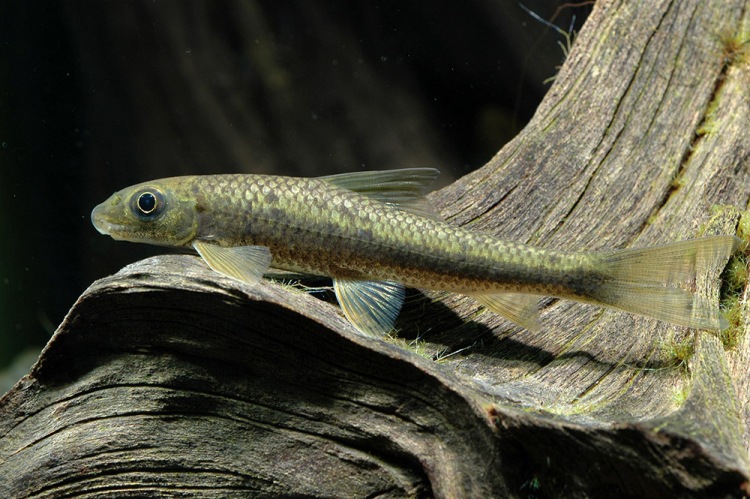
Crossocheilus latius is a cyprinid widespread in India, described from the Tista River on the border with Bangladesh. It lives everywhere from boulder-strewn Himalayan hill streams to silt-laden tributaries and pools. Not often available in the trade, it sometimes turns up in shipments of Indian Garra, and its relatively plain pattern makes it unlikely to be confused with congeners. Juveniles are gregarious and active, but adults tend to become sedentary and solitary.
Etymology
EditCrossocheilus: from the Ancient Greek κροσσός (krossós), meaning 'fringe, tassel', and χείλος (cheílos), meaning 'lip', in reference to the barbels on the upper lip in members of this genus.
latius: a Latinisation of lati, the vernacular Bengali name for this species.
Distribution
EditThis species was described from the Teesta/Tista River close to the border between Darjeeling district, India and Bangladesh, although no preserved type specimens exist. It's widespread in India and has also been recorded from eastern Iran, Afghanistan, Pakistan, Nepal, Bhutan, Bangladesh, China and Myanmar. However some of these records may refer to other species due to recent splitting of the taxon.
For example in the past the form from Bangladesh has been referred to as C. latius latius and that from Pakistan/Afghanistan C. l. diplocheilus, but the latter has since been raised to full species level as C. diplochilus. Kullander et al. (1999) concluded that this fish is not even a Crossocheilus but were unable to place it into an alternative genus with any certainty.
Similarly the form from the upper Ayeyarwady, Salween and upper Mekong rivers in Yunnan province, southwestern China was described as C. multirastellus (Su, Yang & Chen, 2000)[1] but this was corrected by Kottelat (2003). He highlighted inaccuracies in the earlier study and concluded that C. multirastellus is the same fish as C. burmanicus, first described by Hora in 1936. Most of the fish seen in the aquarium trade are likely to originate from India.
Type locality is given as 'Tista River, at base of Darjeeling Himalayas, India/Bangladesh'.
Habitat
Write a noteEditFound in various habitat types, from lower Himalayan hill streams flowing over boulders, pebbles, gravel and sand to slower-moving, silt-laden tributaries and associated pools with muddy substrates. It is now also found inhabiting some permanent bodies of water as a result of human activities such as the damming of river channels.
Aquarium size
Write a noteEditBase measurements of 150 ∗ 45 cm60 ∗ 18 in or more.
Maintenance
Write a noteEditThis species will do well in most well-maintained tanks but we highly recommend keeping it in a set-up designed to resemble a flowing river or stream, with a substrate of variably-sized rocks, gravel and some large water-worn boulders.
It can be further furnished with driftwood branches arranged to form a network of nooks, crannies and shaded spots. While the majority of plant species will fail to thrive in such surroundings hardy types such as Microsorum, Bolbitis or Anubias spp. can be grown attached to the décor and bright lighting will promote the growth of algae upon which the fish will graze. In this kind of environment it will display more natural behaviour and can be kept alongside other species that enjoy similar conditions.
Like many fishes that naturally inhabit running waters it's intolerant to the accumulation of organic wastes and requires spotless water at all times in order to thrive. It also does best if there is a high level of dissolved oxygen and a decent level of water movement in the tank so a external filters, powerheads or similar should be employed in order to obtain the desired effect.
Water conditions
EditTemperature: This species is subject to seasonal temperature fluctuations in nature and is comfortable between 59 - 77°F/15 - 25°C with even greater extremes being tolerated for short periods. A value within the range 18 – 24 °C64 – 75 °F is ideal for long-term care.
pH: Weakly acidic to neutral water within the range 6.0 – 7.5 is usually recommended.
Hardness: 2 – 15 dGH
These recommendations come from this profile’s own figures. They contain affiliate links, so we may earn a commission.
Diet
Write a noteEditIn nature Crossocheilus spp. are aufwuchs grazers feeding on algae, diatoms and other phytoplankton. The use of high protein foods in the aquarium should therefore be avoided as the fish are unable to metabolise some components efficiently; regular, prolonged consumption can result in excessive deposits of fat and even organ degeneration.
A good quality dried product(s) with added Spirulina or similar is ideal but plenty of fresh vegetable matter should also be included in the diet. Shelled peas, blanched courgette, spinach and chopped fruit all make good additions to the menu. Once settled into the aquarium the fish sometimes ascend into midwater to feed and in a rivertank-style set-up as described above will often be seen browsing the biofilm that tends to form on the rockwork. According to reports this species will also eat 'black brush' algae (BBA), also known as 'red' or 'beard' algae.
Behaviour and compatibility
Write a noteEditGenerally peaceful and can be maintained alongside many of the more popular species in the hobby although our preference would be to select fishes from from one of its native countries or rivers. Possibilities from northern India include Acanthocobitis botia, Botia dario, B. almorhae, B. rostrata, Lepidocephalichthys guntea, Balitora brucei, and numerous small cyprinids, for example.
SF member Andy Rushworth has kept C. latius and says that while it's quite gregarious and active when juvenile adults tend to live a more sedentary, solitary existence, though they remain peaceful with one another.
Sexual dimorphism
Write a noteEditSexually mature females are normally thicker-bodied than males but it 's impossible to accurately sex young fish by external characters.
Reproduction
Write a noteEditNot thought to have occured in the hobby. Members of this genus are known to undergo seasonal reproductive migrations in nature, moving upstream during the dryer months and in the opposite direction when water levels rise.
Notes
EditC. latius isn't often available in the ornamental trade but makes an excellent alternative to more commonly-offered members of the genus should you be lucky enough to find some. Shipments of similar-looking Indian Garra species such as G. mullya or G. gotyla sometimes contain the odd specimen.
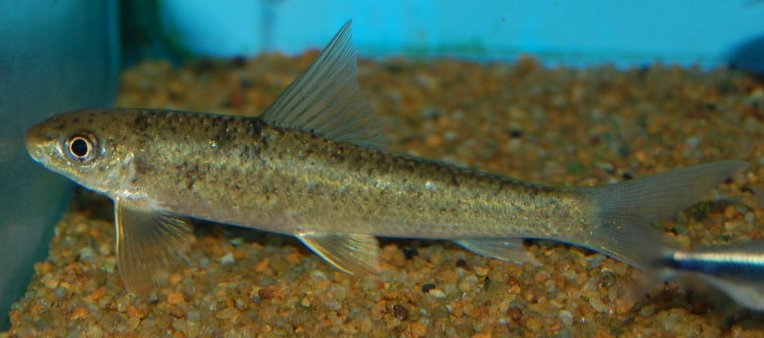
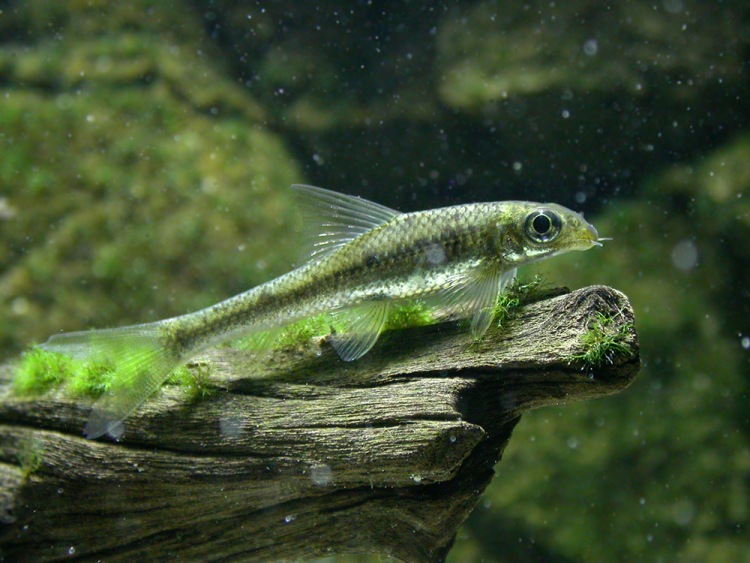
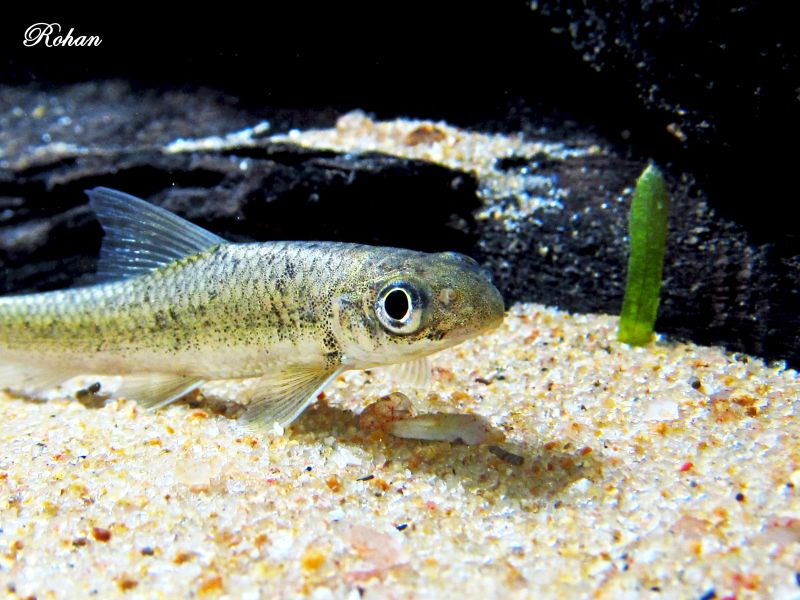
It is unlikely to be confused with any congeners available in the aquarium hobby given its relatively plain colour pattern.
Members of Crossocheilus are characterised by possessing 8 branched dorsal fin rays, immobile rostral lobes, lacking a dorsal spine and by the fact that the upper and lower lips aren't connected, the upper being attached to the lower jaw via a thin membrane.
References
- Su, R.-F., J.-X. Yang and Y.-R. Chen (2000). A review of the Chinese species of Crossocheilus, with description of a new species (Ostariophysi: Cyprinidae). The Raffles Bulletin of Zoology 48(2), 215-221
- Kottelat, M. (2003). Nomenclatural status of Crossocheilus burmanicus, C. horai and C. multirastellatus (Osteichthyes: Cyprinidae). Raffles Bulletin of Zoology 51(2), 399-401
- Rainboth, W. J. (1996). Fishes of the Cambodian Mekong. FAO Species Identification Field Guide for Fishery Purposes. FAO, Rome, 1-265
- Hamilton, F. (1822). An account of the fishes found in the river Ganges and its branches. An account of the fishes found in the river Ganges and its branches., i-vii + 1-405
Species images · 4
These photographs are used with each photographer's permission.
Send a photographDistribution
Profile completeness23 of 24
Community
Questions about Crossocheilus latius?
Ask on Discord