Genus
Hemibarbus
- Species
- 4
- Photographed
- 4 of 4
- Difficulty rated
- 4 of 4
Where the name comes fromEdit
from the Ancient Greek ἡμι- (hēmi-), meaning 'half', and the generic name Barbus, to which members appear similar.
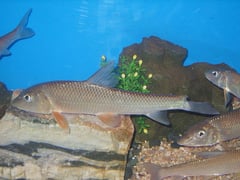
Hemibarbus labeoBarbel Steed
Pallas, 1776
The barbel steed, Hemibarbus labeo, is a cyprinid widespread in eastern Asia between the Yangtze and Amur river basins. A predominantly riverine fish of clear, well-oxygenated running water, it forms schools just above the substrate as an adult, and some populations make annual spawning migrations. Adults lack dark spots on the body and have a long snout and well-developed lips.
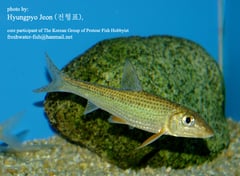
Hemibarbus longirostris
Regan, 1908
Hemibarbus longirostris is a cyprinid native to far eastern Asia, including northeastern China, southeastern Russia, the Korean peninsula and Japan. A predominantly riverine fish, it lives in clear, well-oxygenated running water over sand, gravel, rock or mud, and adults tend to form schools just above the substrate in slower-moving sections.
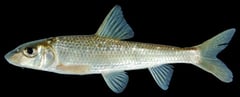
Hemibarbus maculatusSpotted Steed
Bleeker, 1871
The spotted steed, Hemibarbus maculatus, is a cyprinid widespread in eastern Asia between the Yangtze and Amur basins, including Taiwan and Hainan. It has 7–11 large blackish spots on each flank and a deep body with a clearly convex dorsal profile. A riverine fish of clear, well-oxygenated running water, it breeds in May and June, depositing its eggs among aquatic vegetation. It has probably been introduced to Vietnam and Laos, or records from there represent another species.
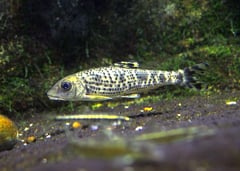
Hemibarbus mylodon
Berg, 1907
Hemibarbus mylodon is a cyprinid endemic to the Korean peninsula, where it occurs throughout North Korea and South Korea. A predominantly riverine fish, it lives in clear, well-oxygenated running water over sand, gravel, rock or mud, and adults tend to form schools just above the substrate in faster-flowing sections.