Genus
Labeo
- Species
- 6
- Photographed
- 6 of 6
- Difficulty rated
- 6 of 6
Where the name comes fromEdit
from the Latin labeo, meaning 'one with lips', in allusion to the remarkably thick, fleshy lips in members of this genus.

Labeo angra
Hamilton, 1822
Labeo angra is a benthic cyprinid from Pakistan, Nepal, northern India, Bangladesh and Myanmar, described from the Brahmaputra. It can be identified by a brownish back, yellowish flanks and belly, and a black to bluish stripe from the eye to the caudal-fin base. It undertakes annual spawning migrations within its native river systems.

Labeo bogaViolet Shark
Hamilton, 1822
The violet shark, Labeo boga, is a cyprinid from most major river systems in India, Pakistan, Nepal, Bangladesh and Myanmar. It inhabits major river channels and larger tributaries and grows to 250 mm, needing a tank of at least 240 x 60 cm. It is unsuitable for most home aquaria but turns up in the trade irregularly, also as the 'violet-gilled shark' or 'blushing violet shark'. L. boga as currently recognised probably represents a complex of closely-related species.

Labeo calbasuOrangefin Labeo
Hamilton, 1822
The orangefin labeo, Labeo calbasu, is a large cyprinid from Pakistan, Nepal, India, Bangladesh, Myanmar and southern China. Growing to 800 mm, it is an important food and game fish across its native range and is not a suitable subject for the home aquarium. It is known as 'black rohu' in parts of India and Bangladesh, and inhabits the lower reaches of major rivers, lakes and reservoirs.

Labeo chrysophekadionBlack Shark
Bleeker, 1849
The black shark, Labeo chrysophekadion, is a large cyprinid from Southeast Asia, including the Mekong, Chao Phraya and the Greater Sunda Islands. Also known as the black sharkminnow, it reaches 600 mm and is aggressively territorial towards conspecifics and similarly-shaped fishes. It continues to be sold despite its patent unsuitability for the home aquarium, and an albino form has been selectively bred for the trade.
Labeo cyclorhynchusHarlequin Shark
authority not recorded
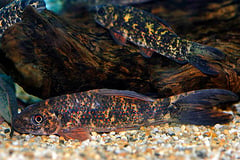
The harlequin shark, Labeo cyclorhynchus, is a cyprinid from the middle and lower Congo basin and the Ogooué drainage in Gabon. The patterning of young fish fades with age and adults are much darker. It becomes increasingly territorial as it grows, especially towards similar-looking species, so tankmates need choosing with care. It may still be seen as Labeo variegatus, an invalid name, in older literature and trade lists.

Labeo pierrei
Sauvage, 1880
Labeo pierrei is a large cyprinid from the Mekong river system in southern China, Laos, Thailand, Cambodia and Vietnam, and the Dong Nai in Vietnam. It grows to 800 mm and inhabits main river channels and large, deep tributaries. It migrates seasonally, moving upstream into the Sekong, Sesan and Srepok rivers at the onset of the wet season and returning downstream in the dry months.