Genus
Labiobarbus
- Species
- 4
- Photographed
- 4 of 4
- Difficulty rated
- 4 of 4
Where the name comes fromEdit
from the generic names Labeo and Barbus.
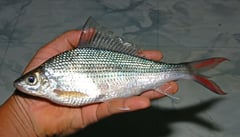
Labiobarbus fasciatus
Bleeker, 1853
Labiobarbus fasciatus is a labeonin cyprinid from the Pahang River system in Peninsular Malaysia and the islands of Sumatra and Borneo. It has a red caudal fin with a thin dark stripe along each lobe, and longitudinal stripes formed by spots on the scales. Like other Labiobarbus it has two pairs of well-developed barbels and an extremely long dorsal fin, and the genus was known as Dangila for over 100 years.

Labiobarbus leptocheilus
Valenciennes, 1842
Labiobarbus leptocheilus is a large cyprinid widespread in Southeast Asia, from the Mekong and Salween to the Greater Sunda Islands. Different populations vary somewhat in appearance, and it may turn out to represent a group of closely-related species. The Cambodian Mekong population has been considered a distinct species, Labiobarbus lineatus, and that name is widely used in the ornamental trade although it is currently a synonym. It grows to 260 mm SL and needs spotless, well-oxygenated water.
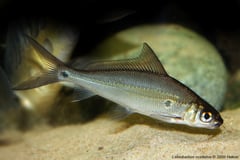
Labiobarbus ocellatus
Heckel, 1843
Labiobarbus ocellatus is a cyprinid from Peninsular Malaysia, Sumatra and Borneo, with a black spot on the shoulder and one on the caudal peduncle. It is occasionally available in the ornamental trade, typically under a name such as 'Bornean eye-spot silver shark' or the invalid scientific name Cirrhinus chinensis. A pelagic species of rivers and some lakes, it moves into seasonally inundated floodplains and forest during the wet season, and grows to 180 mm SL.

Labiobarbus siamensis
Sauvage, 1881
Labiobarbus siamensis is a cyprinid from the Mekong in Laos, Thailand and Cambodia, and the Chao Phraya and Bang Pakong in central Thailand. It inhabits rivers and streams of all sizes and moves into inundated floodplains and forests during the wet season. Wild fish feed on small items including phytoplankton, zooplankton, periphyton and benthic algae. Relatively long maxillary barbels, reaching well beyond the eye, help separate it from congeners.