Labiobarbus siamensis
Formerly Dangila siamensis Sauvage, 1881 · Dangila spilopleura Smith, 1934
On this page7 sections
Quick facts
Difficulty3 of 8 measures
More bars, more demanding. Hardiness is not averaged with the rest.
- Space
- large tank
- Water
- unknown
- Temp
- unknown
- Diet
- unknown
- Temperament
- unknown
- Social
- shoal
- Compatibility
- community tank
Hardiness on its own can raise the rating, whatever the measures above say.
- Hardiness
- unknown
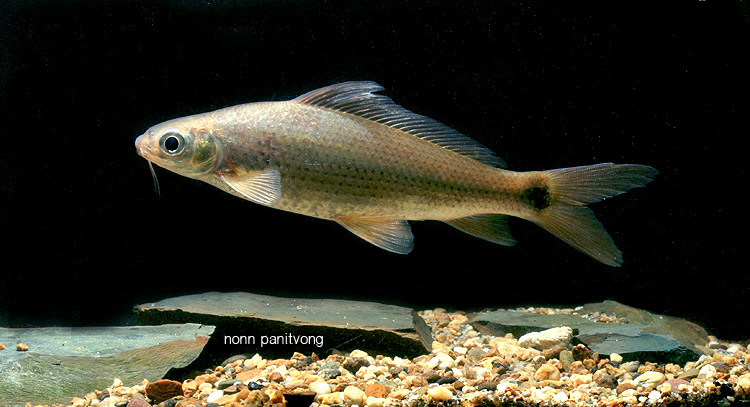
L. siamensis can be distinguished from congeners by the following combination of characters: 39-42 scales in the lateral series; shoulder spot usually absent, but sometimes well-defined; body with longitudinal stripes formed by a spot on each scale; dorsal fin with dusky median stripe and no red coloration; caudal fin dusky, sometimes with reddish coloration, but no well-defined stripes; 20-23 circumpeduncular scales...
Etymology
Distribution
Known from the Mekong River system in Laos, Thailand, and Cambodia, plus the Chao Phraya and Bang Pakong watersheds in central Thailand.
Type locality is 'Thailand: Petschaburi [Petchaburi] and Bangkok'.
Habitat
Inhabits rivers and streams of all sizes, and typically moves into inundated floodplains and forests during the wet season.
Diet
Wild fish are known to feed on small items including phytoplankton, zooplankton, periphyton, and benthic algae.
These recommendations come from this profile’s own figures. They contain affiliate links, so we may earn a commission.
Notes
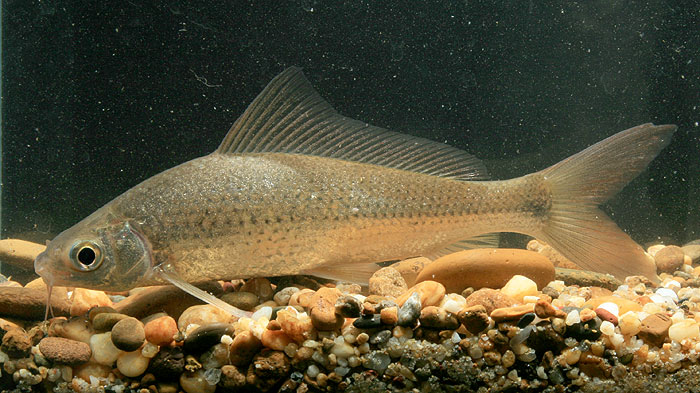
L. siamensis can be distinguished from congeners by the following combination of characters: 39-42 scales in the lateral series; shoulder spot usually absent, but sometimes well-defined; body with longitudinal stripes formed by a spot on each scale; dorsal fin with dusky median stripe and no red coloration; caudal fin dusky, sometimes with reddish coloration, but no well-defined stripes; 20-23 circumpeduncular scales; 25-30½ branched dorsal-fin rays; maxillary barbels relatively long, extending well beyond posterior border of eye.
Different populations vary in appearance somewhat (see image of Salween specimen for example), and L. leptocheilus may turn out to represent a group of closely-related species rather than a single taxon. The population from the Cambodian Mekong has been considered to represent a distinct species, Labiobarbus lineatus, although that name is currently a synonym of L. leptocheilus following Kottelat (2013). However, it is widely used in the ornamental trade, and typically applied to all forms of L. leptocheilus.
In recent studies the genus Labiobarbus is usually grouped within the cyprinid subfamily Labeoninae. Several authors including Roberts (1989) have argued that the generic name Dangila (Valenciennes, 1842), which was officially used for over 100 years, should continue to take precedence.
However according to rules set out in the modern-day International Code of Zoological Nomenclature Labiobarbus is the correct name on the basis of priority, having first been proposed by van Hasselt in 1823. Further doubts that van Hasselt and Valenciennes may have described two different fish were settled by Roberts (1993) who found that they were the same.
Members are most-easily distinguished from their close relatives by the possession of two pairs of well-developed barbels, an extremely long dorsal-fin with 4 simple and 18-30 branched rays and unique soft mouth parts which lack unculi (these form ridge-like rows on the lips of other Labeonins).
References
- Roberts, T. R. (1993). Systematic revision of the Southeast Asian cyprinid fish genus Labiobarbus (Teleostei: Cyprinidae). Raffles Bulletin of Zoology 41(2), 315-329
- Kottelat, M. (2013). The fishes of the inland waters of southeast Asia: a catalogue and core bibiography of the fishes known to occur in freshwaters, mangroves and estuaries. The Raffles Bulletin of Zoology Supplement 27, 1-663
- Yang, L. and R. L. Mayden (2010). Phylogenetic relationships, subdivision, and biogeography of the cyprinid tribe Labeonini (sensu Rainboth, 1991) (Teleostei: Cypriniformes), with comments on the implications of lips and associated structures in the labeonin classification. Molecular Phylogenetics and Evolution 54(1), 254-265
- Sauvage, H.-E. (1881). Recherches sur la faune ichthyologique de l'Asie et description d'espèces nouvelles de l'Indo-Chine. Nouvelles Archives du Muséum d'Histoire Naturelle, Paris (Série 2) v. 4, 123-194
- Kottelat, M. (2001). Fishes of Laos. WHT Publications, Colombo, 1-198
Species images · 2
Used with the photographer’s permission. Not licensed for reuse.
Distribution
Profile completeness13 of 24
54% complete
Also missing: aquarium size, a common name, aquarium notes, maintenance, water condition notes, behaviour and compatibility, sexual dimorphism, reproduction.
Community
Questions about Labiobarbus siamensis?
Ask on Discord