Genus
Opsarius
- Species
- 9
- Photographed
- 9 of 9
- Difficulty rated
- 9 of 9
Where the name comes fromEdit
apparently from an Ancient Greek word meaning 'small fish'.

Opsarius barna
Hamilton, 1822
Traded as 'striped hill trout' or 'banded hill trout', Opsarius barna is a cyprinid from the Ganges and Brahmaputra basins in northern India. It is thought to also occur in the Mahanadi and in river systems in Nepal, Bhutan, Bangladesh and Rakhine State, Myanmar, in well-oxygenated, fast-flowing rivers over gravel, cobbles and boulders. An extremely fast swimmer and vigorous feeder, it is unsuitable for the general community.

Opsarius bernatziki
Koumans, 1937
Sold as 'blue hillstream trout', Opsarius bernatziki is a cyprinid from peninsular Thailand and Tanintharyi, Myanmar, south of the Isthmus of Kra. It inhabits well-oxygenated, moderate to fast-flowing rivers and streams, usually 10-20 km or more from the sea. Six or seven bluish vertical bars on each flank and a large blotch at the caudal-fin base help identify it. Like its congeners it is too fast and vigorous a feeder for the general community.

Opsarius caudiocellatus
Chu, 1984
Opsarius caudiocellatus is a cyprinid known only from the Salween in southern China, Myanmar and western Thailand, and the upper Mekong in Yunnan. It is named for the black round spot at the caudal-fin base, which with its black dorsal-fin rays separates it from similar congeners. It may have appeared in the aquarium trade, though probably not under the correct name, and inhabits well-oxygenated, moderate to fast-flowing rivers and streams.

Opsarius dogarsinghiManipur Baril
Hora, 1921
The Manipur baril, Opsarius dogarsinghi, is a cyprinid from the Chindwin river system in Manipur and Nagaland, northeastern India, and Myanmar. It occasionally appears in the trade as 'Burmese hill trout' or 'striped hill trout'. A large dark blotch at the caudal-fin base and 8-9 dark blue vertical bars help separate it from congeners, and it has been bred in aquaria.

Opsarius infrafasciatus
Fowler, 1934
Opsarius infrafasciatus is a cyprinid from the Ping river in Thailand, the Ataran and Salween in Myanmar and China, and Mekong tributaries in China. Once considered synonymous with both O. ornatus and O. pulchellus, it has been treated as distinct since Tejavej (2012). It typically inhabits headwaters and minor rivers and streams with moderate to fast flow, and a small caudal spot is among the characters separating it from congeners.

Opsarius koratensis
Smith, 1931
Opsarius koratensis is a cyprinid of the middle and lower Mekong in Thailand, Laos and Cambodia, and the Chao Phraya, Mae Klong and Dong Nai systems. It apparently inhabits larger, deeper and more turbid rivers than many congeners. Genetic evidence from Tang et al. (2010) suggests it may represent a distinct genus, and it occasionally appears in the ornamental trade.
Opsarius ornatus
Sauvage, 1883
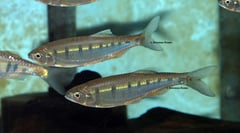
Opsarius ornatus is a cyprinid from Thailand, possibly restricted to a few small systems in Chumphon Province, mostly in the Tha Sae basin. Kottelat (2013) disputed that view, and the species may have been described from the Chao Phraya system. Populations in the Salween, Ataran, Ping and Mekong drainages formerly considered O. ornatus are O. infrafasciatus. It may have been exported for aquaria, though probably not under the correct name.

Opsarius pulchellus
Smith, 1931
Traded as 'butterfly barb' or 'mackerel barb', Opsarius pulchellus is a cyprinid from the Chao Phraya and mid-to-lower Mekong basins. It occurs in Thailand, Laos, Cambodia and Vietnam, typically in submontane headwaters and fast-flowing minor rivers and streams. Also sold as 'royal opsarius', it carries 7-10 elongate vertical bars on each flank, and like its congeners is too fast and vigorous a feeder for the general community.
Opsarius signicaudus
Tejavej, 2012
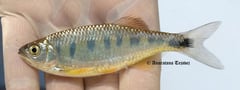
Opsarius signicaudus is a cyprinid known only from headwater tributaries of the Mae Klong River in western Thailand. It inhabits well-oxygenated, moderate to fast-moving rivers and streams over gravel, cobbles and boulders, and is intolerant of organic wastes. A large, elongated blotch at the caudal-fin base helps separate it from congeners. It may have been exported for aquaria, though probably not under the correct name.