Genus
Oryzias
- Species
- 12
- Photographed
- 12 of 12
- Difficulty rated
- 11 of 12
Where the name comes fromEdit
from the Greek ὄρυζα (oryza), meaning 'rice', in reference to the tendency of some members of the genus to inhabit rice paddy fields.
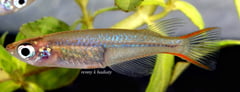
Oryzias asinuaAsinua Ricefish
Parenti, Hadiaty, Lumbantobing & Herder, 2013
The Asinua ricefish, Oryzias asinua, is known only from the Sungai Asinua in Southeast Sulawesi, Indonesia. The type series was collected along the shores and in small marginal pools on the adjacent floodplain. A member of the O. woworae species group, it differs from O. wolasi in that both sexes have orange-coloured olfactory epithelia, and it has a relatively slender body.
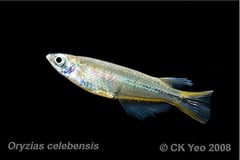
Oryzias celebensisCelebes Ricefish
Weber, 1894
The Celebes ricefish, Oryzias celebensis, lives in rivers and streams of southwestern Sulawesi, Indonesia, with a further record from Timor. It is mostly found in slow-moving or standing waters, often where aquatic plants proliferate. Infrequently available in the hobby, it is exported on occasion and sometimes referred to as 'Celebes medaka'.

Oryzias dancenaIndian Ricefish
Hamilton, 1822
The Indian ricefish, Oryzias dancena, is widely distributed through eastern and southern India, Sri Lanka, Bangladesh and Myanmar. Mostly coastal but adaptable, it has been collected from strongly brackish mangrove swamps to acidic freshwater forest streams. It continues to be misidentified as O. melastigma, a name most recent workers consider invalid, or as O. javanicus, a valid but distinct taxon.
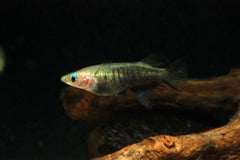
Oryzias eversi
Herder, Hadiaty & Nolte, 2012
Oryzias eversi is a ricefish known only from a single karst pool in the Salo Sadang drainage, Tana Toraja, South Sulawesi, Indonesia. The pool holds still, transparent water and is surrounded by rainforest. Nuptial males develop a blackish belly and posterior body, and females show pelvic brooding behaviour. The species is not common in the aquarium hobby.
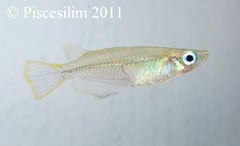
Oryzias javanicusJavanese Ricefish
Bleeker, 1854
The Javanese ricefish, Oryzias javanicus, ranges through Peninsular Thailand, Malaysia, Singapore and Indonesia as far east as Lombok and Sulawesi. Typically found in coastal, normally brackish, streams, pools and mangrove swamps, it tolerates a wide salinity range and has also been recorded in fresh water. It is exported on occasion and sometimes referred to as the 'blue-eyed ricefish'.
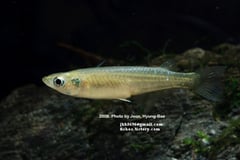
Oryzias latipesMedaka
Temminck & Schlegel, 1846
The medaka, Oryzias latipes, is a ricefish from Japan, Korea, Taiwan, eastern China, Laos and Vietnam. Long used as a model organism in genomic and experimental biology, it was the first vertebrate animal to mate in space, in the mid-1990s. The ornamental 'golden' variant is more often seen than the natural form, and a transgenic 'glowing' form is illegal to buy, sell or own within the European Union.

Oryzias mekongensisMekong Ricefish
Uwa & Magtoon, 1986
Oryzias mekongensis, the Mekong ricefish, is endemic to the Mekong River system in northeastern Thailand, Laos and Cambodia. It reaches about 21 mm SL and is known only from fresh water, mainly clear water swamps, canals, ditches and ponds with dense fine-leaved plants. Males have bright orange-red marginal bands on the caudal-fin lobes, and it may be sold as the 'Mekong redfin lampeye killifish'.

Oryzias minutillusDwarf Medaka
Smith, 1945
The dwarf medaka, Oryzias minutillus, is a miniature ricefish from Thailand, with records from Myanmar, Cambodia and southern China. It lives only in fresh, normally standing waters such as shallow pools, ditches, rice paddies and clear water swamps. Adults reach just 17 mm SL. Traded occasionally, it is also known as the 'dwarf ricefish'.
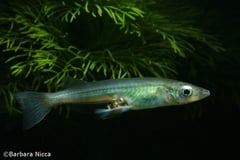
Oryzias sarasinorumSarasin's Buntingi
Popta, 1905
Sarasin's buntingi, Oryzias sarasinorum, is a ricefish endemic to Lake Lindu in Lore Lindu National Park, Central Sulawesi, Indonesia. Also known as Sarasin's minnow, it is exceptionally rare both in nature and the aquarium hobby. It was formerly placed in Xenopoecilus, and a broad silvery lateral stripe and 70-75 lateral scales separate it from all other Oryzias.

Oryzias songkhramensis
Magtoon, 2010
Oryzias songkhramensis is a small ricefish known only from the Songkhram River basin in northeastern Thailand and the Mekong drainage in Laos. It lives only in fresh, normally standing water such as shallow pools, ditches, rice paddies and clear water swamps. Males have black and yellow or orange marginal bands on the caudal-fin lobes, and there is a black spot at the base of the pectoral fins. It resembles O. mekongensis, which has been available in the hobby.
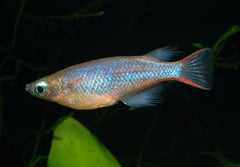
Oryzias wolasiWolasi Ricefish
Parenti, Hadiaty, Lumbantobing & Herder, 2013
The Wolasi ricefish, Oryzias wolasi, is known from four localities south of Kendari in Southeast Sulawesi, Indonesia. Discovered in 2009, it was referred to as O. sp. 'Kendari', O. sp. 'neon' or O. sp. 'Sulawesi' before description. A member of the O. woworae species group, it lives in karstic streams ranging from swift waterfalls to the remnant pools of an ephemeral river.
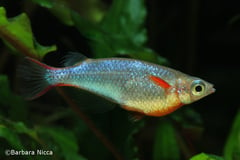
Oryzias woworaeDaisy's Ricefish
Parenti & Hadiaty, 2010
Daisy's ricefish, Oryzias woworae, is known only from a single stream on the island of Muna, Southeast Sulawesi, Indonesia. At 25-30 mm it is the most diminutive Oryzias known from Sulawesi. It caused something of a sensation when it first appeared in the trade shortly after description, and was collected schooling in a still pool of a karstic forest stream.