Oryzias minutillus
Dwarf Medaka
Last revised 2013Edit this page
On this page13 sections
Quick factsEdit
Difficulty6 of 8 measures
- Space
- small tank
- Water
- flexible
- Temp
- flexible
- Diet
- unknown
- Temperament
- peaceful
- Social
- needs to be in a group
- Compatibility
- fine with others
Other demands
Each of these can raise the rating on its own, whatever the measures above say.
- Hardiness
- unknown
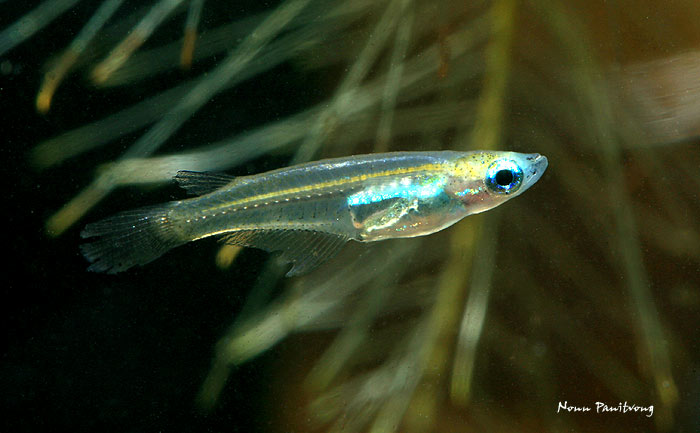
The dwarf medaka, Oryzias minutillus, is a miniature ricefish from Thailand, with records from Myanmar, Cambodia and southern China. It lives only in fresh, normally standing waters such as shallow pools, ditches, rice paddies and clear water swamps. Adults reach just 17 mm SL. Traded occasionally, it is also known as the 'dwarf ricefish'.
Etymology
EditOryzias: from the Greek ὄρυζα (oryza), meaning 'rice', in reference to the tendency of some members of the genus to inhabit rice paddy fields.
minutillus: from the Latin minutus, meaning 'small'.
Distribution
EditThe type series was collected from 'a small canal in Bangkok, Central Thailand', and it's subsequently been recorded throughout the country in the Chao Phraya and Mekong river drainages, on the island of Phuket, plus the lower Mekong in Cambodia and parts of the Salween river system in northern Thailand, Myanmar and Yunnan province, southern China.
Some of these records may pertain to other species, however.
Roberts (1998) speculated it should also occur in the middle section of the Mekong in Laos and also proposed the Yunnan collections to represent a distinct, undescribed species but we've been unable to obtain confirmation of the former while Parenti (2008) considers the latter to be conspecific with Thai populations.
However, in the description of O. songkhramensis (Magtoon 2010) the distribution map depicts it to occur only in the middle-to-lower Chao Phraya basin, plus Peninsular Thailand, suggesting it may be restricted to eastern and southern parts of Thailand.
Habitat
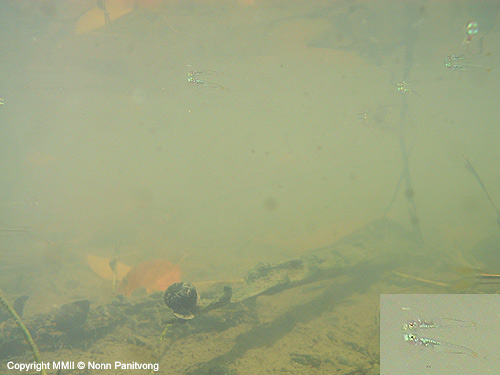
Write a noteEditAn exclusive inhabitant of fresh, normally standing, waters including shallow pools, ditches, rice paddies and clear water swamps.
Aquatic vegetation often proliferates such habitats with other fishes typically including Dermogenys, Rasbora, Trichopodus, Trichopsis and Channa spp..
Aquarium size
Write a noteEditAn aquarium with base dimensions of 40 ∗ 20 cm16 ∗ 8 in or more is recommended for a group.
Maintenance
Write a noteEditBest maintained in a heavily planted set-up, ideally with a dark substrate, patches of dense vegetation, and some open areas.
Other décor can consist of twisted roots and pieces of bogwood, while surface vegetation is also appreciated by the fish.
When maintained under such conditions they're more likely to display their best colours, and planted aquaria also offer fry a more favourable chance of survival alongside the adults.
Water conditions
EditThese recommendations come from this profile’s own figures. They contain affiliate links, so we may earn a commission.
Diet
Write a noteEditA micropredator feeding on small insects, worms, crustaceans and other zooplankton in nature.
In the aquarium it will accept dried foods of a suitable size but should be offered daily meals of small live and frozen fare such as Daphnia, Artemia, chopped bloodworm, etc., along with good quality, suitably-sized flakes and granules.
Behaviour and compatibility
Write a noteEditGenerally peaceful but does not make an ideal addition to many communities due to its small size.
Should you wish to maintain it alongside other fishes diminutive species enjoying similar conditions such as Boraras, Trigonostigma, Danionella and some Danio spp. constitute the best options, while freshwater shrimp of the genera Caridina and Neocaridina are also suitable.
It may also do well alongside smaller anabantoids such as Sphaerichthys, Parosphromenus or the more diminutive Betta species.
If the intention is breeding then obviously it should ideally be maintained alone, and we don't recommend keeping it with other Oryzias spp. due to the potential of hybridisation, already proven in laboratory experiments.
It's mostly non-aggressive towards conspecifics, and tends to look most effective and behave more confidently in a group of 8 or more.
Sexual dimorphism
Write a noteEditReproduction
Write a noteEditQuite easy to breed and fairly prolific, with females capable of producing batches of eggs every few days or even on a daily basis when in good condition.
Spawning normally occurs in the early morning, with males darkening in colouration and defending small, temporary territories against one another while attempting to entice females.
The adhesive eggs are typically expelled as a single mass and fertilised simultaneously, after which they continue to hang from the genital pore of the female for a period before eventually being deposited singly or in small clumps among vegetation or other suitable media.
Fine-leaved plants such as Cabomba, Ceratophyllum or Taxiphylum spp. are ideal, but synthetic spawning mops or other artificial alternatives also work.
The incubation period is temperature dependant to an extent but typically 1-3 weeks, and while the adults tend to ignore the eggs they do predate free-swimming fry, though if the tank is densely-planted some will usually survive.
Alternatively the eggs or fry can be removed to a separate rearing container filled with water from the adults tank. Once free-swimming the fry are able to accept microworm, Artemia nauplii, etc.
Caution is recommended when housing juveniles of different ages together as the older will predate on the younger if there is a large enough discrepancy in size.
Notes
EditO. minutillus is traded occasionally and is also known by the vernacular name 'dwarf ricefish'.
Within the genus it appears to be most closely-related to the other miniature species O. pectoralis, O. setnai and O. uwai, sharing with the latter pair elongated anterior anal-fin rays which are set off from the rest of the fin, a medial extension to the ethmoid cartilage and only 7 principle caudal-fin rays.
All four species possess a pigmented anal or urogenital region and a rounded caudal-fin.
It can be distinguished from all congeners by the following combination of characters: small adult size; caudal-fin rounded; principal caudal-fin rays i,3/4,i; 5-7 dorsal-fin rays; 17-21 anal-fin rays with the last unbranched, and no bony contact organs; 4-5 pectoral-fin rays; large teeth on premaxillary and dentary absent; pigmented anal or urogenital region.
Members of the family Adrianichthyidae are often referred to collectively as 'ricefishes' and were traditionally considered to be members of the family Cyprinodontiformes and thus closely-related to toothcarps.
This misconception is sometimes still upheld despite the fact that Rosen and Parenti reclassified them within the cyprinodontiform sister group Beloniformes as long ago as 1981.
The best-known member of the family is the medaka or Japanese ricefish, Oryzias latipes, which has been widely used as a model organism in genomic and experimental biology for well over a century and was the first vertebrate animal to mate in space during the mid-1990s.
There are currently just two genera included in the family, Oryzias and Adrianichthys, with the historically-recognised groupings Xenopoecilus and Horaichthys having been synonymised with Oryzias by Parenti (2008).
Of the three species previously included in the paraphyletic Xenopoecilius, X. oophorus and X. poptae were moved into Adrianichthys with the third, X. sarasinorum currently recognised as Oryzias sarasinorum.
In addition the formerly monotypic Indian species Horaichthys setnai is currently classified as O. setnai.
References
- Herder, F. and S. Chapuis (2010). Oryzias hadiatyae, a new species of ricefish (Atherinomorpha: Belonifornes: Adrianichthyidae) endemic to Lake Masapi, Central Sulawesi, Indonesia. The Raffles Bulletin of Zoology 58(2), 269-280
- Magtoon, W. (2010). Oryzias songkhramensis, a new species of ricefish (Beloniformes; Adrianichthyidae) from northeast Thailand and central Laos. Tropical Natural History 10(1), 107-129
- Magtoon, W. and A. Termvidchakorn (2009). A Revised Taxonomic Account of Ricefish Oryzias (Beloniformes; Adrianichthyidae), in Thailand, Indonesia and Japan. The Natural History Journal of Chulalongkorn University 9(1), 35-68
- Parenti, L. R. (2008). A phylogenetic analysis and taxonomic revision of ricefishes, Oryzias and relatives (Beloniformes, Adrianichthyidae). Zoological Journal of the Linnean Society 154(3), 494-610
- Parenti, L. R. and B. Soeroto (2004). Adrianichthys roseni and Oryzias nebulosus, two new ricefishes (Atherinomorpha: Beloniformes: Adrianichthyidae) from Lake Poso, Sulawesi, Indonesia. Ichthyological Research 51(1), 10-19
- Parenti, L. R. and R. K. Hadiaty (2010). A new, remarkably colorful, small ricefish of the genus Oryzias (Beloniformes, Adrianichthyidae) from Sulawesi, Indonesia. Copeia 2010 (2), 268-273
- Roberts, T. R. (1998). Systematic observations on tropical Asian medakas or ricefishes of the genus Oryzias, with descriptions of four new species. Ichthyological Research 45(3), 213-224
- Rosen, D. E. and L. R. Parenti (1981). Relationships of Oryzias, and the groups of atherinomorph fishes. American Museum Novitates 2719, 1–25
- Smith, H. M. (1945). The Fresh-Water Fishes of Siam, Or Thailand. Bulletin of the United States National Museum 188, i-xi + 1-622
- Takehana, Y., K. Naruse K and M. Sakaizumi (2005). Molecular phylogeny of the medaka fishes genus Oryzias (Beloniformes: Adrianichthyidae) based on nuclear and mitochondrial DNA sequences. Molecular Phylogenetics and Evolution 36(2), 417–428
- Uwa, H. and W. Magtoon (1986). Description and karyotype of a new ricefish, Oryzias mekongensis from Thailand. Copeia 1986 (2), 473-478
- Uwa, H. and L. Parenti (1988). Morphometric and meristic variation in ricefishes, genus Oryzias: a comparison with cytogenetic data. Japanese Journal of Ichthyology 35(2), 159-166
Species images · 2
These photographs are used with each photographer's permission.
Send a photograph