Genus
Pangio
- Species
- 15
- Photographed
- 15 of 15
- Difficulty rated
- 15 of 15
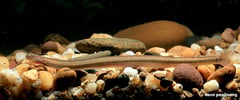
Pangio anguillaris
Vaillant, 1902
Traded as 'eel loach', Pangio anguillaris is a cobitid loach from Borneo, Sumatra, Peninsular Malaysia and the Chao Phraya and Mekong basins. It has an extremely elongated, worm-like body with 69-71 vertebrae and no nasal barbels, and is most commonly available as bycatch among shipments of other fishes. The species as currently recognised appears to represent a complex of closely-related taxa.
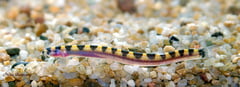
Pangio cuneovirgata
Raut, 1957
Pangio cuneovirgata is a small kuhli loach from southern Thailand, Peninsular Malaysia, Sumatra and western Java, found in forest streams and swamps. It has 7-13 dark saddles on the upper half of the body and looks most like P. malayana, but has nasal barbels and a truncate caudal-fin. It is infrequently encountered in the trade, most often as bycatch among shipments of similar-looking congeners.
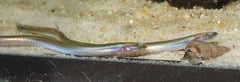
Pangio doriae
Perugia, 1892
Traded as 'eel loach', Pangio doriae is a worm-like cobitid loach from Sarawak in Borneo and from Peninsular Malaysia. Some authors have suggested it is synonymous with P. anguillaris, but it can be told apart by a pair of prominent nasal barbels. The Sumatran population once identified as this species was described as P. bitaimac in 2009. It is most commonly available as bycatch among shipments of other fishes.
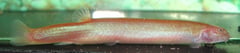
Pangio filinaris
Kottelat & Lim, 1993
Pangio filinaris is a plain-bodied kuhli loach known only from Pahang and Terengganu states in Peninsular Malaysia. It has been confused with P. mariarum, which shares its plain patterning and nasal barbels, and has also been referred to by the invented name P. 'mariae'. It is sometimes exported for the aquarium trade, normally as by-catch among shipments of other species.
Pangio malayana
Tweedie, 1956
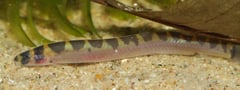
Pangio malayana is a barred kuhli loach from Peninsular Malaysia, the Batang Hari drainage in Sumatra and the Kapuas system in Indonesian Borneo. It has 10-16 dark saddles on the upper half of the body and a black bar at the base of the caudal-fin, and looks most similar to P. cuneovirgata, which has a truncate caudal-fin. It is most often encountered as bycatch among shipments of similar-looking congeners.
Pangio myersiGiant Kuhli Loach
Harry, 1949
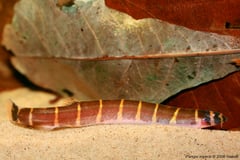
The giant kuhli loach, Pangio myersi, is a barred cobitid loach from the lower Mekong basin in Laos, Cambodia, Vietnam and Thailand. Traded regularly and also known as 'Myer's loach', it has 8-11 very broad dark bars on an orange body. A submarginal dark bar or row of spots on the caudal-fin separates young or undernourished imports from P. kuhlii and P. semicincta. Albino and leucistic forms are also available, though it is unclear whether these occur naturally.
Pangio oblongaBlack Kuhli Loach
Valenciennes, 1846
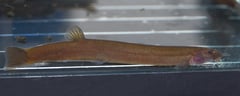
The black kuhli loach, Pangio oblonga, is a plain-bodied cobitid from Java, Sumatra, Borneo, Peninsular Malaysia and Thailand. Among the more readily available Pangio in the hobby, it is also traded as 'Java loach', 'cinnamon loach' and 'chocolate kuhli loach'. The species will probably turn out to be a complex of closely-related taxa, with at least four genetic lineages identified.
Pangio piperata
Kottelat & Lim, 1993
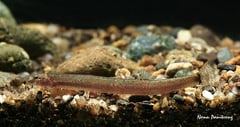
Pangio piperata is a slender kuhli loach from Peninsular Malaysia, Riau Province in Sumatra and the Rajang river drainage in Sarawak. Its yellowish-brown body is peppered with small dark spots forming a rough stripe along the lateral line. Some populations of the variable P. shelfordii look similar and the two often occur together, but P. piperata is generally plainer and has fewer vertebrae. It is exported occasionally, most often as bycatch among congeners.
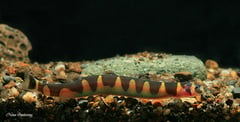
Pangio semicincta'Kuhli' Loach
Fraser-Brunner, 1940
Usually sold as the 'kuhli' loach, Pangio semicincta is a cobitid loach from Peninsular Malaysia, Sumatra and Borneo. It lives in shallow forest streams and swamps, often in black water, and is typically abundant in leaf litter. P. kuhlii itself is currently considered endemic to Java and has possibly never been seen in aquaria, so the common aquarium 'kuhli' is more likely to be this species or an unidentified relative.
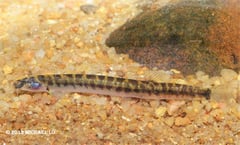
Pangio shelfordii
Popta, 1903
Pangio shelfordii is a variably patterned kuhli loach from Peninsular Malaysia, Singapore, Sumatra and Borneo. Its patterning varies within and between populations, and as currently understood the species represents an assemblage containing a number of unidentified taxa. Some Sumatran and Bornean populations resemble P. piperata, which often occurs alongside it. It is exported occasionally, often as bycatch among shipments of congeners.
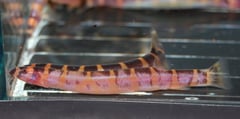
Pangio sp. 'PAN01'
authority not recorded
Pangio sp. 'PAN01' is an unidentified kuhli loach, possibly from Borneo, assigned to the P. kuhlii-oblonga group with a degree of certainty. The imported fish shown in the profile do not correspond to any described Pangio. Some carry a pinkish to purplish pigmentation that has also been reported in P. superba and appears to be shared by some Bornean Pangio populations.
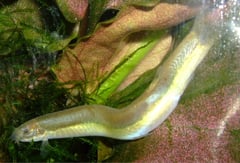
Pangio sp. 'PAN02'
authority not recorded
Pangio sp. 'PAN02' is an unidentified kuhli loach of unknown origin that can be assigned to the P. kuhlii-oblonga group with a degree of certainty. It is apparently exported as a contaminant among shipments of a uniformly brown fish, and unpublished genetic analyses suggest the two might be variants of the same species. Its dark upper and white lower body suggest it may be related to P. alcoides.
Pangio sp. 'PAN03'
authority not recorded
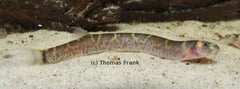
Pangio sp. 'PAN03' is an unidentified kuhli loach that appears to be native to the Barito River basin in Indonesian Borneo. It belongs to the P. kuhlii-oblonga group and has been misidentified and traded as P. alternans, a different-looking species. Like its congeners it needs a soft, sandy substrate, since it digs and spends some of its time buried.
Pangio sp. 'PAN04'Panda Loach
authority not recorded
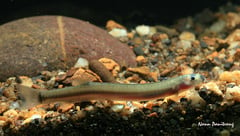
The panda loach, Pangio sp. 'PAN04', is an unidentified kuhli loach apparently native to the Thai portion of the Mekong River basin. Traded since the mid-00s, it comes in two similar forms. One has a darker body, dark pectoral fins and barbels and a blue sheen on the head, while the other is paler with better-defined head markings, hyaline pectoral fins and colourless barbels.
Pangio sp. 'PAN05'
authority not recorded
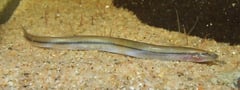
Pangio sp. 'PAN05' appears to be an undescribed eel loach in the P. anguillaris group, and where it comes from is unclear. It is regularly imported and traded as 'eel loach', usually alongside P. anguillaris, and like other members of the group has a worm-like, usually patternless, greyish body and a high vertebral count.