Genus
Rhinogobius
- Species
- 19
- Photographed
- 18 of 19
- Difficulty rated
- 17 of 19
Where the name comes fromEdit
from the Greek rhinos, meaning 'nose', and the generic name Gobius.
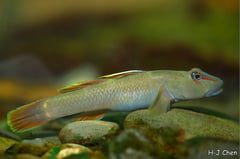
Rhinogobius candidianus
Regan, 1908
Rhinogobius candidianus is a goby from northern and western Taiwan, where it lives in smaller tributaries and hill streams. It is normally imported alongside a smaller, near-identical congener identified as R. nantaiensis, and both are usually traded as R. candidianus. The two can be separated by snout length, noticeably longer in R. candidianus, and by adult size: R. nantaiensis reaches just 50 to 55 mm.
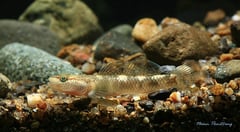
Rhinogobius chiengmaiensisChiangmai Stream Goby
Fowler, 1934
The Chiangmai stream goby, Rhinogobius chiengmaiensis, is a small goby from the middle and upper Chao Phraya river system in central Thailand. It has been exported for the ornamental trade, often labelled as the congener R. mekongianus, but has five irregular dark markings on the body against seven or eight in that species. The male guards eggs laid on the ceiling of a cave or crevice, and it is among the less problematic members of the genus to breed.
Rhinogobius duospilusWhite-cheeked Goby
(Herre, 1935)
The white-cheeked goby, Rhinogobius duospilus, is a small goby from Hong Kong and southern China, living in clear hill streams. It was often sold in the past as 'Rhinogobius wui', a name now listed as a valid species, so aquarium literature published under either name may refer to either fish. Adults are extremely sedentary, and populations in neighbouring streams are genetically distinct from one another.
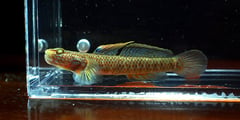
Rhinogobius filamentosus
Wu, 1939
Rhinogobius filamentosus is a small goby from the Li River system in Guangxi, southern China, also collected in neighbouring Guangdong province. Very few details of its range exist, and its habitat is presumed to be smaller rivers and streams over gravel, rocks and boulders. The name refers to the extended primary dorsal-fin rays of males.
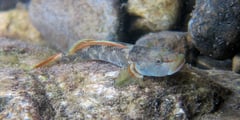
Rhinogobius flumineus
Mizuno, 1960
Rhinogobius flumineus is a goby endemic to Japan, found in central and western Honshu and on the islands of Kyushu and Shikoku. Its entire life cycle takes place in freshwater, in smaller rivers, tributaries and streams, although it occurs alongside amphidromous congeners in places. Two colour forms appear to exist, based on the shape and patterning of the male's first dorsal fin, and its name is sometimes applied to other species.
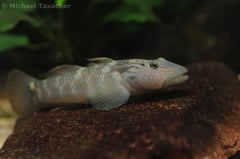
Rhinogobius formosanus
Oshima, 1919
Rhinogobius formosanus is a goby endemic to river systems of northern and northeastern Taiwan. Previously considered a subspecies of R. nagoyae, it has generally been accepted as distinct since 2008. Irregular, worm-like, reddish-brown lines on the cheek and opercle separate it from other Taiwanese Rhinogobius. Like many fishes from running water it needs spotless water and does best in a tank set up to simulate a flowing stream.
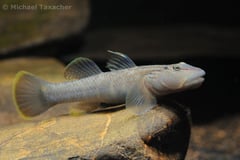
Rhinogobius gigas
Aonuma & Chen, 1996
Rhinogobius gigas is a goby native to eastern Taiwan, found in the middle and lower sections of rivers in Yilan, Hualien and Taitung counties. The species is uncommon in the aquarium hobby, and its name is sometimes applied to similar-looking congeners. Well-defined dark cross bands on the body, a spotted cheek and rows of spots in the second dorsal and anal fins help tell it apart from other Taiwanese Rhinogobius.
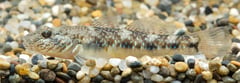
Rhinogobius giurinus
Rutter, 1897
Rhinogobius giurinus is a goby found through much of China, plus Taiwan, the Korean Peninsula, Japan and the Red and Pha river basins in Vietnam. It appears to exist in a number of forms that differ in colour pattern, morphology or both, and it is unclear whether all of them are conspecific. Newly-imported wild fish tend to be aggressive towards conspecifics, so unlike most Rhinogobius it is best kept in sexed pairs.
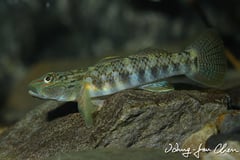
Rhinogobius lanyuensis
Chen, Miller & Fang, 1998
Rhinogobius lanyuensis is a goby known only from Lanyu Island, better known as Orchid Island, off the southeastern coast of Taiwan. It has been available in Japan on occasion. The body carries 8 vertical blackish brown bars, and females have a discontinuous dark lateral stripe that males lack. Lanyu is a small volcanic island with no major rivers, and the species presumably inhabits small streams over gravel, rocks and bedrock.
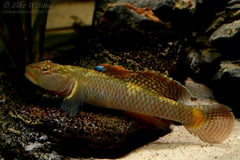
Rhinogobius leavelli
(Herre, 1935)
Rhinogobius leavelli is a goby ranging from northeastern Laos through northern Vietnam to the Pearl drainage in Guangxi, southern China. It appears to exist in a number of forms that differ in colour pattern, morphology or both, although those in the aquarium trade all look similar. Fish identified as this species tend to have an orange blotch at the base of the caudal fin and a dark vertical bar at the base of the pectoral fin.
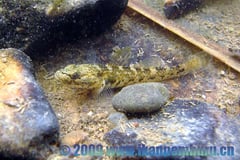
Rhinogobius lentiginis
Wu & Zheng, 1985
Rhinogobius lentiginis is a small goby that appears endemic to Zhejiang province, eastern China, growing to around 32 mm SL. Given its natural range and the lack of commercial collecting there, it is unlikely to have been in the aquarium hobby. Irregular dark blotches and spots on the cheek and opercle separate it from its most similar congener, R. davidi, which has a single dark vertical stripe there.
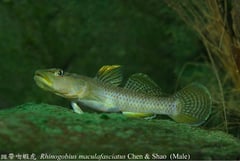
Rhinogobius maculafasciatus
Chen & Shao, 1996
Rhinogobius maculafasciatus is a small goby known only from certain rivers in southern Taiwan, including the Tzengwen and Kaoping drainages. It has been collected by a few individuals. Fewer scale rows between the first dorsal-fin origin and upper pectoral-fin base than in related Taiwanese species give it a somewhat elongate appearance. Typical habitats are small brooks, tributaries and pools with slow flow over rocks and pebbles.

Rhinogobius mekongianus
Pellegrin & Fang, 1940
Rhinogobius mekongianus is a goby from the middle and upper Mekong basin in Laos, Vietnam and Thailand. Its name has been misapplied in the aquarium trade to the congener R. chiengmaiensis, and it does not appear to have been on the market itself. It has 7-8 irregular dark markings on the body (vs. 5 in R. chiengmaiensis), and records from the Chao Phraya drainage most likely refer to that species.
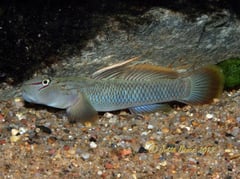
Rhinogobius nantaiensis
Aonuma & Chen, 1996
Rhinogobius nantaiensis is a goby from Taiwan, officially known only from the Tzengwen and Kaoping river basins in the south of the island. It is normally imported in mixed batches with the near-identical R. candidianus, and is the commoner of the two in the aquarium trade. It does not grow as large, has a more rounded snout, and most specimens have spot-like markings on the sides of the head.
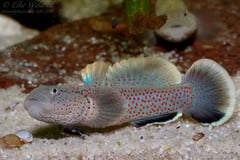
Rhinogobius rubromaculatusRed-spotted Goby
Lee & Chang, 1996
The red-spotted goby, Rhinogobius rubromaculatus, is endemic to Taiwan and apparently quite common in central and western parts of the island. Fish from the Linbian river in the south are smaller, with larger and more intense red spots, and have been called R. rubromaculatus 'rot' or 'red' in the hobby, but they show only minor genetic differences. Among the less problematic members of the genus to breed, it can spawn year-round in aquaria.
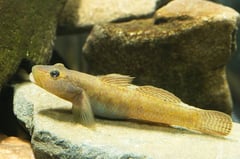
Rhinogobius sp. 'CB'
authority not recorded
Rhinogobius sp. 'CB' is an unidentified goby of the R. brunneus complex, found through most of Japan except Hokkaido. 'CB' is shorthand for 'cross band', after the dark bars on the body. Among the unidentified members of the grouping it is the commonest in Japan. Some wild populations are amphidromous, with the larvae washed down to the sea and the fry developing in brackish to marine estuaries.
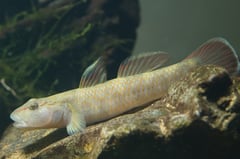
Rhinogobius sp. 'CO'
authority not recorded
Rhinogobius sp. 'CO' is an unidentified goby of the R. brunneus complex that certainly occurs on the island of Honshu, Japan. 'CO' is shorthand for 'cobalt', after the blue spots on the head and body. Some populations live in brackish and others in freshwater environments, and this has led them to adopt different reproductive strategies.
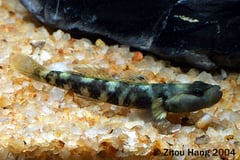
Rhinogobius yaoshanensis
Luo, 1989
Rhinogobius yaoshanensis is a small goby recorded only from streams draining Jinxiu Yao Autonomous County in eastern Guangxi, China. Its name has appeared regularly on trade lists since the mid-2000s, but fish labelled as such do not fully match the most recent key, and whether the species itself has been exported is unclear. It is likely restricted to shallow, well-oxygenated headwaters with riffles and runs broken by pools.
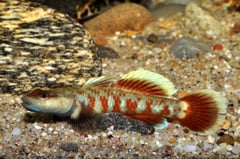
Rhinogobius zhoui
Li & Zhong, 2009
Rhinogobius zhoui is a small goby restricted to a handful of streams around Lianhua Mountain in Haifeng County, Guangdong, China. In the aquarium trade since 2010, it is sold as 'Chinese vermilion goby', 'Zhou's scarlet goby', 'scarlet goby' and 'flame goby'. Adult males have 6-8 red blotches on the flank and broad white bands on the median fins. It has been bred in aquaria but not easily, because males patrol an area and do not defend a single spawning site.