Rhinogobius filamentosus
Formerly Ctenogobius filamentosus Wu, 1939
Last revised 2026Edit this page
On this page10 sections
Quick factsEdit
Difficulty6 of 8 measures
- Space
- medium tank
- Water
- flexible
- Temp
- flexible
- Diet
- unknown
- Temperament
- unknown
- Social
- needs to be in a group
- Compatibility
- choose tankmates carefully
Other demands
Each of these can raise the rating on its own, whatever the measures above say.
- Hardiness
- needs a well-established tank
- Needs strong current, with the filter turning the tank over 8–12 times an hour
Rhinogobius filamentosus is a small goby from the Li River system in Guangxi, southern China, also collected in neighbouring Guangdong province. Very few details of its range exist, and its habitat is presumed to be smaller rivers and streams over gravel, rocks and boulders. The name refers to the extended primary dorsal-fin rays of males.
Etymology
EditRhinogobius: from the Greek rhinos, meaning 'nose', and the generic name Gobius.
filamentosus: from the Latin filamentosus, meaning ‘filamentous’, in reference to the extended primary dorsal-fin rays in males.
Distribution
EditVery few details exist but the type locality is given as 'Yangso, Li Kiang, Kwangsi Province, southern China', which should correspond to an unspecified location within the Li River (Li Jiang) system in Guangxi Zhuang Autonomous Region, southern China, and it's also been collected in neighbouring Guangdong province.
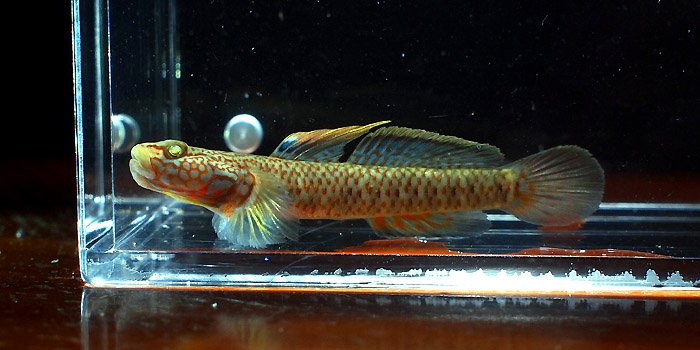
The specimens in our images were collected in Guangxi and appear to represent R. filamentosus based on the key of Chen et al. (2009).
Habitat
Write a noteEditPresumably inhabits smaller rivers, tributaries and streams with substrates of gravel, rocks, boulders, and exposed bedrock which undergo seasonal variations in water flow rate, depth and turbidity.
Aquarium size
Write a noteEditAn aquarium with base dimensions of 60 ∗ 30 cm24 ∗ 12 in should be large enough to house a small group.
Maintenance
Write a noteEditShould not prove difficult to maintain under the correct conditions; as per other Rhinogobius spp. we strongly recommend keeping it in a tank designed to simulate a flowing stream with a substrate of variably-sized rocks, sand, fine gravel, and some water-worn boulders.
This can be further furnished with driftwood branches, terracotta pipes, plant pots, etc., arranged to form a network of nooks, crannies, and shaded spots, thus providing broken lines of sight.
While the majority of aquatic plants will fail to thrive in such surroundings hardy types such as Microsorum, Bolbitis, or Anubias spp. can be grown attached to the décor.
Like many fishes that naturally inhabit running water it's intolerant to accumulation of organic pollutants and requires spotless water in order to thrive, thus weekly water changes of 30-50% tank volume should also be considered routine.
Though torrent-like conditions are unnecessary it does best if there is a high proportion of dissolved oxygen and some water movement in the tank meaning power filter(s), additional powerhead(s), or airstone(s) should be employed as necessary.
Water conditions
EditThese recommendations come from this profile’s own figures. They contain affiliate links, so we may earn a commission.
Diet
Write a noteEditRhinogobius spp. tend to be opportunistic carnivores feeding on a range of small invertebrates, crustaceans and similar in nature.
In the aquarium they should be offered small live or frozen foods such as chironomid (bloodworm) or mosquito larvae, Artemia, Daphnia, Mysis, etc.
Dried foods may be accepted following a period of acclimatisation but should not be used regularly.
Notes
EditThis species may not yet have appeared in the ornamental trade but it has been collected by a few individuals.
Following the key in Chen et al. (2008) it can be told apart from similar congeners by the following combination of characters: preopercular canal and posterior oculoscapular canal present; postorbital region with paired pore ω; preopercular canal always with 3 pores; 5-8 scales between origins of first dorsal and pectoral fin; caudal-fin without a large, basal <-shaped brownish black marking; predorsal scales 0–11; prepelvic region naked; posterior tip of first dorsal fin extending to the insertion of 6–7 branched rays of second dorsal fin when depressed in male.
It’s included in the R. brunneus group of closely-related species within the genus of which members share the following combination of characters: predorsal naked, or with small cycloid scales, the scaled area never extending beyond the vertical of the posterior margin of the preoperculum; cheek with 2 mainly horizontal rows of sensory papillae.
In addition it belongs to an assemblage of fluvial, land-locked, non-diadromous Rhinogobious spp. which have relatively large eggs and 27-29 vertebrae.
The Gobiidae is the most speciose vertebrate family and notoriously problematic in terms of identifying fishes down to species level.
Within this sizeable assemblage Rhinogobius is often included in the subfamily Gobionellinae alongside genera such as Brachygobius, Chlamydogobius, Mugilogobius, Pseudogobiopsis, Schismatogobius, and Stigmatogobius.
Members can be told apart from these and all other gobiid genera by the following combination of characters: head with four simple, longitudinal infraorbital sensory papilla rows a, b, c, and d, single cp papilla, and paired papillae in mental row f; head canal variable from complete loss to normal development of anterior and posterior oculoscapular canals, and preopercular canals, and always with double interorbital pores λ if the pore is present; body mostly covered with ctenoid scales; longitudinal scale series 25–42; head including cheek, snout, opercle, anterior part of nape as well as pre-pectoral region all naked; D1 usually VI; D2 I, 6–11; A I, 5–11; P 14–23; and V I, 5 + I, 5, forming a rounded disc with frenum present, performing two pointed spinous lobes, the spinous ray usually longer than the first branched ray; dorsal pterygiophore formulae modally 3–22 1 101; vertebrae 25–29, usually 26 for most landlocked species.
The genus is widely-distributed throughout much of continental Asia in Russia, Korea, China, Vietnam, Laos, Cambodia, and Thailand, plus numerous islands of the Western Pacific including Japan, Taiwan, Hainan, and the Philippines.
There currently exist over 60 recognised species with many more awaiting formal description, and a number of the described ones are only considered nominal taxa pending additional study.
Those exhibiting similarities in appearance, morphology and behaviour are therefore often aggregated in nominal species groups, e.g., the R. brunneus group, R. duospilus group, etc., for ease of reference.
The fused pelvic fins form a structure normally referred to as the 'pelvic disc', a common feature among gobiids which is used to adhere to rocks and other submerged surfaces.
Rhinogobius spp. also exhibit different reproductive strategies depending on environment, with those inhabiting rivers connected directly to the sea typically amphidromous, and those landlocked in upper reaches of rivers or lakes non-diadromous.
Many of those appearing in the aquarium trade have proven difficult to identify for a number of reasons including:
- taxonomic confusion.
- lack of aquarium literature.
- incorrect labelling by exporters and subsequently shops.
- historical over-use of some names, e.g., 'Rhinogobius wui', long treated as a synonym of R. duospilus and now recognised as a valid species.
- likely trade of undescribed species without locality data.
- mixing of species at export facilities.
References
- Chen, I-S., Y.-H. Cheng, and K.-T. Shao (2008). A new species of Rhinogobius (Teleostei: Gobiidae) from the Julongjiang basin in Fujian Province, China. Ichthyological Research 55(4), 335-343
Species images · 2
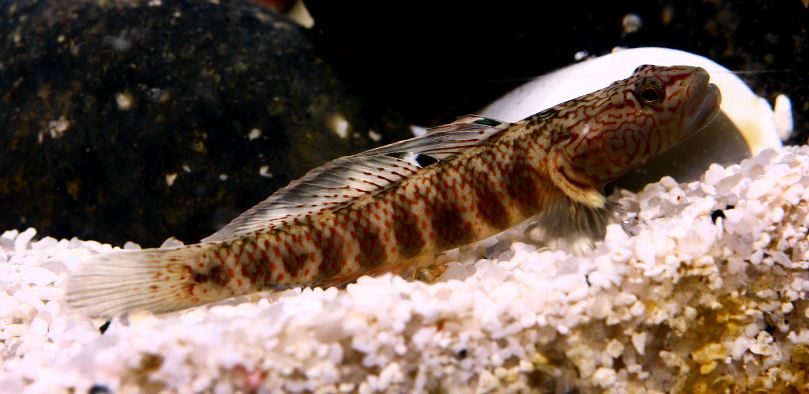
These photographs are used with each photographer's permission.
Send a photographDistribution
Profile completeness18 of 24
75% complete
Also missing: a common name, water condition notes, behaviour and compatibility, sexual dimorphism, reproduction.
Community
Questions about Rhinogobius filamentosus?
Ask on Discord