Region · Indonesia
Belitung
Only species with a profile on Seriously Fish are counted.
- Species
- 9
- Countries
- 1
- Photographed
- 9 of 9
- Difficulty rated
- 9 of 9
Countries here

Barbodes binotatusSpotted Barb
Cyprinidae · Valenciennes, 1842
The spotted barb, Barbodes binotatus, is a cyprinid ranging from Myanmar and Thailand through the Greater Sunda Islands to the Philippines. So ubiquitous across its range that it's often called simply 'common barb', it occurs from sea level to at least 2000 m in habitats from fast-flowing hill streams to irrigation canals and floodplain ponds. The basic pattern of a dark spot at the dorsal-fin origin and another on the caudal peduncle varies with origin.

Betta edithae
Osphronemidae · Vierke, 1984
Betta edithae is a paternal mouthbrooding labyrinth fish from Indonesia, recorded across Kalimantan, southern Sumatra, Bangka, Belitung and Bintan. The only member of the B. edithae group, it is separated from all other Betta spp. by its opaque or translucent branchiostegal membrane and posterior opercle. Fish from Bintan differ from Bornean specimens in several characters, and it remains unclear whether all populations are conspecific.
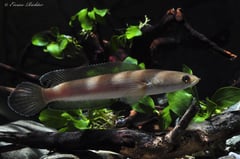
Channa melasomaBlack Snakehead
Channidae · Bleeker, 1851
The black snakehead, Channa melasoma, is a snakehead from southern Thailand, Peninsular Malaysia, Singapore, Borneo, Sumatra and the Philippines. It can be told apart from the similar C. baramensis, once considered a synonym, by lacking a black spot in the centre of many body scales and a barred caudal fin. In nature it appears to favour clear forest streams with mud and leaf litter, but it has also been recorded from acidic blackwater in peat swamp forest.
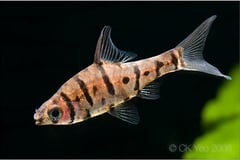
Eirmotus insignis
Cyprinidae · Tan & Kottelat, 2008
Eirmotus insignis is a small cyprinid known only from the Kapuas basin in West Kalimantan, Borneo, and Belitung Island off Sumatra. It inhabits shady, slow-moving rainforest streams and swamps with dense vegetation. One of four similar species in the genus, it is traded alongside E. octozona as the 'false eight-banded barb' and is told apart mainly by the black markings on its dorsal fin.
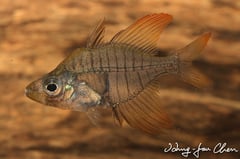
Gymnochanda verae
Ambassidae · Tan & Lim, 2011
Gymnochanda verae is a small glassfish known only from the Gantung area of Belitung Island, in Indonesia's Bangka-Belitung Islands province. Mature males have extended anal and second dorsal fins forming a triangular profile, with the outer parts of those fins and of the caudal-fin lobes carmine red in life. Females have neither elongated rays nor colour. It has appeared in the ornamental trade but is evidently delicate and recommended only to experienced aquarists.
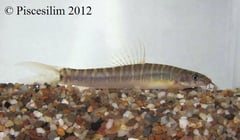
Nemacheilus selangoricus
Nemacheilidae · Duncker, 1904
Nemacheilus selangoricus is a nemacheilid loach ranging from southern Thailand through Peninsular Malaysia and Singapore to western Borneo and Sumatra. It is most common in shallow, flowing forest streams over sand, gravel and detritus. It belongs to the N. selangoricus group and is most similar to N. spiniferus, from which it differs in its 8-12 very regular dark bars on the flanks.

Parosphromenus deissneriDeissner's Liquorice Gourami
Osphronemidae · Bleeker, 1859
Deissner's liquorice gourami, Parosphromenus deissneri, is endemic to the island of Bangka in Indonesia, mostly in its northern and eastern portions. For almost a century after its description in 1859 it was the only recognised member of the genus, so its name has been widely misapplied in aquarium and ichthyological literature, though it's probably always been very rare in the hobby. Males have pale subdistal bands of oval spots in the unpaired fins.

Sphaerichthys osphromenoidesChocolate Gourami
Osphronemidae · Canestrini, 1860
The chocolate gourami, Sphaerichthys osphromenoides, is a small gourami from Peninsular Malaysia, Sumatra and Borneo. By far the best known member of the genus, it mostly inhabits peat swamps and black water streams where the pH can drop to 3.0 or 4.0. A maternal mouthbrooder, it is slow-moving and easily outcompeted for food by more boisterous tankmates.

Channa micropeltesGiant Snakehead
Channidae · Cuvier, 1831
The giant snakehead, Channa micropeltes, is a predatory fish from Southeast Asia that grows to well over a metre. Juveniles are sold as 'red' or 'redline' snakehead, but it is suitable only for public installations or the very largest private aquaria. Unlike most Channa species it is pelagic and needs plenty of room to swim, and adults become aggressive at sexual maturity.