Region · China
Hainan

Only species with a profile on Seriously Fish are counted.
- Species
- 12
- Countries
- 1
- Photographed
- 12 of 12
- Difficulty rated
- 12 of 12
Countries here
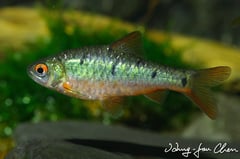
Barbodes semifasciolatusGolden Barb*
Cyprinidae · (Günther, 1868)
Barbodes semifasciolatus, the green or Chinese barb, is a cyprinid from Vietnam, Taiwan, southwestern China and northern Laos. The natural green form is an infrequent find in the trade, but the selectively-bred golden variant, first produced in the 1960s, is farmed in huge numbers. Commercial fish are largely inbred, with reduced fins and other deformities not uncommon. The name 'Puntius schuberti' often given to the golden form is not an official scientific name.

Folifer brevifilis
Cyprinidae · (Peters, 1881)
Folifer brevifilis is a large cyprinid from the Mekong, Salween and Ayeyarwady systems of southern China, Myanmar, Thailand, Laos and Vietnam. It has also been recorded from Hainan and Hong Kong. Growing to 300 mm SL, it is unsuitable for the majority of home aquaria and extremely rare in the ornamental trade. It inhabits flowing middle and lower sections of major rivers and may migrate seasonally to spawn.
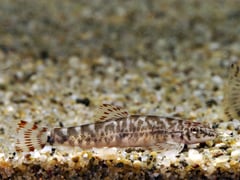
Liniparhomaloptera disparisBroken-band Hillstream Loach
Gastromyzontidae · (Lin, 1934)
The broken-band hillstream loach, Liniparhomaloptera disparis, is a gastromyzontid from the Pearl River system of southern China and from Hong Kong. It is restricted to shallow, fast-flowing, highly oxygenated headwaters with riffles and runs. Sometimes available as bycatch among shipments of Rhinogobius duospilus, it also appears on trade lists under the fictitious name 'Homaloptera hoffmani'. It has been bred in aquaria and buries its eggs within the substrate.

Macropodus opercularisParadise Fish
Osphronemidae · (Linnaeus, 1758)
The paradise fish, Macropodus opercularis, is a labyrinth fish from China south of the Yangtze, including Taiwan and Hainan, plus Vietnam and Laos. Imported to France in 1869, it was among the very first ornamental fish brought to Europe. Wild examples are uncommon in the hobby since it is farmed extensively, and xanthic, albino, red, blue and stripeless strains exist. Males are territorially aggressive, especially when breeding, and should not be housed together unless the aquarium is very large.
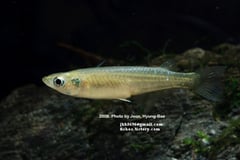
Oryzias latipesMedaka
Adrianichthyidae · (Temminck & Schlegel, 1846)
The medaka, Oryzias latipes, is a ricefish from Japan, Korea, Taiwan, eastern China, Laos and Vietnam. Long used as a model organism in genomic and experimental biology, it was the first vertebrate animal to mate in space, in the mid-1990s. The ornamental 'golden' variant is more often seen than the natural form, and a transgenic 'glowing' form is illegal to buy, sell or own within the European Union.
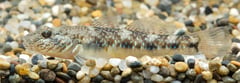
Rhinogobius giurinus
Gobiidae · (Rutter, 1897)
Rhinogobius giurinus is a goby found through much of China, plus Taiwan, the Korean Peninsula, Japan and the Red and Pha river basins in Vietnam. It appears to exist in a number of forms that differ in colour pattern, morphology or both, and it is unclear whether all of them are conspecific. Newly-imported wild fish tend to be aggressive towards conspecifics, so unlike most Rhinogobius it is best kept in sexed pairs.
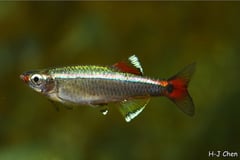
Tanichthys albonubesWhite Cloud Mountain Minnow
Cyprinidae · Lin, 1932
The White Cloud Mountain minnow, Tanichthys albonubes, is a small cyprinid from Guangdong and Hainan in southern China and from northeastern Vietnam. It appears to have been extirpated from White Cloud Mountain itself and is considered endangered in China, but all the fish on sale are commercially bred. Inbreeding among farm-bred stock has left many genetically weak and prone to disease or deformity, and permanent exposure to warmer conditions is likely to shorten its life.
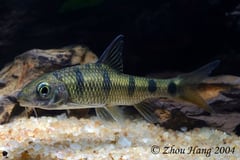
Acrossocheilus beijiangensis
Cyprinidae · Wu & Lin, 1977
Acrossocheilus beijiangensis is a barred cyprinid from Fujian, Guangdong and Guangxi in southern China, plus the islands of Hainan and Hong Kong. With A. clivosius it is one of only two species in the genus always to have five dark vertical bars on each flank. Wild fish feed on small benthic invertebrates and graze biofilm from rocks and other solid surfaces.
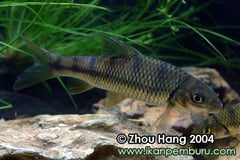
Acrossocheilus parallens
Cyprinidae · (Nichols, 1931)
Acrossocheilus parallens is a barred cyprinid from Guangdong and Hainan provinces in southern China, plus the island of Taiwan. It has five or six dark vertical bars on each flank, each two scales wide, a pattern it shares with A. paradoxus and several other congeners. Wild fish feed on small benthic invertebrates and graze biofilm from rocks and other solid surfaces.
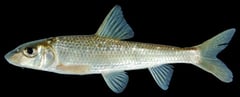
Hemibarbus maculatusSpotted Steed
Cyprinidae · Bleeker, 1871
The spotted steed, Hemibarbus maculatus, is a cyprinid widespread in eastern Asia between the Yangtze and Amur basins, including Taiwan and Hainan. It has 7–11 large blackish spots on each flank and a deep body with a clearly convex dorsal profile. A riverine fish of clear, well-oxygenated running water, it breeds in May and June, depositing its eggs among aquatic vegetation. It has probably been introduced to Vietnam and Laos, or records from there represent another species.
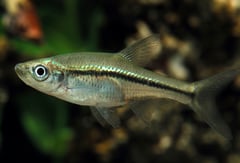
Metzia formosae
Cyprinidae · (Oshima, 1920)
Metzia formosae is a small cyprinid from northern Taiwan, Hainan, Hong Kong, southern China and northern Vietnam. It is identified by its upturned mouth and a black stripe along the flank from the gill opening to the caudal-fin base. It inhabits slow-moving to still, well-vegetated waters, including streams, rice paddies, ditches and canals. The genus remains unresolved in taxonomic terms.
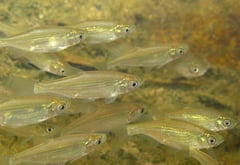
Metzia lineata
Cyprinidae · (Pellegrin, 1907)
Metzia lineata is a cyprinid from southern China, Hainan, Hong Kong and the Red River basin of northern Vietnam. Populations from the upper Pearl River and from Vietnam differ from those elsewhere, which suggests several species may be included under the name. It lives in slow-moving to still, well-vegetated waters. It has been introduced to other river systems in China and to northern Laos.