Country · Asia
China
Only species with a profile on Seriously Fish are counted, whether native or introduced.
- Species
- 107
- Families
- 17
- Genera
- 49
- Found only here
- 39
- Photographed
- 105 of 107
Regions here
Shares its fishes withspecies recorded in both
Found only here39
39 of the species on this page are recorded in China and in no other country. This is not the same as being endemic.
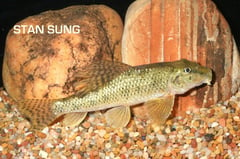
Abbottina rivularisChinese False Gudgeon
Cyprinidae · (Basilewsky, 1855)
The Chinese false gudgeon, Abbottina rivularis, is a small bottom-dwelling cyprinid native to China, the Korean peninsula and southern Japan. It has been widely introduced elsewhere, including the Mekong and Salween basins, Taiwan, Turkmenistan and Kyrgyzstan, and is considered invasive. It has started to appear in the aquarium trade and should never be released into natural waters outside its native range.
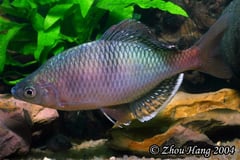
Acheilognathus macropterusGiant Chinese Bitterling
Cyprinidae · (Bleeker, 1871)
The giant Chinese bitterling, Acheilognathus macropterus, is a bitterling from China, the Korean peninsula, northern Vietnam and southeastern Russia. It has been introduced to Japan and is considered invasive there. Typical adults are 100 to 150 mm, and it appears in the trade only irregularly. Like all bitterlings it spawns in living unionid mussels, and its wide range suggests it may be a group of closely-related species.
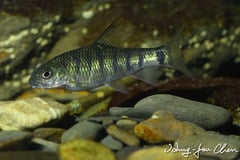
Acrossocheilus paradoxusTaiwan Banded Barb
Cyprinidae · (Günther, 1868)
The Taiwan banded barb, Acrossocheilus paradoxus, is a cyprinid native to Taiwan, where it occurs throughout western and northeastern river drainages. It inhabits subtropical streams and small to medium rivers at medium to relatively high altitudes, and in the aquarium needs spotless, well-oxygenated water with moderate flow. Growing to around 200 mm SL, it needs a tank of at least 180 x 45 cm.
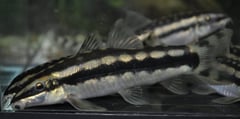
Ambastaia nigrolineataBlack-Lined Loach
Botiidae · (Kottelat & Chu, 1987)
The black-lined loach, Ambastaia nigrolineata, is a botiid loach from the Mekong drainage in southern China and Laos, and the Nan River in Thailand. It resembles its only congener A. sidthimunki but has a solid dark lateral stripe and another along the dorsal mid-line, with the vertical bars between them much less prominent. In Thailand it is considered endangered and appears in the national Red Book of threatened species.
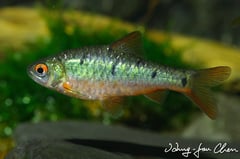
Barbodes semifasciolatusGolden Barb*
Cyprinidae · (Günther, 1868)
Barbodes semifasciolatus, the green or Chinese barb, is a cyprinid from Vietnam, Taiwan, southwestern China and northern Laos. The natural green form is an infrequent find in the trade, but the selectively-bred golden variant, first produced in the 1960s, is farmed in huge numbers. Commercial fish are largely inbred, with reduced fins and other deformities not uncommon. The name 'Puntius schuberti' often given to the golden form is not an official scientific name.
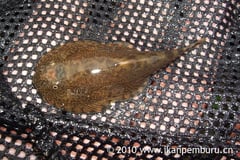
Beaufortia cyclica
Gastromyzontidae · Chen, 1980
Beaufortia cyclica is a hillstream loach known from a handful of localities in the Xi River drainage and the Tuoniang river system in southern China. Its flattened head and body and horizontal paired fins form a sucking cup that lets it cling to rocks in shallow, fast-flowing, highly-oxygenated headwaters. Kottelat (2012) states that B. cyclica may be a synonym of B. elongata.
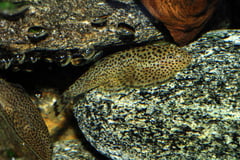
Beaufortia kweichowensisButterfly Loach
Gastromyzontidae · (Fang, 1931)
The butterfly loach, Beaufortia kweichowensis, is a hillstream loach from the Xi Jiang (West River) system in southern China. In many countries it is the most common gastromyzontid in the shops, one of several loaches traded as 'butterfly loach', 'Hong Kong plec' or 'Chinese hillstream loach' regardless of species. The name B. leveretti is often applied to it. It needs clean, well-oxygenated, fast-flowing water, and 16 to 24 °C is recommended.
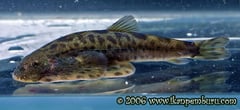
Beaufortia szechuanensis
Gastromyzontidae · (Fang, 1930)
Beaufortia szechuanensis is a hillstream loach from the upper Yangtze River basin in Sichuan province, southwestern China. It has been recorded from several tributary systems including the Qing, Wu and Da Ning He. Its flattened head and body and horizontal paired fins form a sucking cup that lets it cling to rocks in shallow, fast-flowing, highly-oxygenated headwaters.
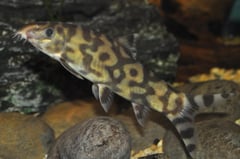
Botia histrionica
Botiidae · Blyth, 1860
Known in the trade as the 'Burmese loach', Botia histrionica is a botiid loach from Myanmar, Manipur in India and Yunnan, China. Young fish all carry five solid dark bars on each flank and are often confused with B. kubotai, but in B. histrionica the bars stay solid for longer and the central bar usually forms a 'y' shape. Adult patterning varies considerably between the Ayeyarwady, Salween, Manipur and Ataran forms, and there has been speculation that some represent distinct species.

Butis butisCrazy Fish
Butidae · (Hamilton, 1822)
The crazy fish, Butis butis, is a flathead gudgeon of coastal and brackish waters across the Indo-Pacific, from eastern Africa to Fiji. The most commonly traded member of the genus, it has many other names, including crocodile fish, duckbill sleeper and upside-down sleeper. A nocturnal ambush predator, it often swims upside-down, and it is territorial and not sociable with conspecifics, so is best kept singly.
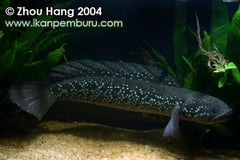
Channa asiaticaChinese Snakehead
Channidae · (Linnaeus, 1758)
The Chinese snakehead, Channa asiatica, is a snakehead native to central and southern China and northern Vietnam. One of several Channa lacking pelvic fins, it is told apart from them by vertical black bars on a brownish body and numerous white spots on the body and fins. It is best kept in a species tank. Pairs build no bubble nest, and both parents defend several thousand floating eggs and the fry.

Channa gachuaDwarf Snakehead
Channidae · (Hamilton, 1822)
The dwarf snakehead, Channa gachua, is a snakehead recorded across an enormous range from Iran to Taiwan and Bali. There is significant evidence that C. gachua as currently understood is a complex of similar-looking species in need of taxonomic review. A mouthbrooder bred regularly in captivity, it can share a well-chosen community with peaceful fishes too large to be prey, but populations should not be mixed as some may hybridise.
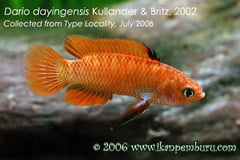
Dario dayingensis
Badidae · Kullander & Britz, 2002
Dario dayingensis is a small badid from a tributary of the Daying River in the Irrawaddy drainage of Yunnan Province, China. Known for some years before its description, it was identified as Badis dario but is much closer to D. hysginon. It has been maintained by a handful of private collectors, and given its rarity the emphasis should be on captive reproduction, with the fish kept alone.
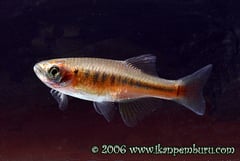
Devario apogon
Cyprinidae · (Chu, 1981)
Devario apogon is a small devario from southwestern Yunnan, China, where all known localities lie in the Daying river watershed. Narrow, indistinct vertical bars on the front of the flank, a wide, tapering P stripe behind them, and no barbels or lateral line separate it from similar congeners. It is apparently abundant in rivers, streams and even ditches, in clear or turbid water.

Devario chrysotaeniatus
Cyprinidae · (Chu, 1981)
Devario chrysotaeniatus is a devario from the upper Mekong watershed in Yunnan, southwestern China, northern Laos and northern Thailand. It first appeared in the hobby in 2005 and is rarely seen, probably because its natural waters lie outside the range of most commercial collectors. Its flank pattern is indistinct: a few short, thin horizontal stripes, a dark stripe along the back and a spot behind the gill opening.
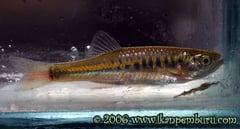
Devario interruptus
Cyprinidae · (Day, 1870)
Devario interruptus is a devario from the Hotha valley and nearby areas of southwestern Yunnan, China, close to the border with Myanmar. Short, wide vertical bars on the flanks and a P stripe made of contiguous dark blotches separate it from the similar D. maetaengensis and D. shanensis. It has mostly been collected from small, clear, moderate to swiftly-flowing streams over sand, gravel and rocks with no aquatic vegetation.
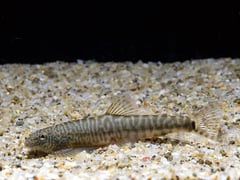
Erromyzon sinensis
Gastromyzontidae · (Chen, 1980)
Erromyzon sinensis is a gastromyzontid loach from the Xi Jiang (West River) system in southern China, mostly in Guangxi. It is extremely rare to nonexistent in the aquarium trade, although its name has been widely misapplied to congeners such as the unidentified E. sp. 'ER02'. An obligate bottom-dweller, it lives in shallow, fast-flowing, highly-oxygenated headwaters and minor tributaries, clinging to rocks with its flattened body and horizontally-orientated paired fins.
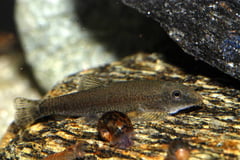
Erromyzon sp. 'ER01'
Gastromyzontidae · authority not recorded
Erromyzon sp. 'ER01' is an unidentified gastromyzontid loach, probably native to the Xi Jiang (West River) system in southern China. Its range is unconfirmed: the fish pictured arrived as a contaminant in a shipment of Beaufortia kweichowensis. It appears somewhat similar to Erromyzon yangi. Like its congeners it needs the clean, well-oxygenated, fast-flowing water of shallow headwaters and minor tributaries.
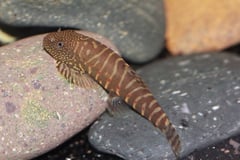
Erromyzon sp. 'ER02'
Gastromyzontidae · authority not recorded
Erromyzon sp. 'ER02' is an unidentified gastromyzontid loach from southern China, traded as Erromyzon sp. 'red spots'. Other trade names include 'Strawberry Spot Sucker Loach', and it has also been sold as a Gastromyzon or Pseudogastromyzon species. No other Erromyzon is known with a dark base colour, thin paler vertical bars on the body and similar spots on the head, and older fish develop red spots along the lateral line.

Folifer brevifilis
Cyprinidae · (Peters, 1881)
Folifer brevifilis is a large cyprinid from the Mekong, Salween and Ayeyarwady systems of southern China, Myanmar, Thailand, Laos and Vietnam. It has also been recorded from Hainan and Hong Kong. Growing to 300 mm SL, it is unsuitable for the majority of home aquaria and extremely rare in the ornamental trade. It inhabits flowing middle and lower sections of major rivers and may migrate seasonally to spawn.
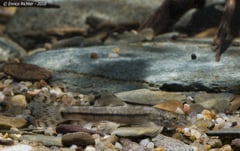
Formosania lacustrisTasseled-mouth Loach
Gastromyzontidae · (Steindachner, 1908)
The tasseled-mouth loach, Formosania lacustris, is a gastromyzontid from Taiwan and some coastal drainages of Fujian Province, mainland China. An obligate dweller of swiftly-flowing streams and headwaters, it clings to rocks in riffles and runs using its flattened head and body and horizontal paired fins. The genus was formerly Crossostoma, and colour and pattern vary with locality and age.

Hypsibarbus vernayi
Cyprinidae · (Norman, 1925)
Hypsibarbus vernayi is a cyprinid widespread in mainland Southeast Asia, from the Mekong basin in southern China to northern Peninsular Malaysia. Very similar to H. wetmorei, it has yellow pectoral, pelvic and anal fins (orange to red in H. wetmorei), so yellow-finned fish sold as H. wetmorei or 'lemon fin barb' appear likely to be this species. It prefers flowing water with abundant riparian vegetation and migrates seasonally.
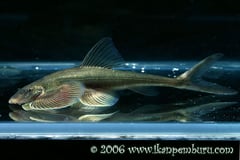
Jinshaia sinensis
Balitoridae · (Sauvage & Dabry de Thiersant, 1874)
Jinshaia sinensis is a balitorid loach known only from the Jinsha river basin, the westernmost headwater tributary of the Yangtze in China. Like other balitorids it has a flattened head and body and horizontally extended paired fins that form a powerful sucking cup. It lives only in riffles, runs and cascades of swift, clear, oxygen-saturated water, and the aquarium must be set up to resemble such a habitat.

Labiobarbus leptocheilus
Cyprinidae · (Valenciennes, 1842)
Labiobarbus leptocheilus is a large cyprinid widespread in Southeast Asia, from the Mekong and Salween to the Greater Sunda Islands. Different populations vary somewhat in appearance, and it may turn out to represent a group of closely-related species. The Cambodian Mekong population has been considered a distinct species, Labiobarbus lineatus, and that name is widely used in the ornamental trade although it is currently a synonym. It grows to 260 mm SL and needs spotless, well-oxygenated water.
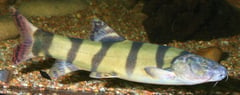
Leptobotia elongataImperial Flower Loach
Botiidae · (Bleeker, 1870)
The imperial flower loach, Leptobotia elongata, is a large botiid loach native to the middle and upper Yangtze River in China. Growing to 400 to 500 mm SL, it has declined drastically in the wild through damming, pollution and habitat degradation, and it is rare in the aquarium trade and prohibitively expensive when available. Also known as the 'royal clown' loach, a name since applied to the smaller L. pellegrini, it is a species for the specialist able to house it long term.
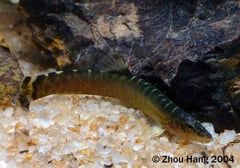
Leptobotia guilinensis
Botiidae · Chen, 1980
Leptobotia guilinensis is a botiid loach from southern China, described from Guangxi Province and also recorded from neighbouring Hunan. The species is rarely exported for the aquarium hobby, and fish labelled as such are usually Sinibotia pulchra or other related species. In the formal description Chen states that it is closely related to the fish now called Sinibotia zebra but lacks stripes on the head. Its habitat is unconfirmed but presumably clear, well-oxygenated running water over rocks and gravel.
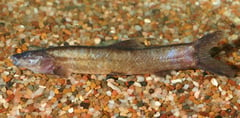
Leptobotia microphthalma
Botiidae · Fu & Ye, 1983
Leptobotia microphthalma is a botiid loach from the upper Yangtze basin in southwestern China, known from the Min and Jialing rivers. Its near-vestigial eyes and the variable hypopigmentation seen in many individuals suggest a deep water or even subterranean existence. Poorly known in the hobby, it is superficially similar to L. tientainensis and differs in a more deeply forked caudal-fin and a smaller eye, although eye size varies considerably between individuals.
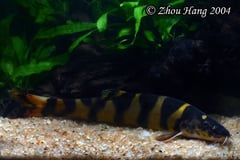
Leptobotia pellegrini
Botiidae · Fang, 1936
Leptobotia pellegrini is a botiid loach from southern China, described from Sichuan province and also known from the Pearl River (Zhu Jiang) basin. Often traded as 'royal clown loach', a name also applied to L. elongata, it differs from that species chiefly in adult size, reaching around 200 mm SL against 500 mm. It is also more slender with a darker head, and its relatively wide distribution probably explains why it is commoner in the hobby.
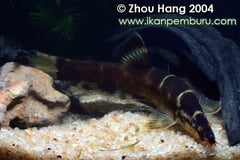
Leptobotia rubrilabris
Botiidae · (Dabry de Thiersant, 1872)
Leptobotia rubrilabris is a riverine botiid loach native to the middle and upper Yangtze River in China, with most records from Sichuan and Hunan. Fish labelled as this species in the trade are typically Sinibotia pulchra or other related species. In nature it favours clear, well-oxygenated running water over rocks and gravel, from boulder-filled headwater streams to larger, turbid river channels, and much of the Yangtze has been degraded by dam construction and pollution.
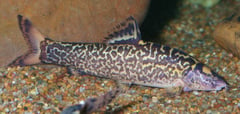
Leptobotia taeniops
Botiidae · (Sauvage, 1878)
Leptobotia taeniops is a botiid loach native to the middle and upper Yangtze River in China, recorded mostly from Hunan including Dongting Lake. Poorly known in the hobby, it is available occasionally and normally traded as 'honeycomb loach'. It exists in a number of colour forms from plain to reticulated and brown to pink, with reticulated populations towards the eastern end of its range, and it was previously included in the related genus Parabotia.
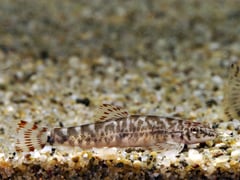
Liniparhomaloptera disparisBroken-band Hillstream Loach
Gastromyzontidae · (Lin, 1934)
The broken-band hillstream loach, Liniparhomaloptera disparis, is a gastromyzontid from the Pearl River system of southern China and from Hong Kong. It is restricted to shallow, fast-flowing, highly oxygenated headwaters with riffles and runs. Sometimes available as bycatch among shipments of Rhinogobius duospilus, it also appears on trade lists under the fictitious name 'Homaloptera hoffmani'. It has been bred in aquaria and buries its eggs within the substrate.

Macropodus hongkongensis
Osphronemidae · Freyhof & Herder, 2002
Macropodus hongkongensis is a paradisefish from Hong Kong and the neighbouring Chinese provinces of Guangdong and Fujian. In Hong Kong it is now known only from Tai Po and Sai Kung districts. It lives in hill streams and lowland, sometimes agricultural, habitats, apparently preferring shallow, densely vegetated water with slow flow. Males are territorially aggressive, especially when breeding, and the species is a bubble nester that is occasionally available in the trade.

Macropodus ocellatusRoundtail Paradise Fish
Osphronemidae · Cantor, 1842
The roundtail paradise fish, Macropodus ocellatus, is a labyrinth fish with an enormous range in China, Korea and Japan, north to the Amur River. It lives in ditches, rice paddies, marshes and river backwaters, where winter can freeze the surface and drop the water to 3 °C. It is sometimes referred to as M. chinensis in older literature, a name now considered a synonym of M. opercularis. Males are territorial when breeding and build bubble nests.

Macropodus opercularisParadise Fish
Osphronemidae · (Linnaeus, 1758)
The paradise fish, Macropodus opercularis, is a labyrinth fish from China south of the Yangtze, including Taiwan and Hainan, plus Vietnam and Laos. Imported to France in 1869, it was among the very first ornamental fish brought to Europe. Wild examples are uncommon in the hobby since it is farmed extensively, and xanthic, albino, red, blue and stripeless strains exist. Males are territorially aggressive, especially when breeding, and should not be housed together unless the aquarium is very large.
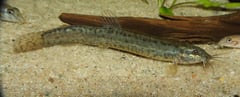
Misgurnus dabryanusLarge-scaled Loach
Cobitidae · (Guichenot, 1872)
The large-scaled loach, Misgurnus dabryanus, is a 'true' loach from the Yangtze and Pearl rivers in China, plus Taiwan and the Amur in Russia. It is sold regularly in the hobby but almost always labelled as or mixed in with M. anguillicaudatus, from which it differs in its high adipose crests on the caudal peduncle and the lack of a dark spot at the caudal-fin base. It spends some of its time completely buried, so it needs a soft, sandy substrate.

Mystacoleucus obtusirostris
Cyprinidae · Valenciennes, 1842
Mystacoleucus obtusirostris is a riverine cyprinid found from Myanmar and southwestern China to Vietnam, Borneo, Sumatra and Java. Referred to as M. marginatus for decades, it is the most widely distributed member of the genus, and populations vary somewhat in colour pattern. It is occasionally marketed as 'Burmese rainbow barb'. A group of six or more is the smallest to consider, and like all Mystacoleucus it has a forward-pointing predorsal spine that can snag in a net.

Opsarius caudiocellatus
Cyprinidae · (Chu, 1984)
Opsarius caudiocellatus is a cyprinid known only from the Salween in southern China, Myanmar and western Thailand, and the upper Mekong in Yunnan. It is named for the black round spot at the caudal-fin base, which with its black dorsal-fin rays separates it from similar congeners. It may have appeared in the aquarium trade, though probably not under the correct name, and inhabits well-oxygenated, moderate to fast-flowing rivers and streams.

Opsarius infrafasciatus
Cyprinidae · (Fowler, 1934)
Opsarius infrafasciatus is a cyprinid from the Ping river in Thailand, the Ataran and Salween in Myanmar and China, and Mekong tributaries in China. Once considered synonymous with both O. ornatus and O. pulchellus, it has been treated as distinct since Tejavej (2012). It typically inhabits headwaters and minor rivers and streams with moderate to fast flow, and a small caudal spot is among the characters separating it from congeners.

Opsarius pulchellus
Cyprinidae · (Smith, 1931)
Traded as 'butterfly barb' or 'mackerel barb', Opsarius pulchellus is a cyprinid from the Chao Phraya and mid-to-lower Mekong basins. It occurs in Thailand, Laos, Cambodia and Vietnam, typically in submontane headwaters and fast-flowing minor rivers and streams. Also sold as 'royal opsarius', it carries 7-10 elongate vertical bars on each flank, and like its congeners is too fast and vigorous a feeder for the general community.
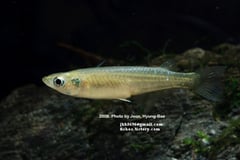
Oryzias latipesMedaka
Adrianichthyidae · (Temminck & Schlegel, 1846)
The medaka, Oryzias latipes, is a ricefish from Japan, Korea, Taiwan, eastern China, Laos and Vietnam. Long used as a model organism in genomic and experimental biology, it was the first vertebrate animal to mate in space, in the mid-1990s. The ornamental 'golden' variant is more often seen than the natural form, and a transgenic 'glowing' form is illegal to buy, sell or own within the European Union.
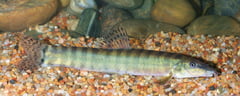
Parabotia bimaculata
Botiidae · Chen, 1980
Parabotia bimaculata is a riverine botiid loach from the upper Yangtze basin in Sichuan, southwest China, described from the Laixi River at Luxian. It looks similar to P. fasciata but has two dark markings at the caudal-fin base (vs. one) and 12-15 dark bars on the body. Like other Parabotia it favours clear, well-oxygenated running water over rocks and gravel, and needs spotless water in the aquarium.
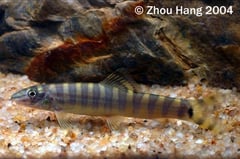
Parabotia lijiangensis
Botiidae · Chen, 1980
Parabotia lijiangensis is a botiid loach described from the Li River drainage near Guilin, in the Pearl River system of southern China. It has 10-13 dark vertical bars on the body and a dark, ocellated spot in the centre of the caudal-fin base. It probably inhabits clear, well-oxygenated running water, and the occasional specimen may turn up among shipments of similar-looking Sinibotia.
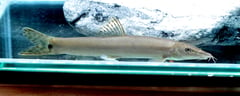
Parabotia sp. 'PB01'
Botiidae · authority not recorded
Parabotia sp. 'PB01' is an unidentified botiid loach imported into Singapore in 2012 from Sichuan province, southwestern China. Its name is unclear, and identification is harder still because diagnoses for several members of the genus do not appear to exist in English. It is not common in the aquarium trade and presumably needs clear, well-oxygenated running water like its congeners.

'Puntius' snyderi
Cyprinidae · Oshima, 1919
'Puntius' snyderi is a cyprinid from central and northern Taiwan, found in shallow margins of slow streams, irrigation canals and ponds. Almost identical to the wild form of 'P.' semifasciolatus, the 'golden barb' of the hobby, it is reliably told apart externally only by its tiny, indistinct barbels. It is also a deeper-bodied fish with 4-5 main dark markings on the flank, and the two differ genetically.
Rhinogobius duospilusWhite-cheeked Goby
Gobiidae · (Herre, 1935)
The white-cheeked goby, Rhinogobius duospilus, is a small goby from Hong Kong and southern China, living in clear hill streams. It was often sold in the past as 'Rhinogobius wui', a name now listed as a valid species, so aquarium literature published under either name may refer to either fish. Adults are extremely sedentary, and populations in neighbouring streams are genetically distinct from one another.
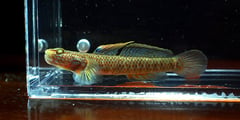
Rhinogobius filamentosus
Gobiidae · (Wu, 1939)
Rhinogobius filamentosus is a small goby from the Li River system in Guangxi, southern China, also collected in neighbouring Guangdong province. Very few details of its range exist, and its habitat is presumed to be smaller rivers and streams over gravel, rocks and boulders. The name refers to the extended primary dorsal-fin rays of males.
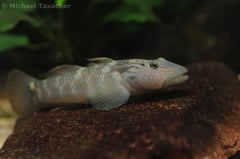
Rhinogobius formosanus
Gobiidae · Oshima, 1919
Rhinogobius formosanus is a goby endemic to river systems of northern and northeastern Taiwan. Previously considered a subspecies of R. nagoyae, it has generally been accepted as distinct since 2008. Irregular, worm-like, reddish-brown lines on the cheek and opercle separate it from other Taiwanese Rhinogobius. Like many fishes from running water it needs spotless water and does best in a tank set up to simulate a flowing stream.
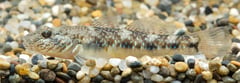
Rhinogobius giurinus
Gobiidae · (Rutter, 1897)
Rhinogobius giurinus is a goby found through much of China, plus Taiwan, the Korean Peninsula, Japan and the Red and Pha river basins in Vietnam. It appears to exist in a number of forms that differ in colour pattern, morphology or both, and it is unclear whether all of them are conspecific. Newly-imported wild fish tend to be aggressive towards conspecifics, so unlike most Rhinogobius it is best kept in sexed pairs.
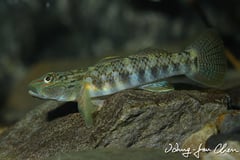
Rhinogobius lanyuensis
Gobiidae · Chen, Miller & Fang, 1998
Rhinogobius lanyuensis is a goby known only from Lanyu Island, better known as Orchid Island, off the southeastern coast of Taiwan. It has been available in Japan on occasion. The body carries 8 vertical blackish brown bars, and females have a discontinuous dark lateral stripe that males lack. Lanyu is a small volcanic island with no major rivers, and the species presumably inhabits small streams over gravel, rocks and bedrock.
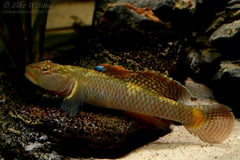
Rhinogobius leavelli
Gobiidae · (Herre, 1935)
Rhinogobius leavelli is a goby ranging from northeastern Laos through northern Vietnam to the Pearl drainage in Guangxi, southern China. It appears to exist in a number of forms that differ in colour pattern, morphology or both, although those in the aquarium trade all look similar. Fish identified as this species tend to have an orange blotch at the base of the caudal fin and a dark vertical bar at the base of the pectoral fin.
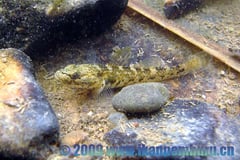
Rhinogobius lentiginis
Gobiidae · (Wu & Zheng, 1985)
Rhinogobius lentiginis is a small goby that appears endemic to Zhejiang province, eastern China, growing to around 32 mm SL. Given its natural range and the lack of commercial collecting there, it is unlikely to have been in the aquarium hobby. Irregular dark blotches and spots on the cheek and opercle separate it from its most similar congener, R. davidi, which has a single dark vertical stripe there.
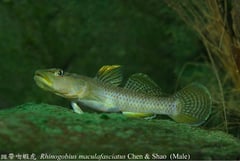
Rhinogobius maculafasciatus
Gobiidae · Chen & Shao, 1996
Rhinogobius maculafasciatus is a small goby known only from certain rivers in southern Taiwan, including the Tzengwen and Kaoping drainages. It has been collected by a few individuals. Fewer scale rows between the first dorsal-fin origin and upper pectoral-fin base than in related Taiwanese species give it a somewhat elongate appearance. Typical habitats are small brooks, tributaries and pools with slow flow over rocks and pebbles.
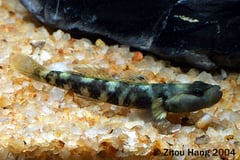
Rhinogobius yaoshanensis
Gobiidae · (Luo, 1989)
Rhinogobius yaoshanensis is a small goby recorded only from streams draining Jinxiu Yao Autonomous County in eastern Guangxi, China. Its name has appeared regularly on trade lists since the mid-2000s, but fish labelled as such do not fully match the most recent key, and whether the species itself has been exported is unclear. It is likely restricted to shallow, well-oxygenated headwaters with riffles and runs broken by pools.
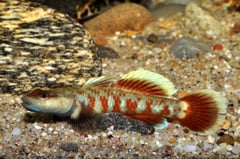
Rhinogobius zhoui
Gobiidae · Li & Zhong, 2009
Rhinogobius zhoui is a small goby restricted to a handful of streams around Lianhua Mountain in Haifeng County, Guangdong, China. In the aquarium trade since 2010, it is sold as 'Chinese vermilion goby', 'Zhou's scarlet goby', 'scarlet goby' and 'flame goby'. Adult males have 6-8 red blotches on the flank and broad white bands on the median fins. It has been bred in aquaria but not easily, because males patrol an area and do not defend a single spawning site.
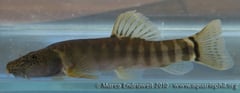
Schistura callichroma
Nemacheilidae · (Zhu & Wang, 1985)
Schistura callichromus is a nemacheilid loach recorded only from the Babianjiang River in the Red River basin, Yunnan Province, China. It is expected to occur in Vietnamese waters as well, and Kottelat (2012) amended the spelling of its name to 'callichroma'. Wild specimens have been observed living in social aggregations of up to six in clear, well-oxygenated headwater streams.
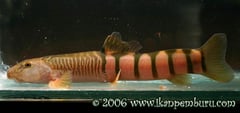
Schistura disparizona
Nemacheilidae · Zhou & Kottelat, 2005
Schistura disparizona is a nemacheilid loach known only from its type locality on the Nangun River, a Salween tributary in Yunnan Province, China. Its colour pattern of 8-11 closely-set, narrow dark bars at the front of the body and 5 wider bars behind separates it from congeners, and it has prominent adipose crests on the caudal peduncle. It inhabits shallow, narrow branches of streams over gravel or stone.
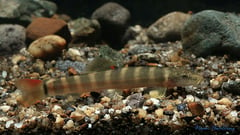
Schistura kengtungensis
Nemacheilidae · (Fowler, 1936)
Schistura kengtungensis is a nemacheilid loach from the middle Mekong basin in Thailand, Myanmar, Laos and Yunnan Province, southern China. It has 9-13 vertical bars as wide as or wider than the interspaces, and specimens from China differ from those in Thailand and Myanmar in several morphological characters. It inhabits shallow, narrow branches of streams over gravel or stone.
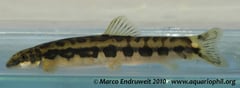
Schistura kloetzliae
Nemacheilidae · Kottelat, 2000
Schistura kloetzliae is a nemacheilid loach known only from the Mengla River system in Yunnan, China, and Luang Namtha province, northern Laos. It appears restricted to highly-oxygenated, fast-flowing riffles of small to medium streams with clear water and no aquatic plants. A series of large black blotches along the lateral line, each connected with blotches on the dorsal midline, separates it from congeners.
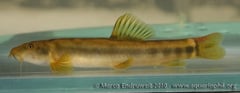
Schistura laterivittata
Nemacheilidae · (Zhu & Wang, 1985)
Schistura laterivittata is a nemacheilid loach recorded only from the Babianjiang River in the Red River basin, Yunnan Province, China. Most recent authors have treated it as a synonym of S. caudofurca, but this appears to be a case of misidentification: S. caudofurca has a deeply forked caudal-fin and no dark lateral body stripe. It is expected to occur in Vietnamese waters as well.
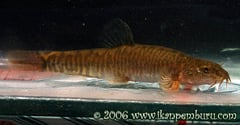
Schistura polytaenia
Nemacheilidae · (Zhu, 1982)
Schistura polytaenia is a nemacheilid loach known only from its type locality, an Irrawaddy tributary in Tengchong County, Yunnan, China. It appears never to have been exported for the aquarium hobby. Normally listed in Nemacheilus, it appears under Schistura in Kottelat (2012), and the specimens shown on the profile were identified on the basis of collection locality.
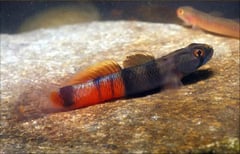
Sicyopus zosterophorus
Gobiidae · (Bleeker, 1856)
Sicyopus zosterophorus is a stream goby with a patchy but wide range from the Marquesas Islands westwards to Indonesia, Japan and southern China. It is occasionally available in the hobby as the 'flaming arrow goby', 'belted rockclimbing goby' or 'ornate goby', often under the invalid name Sicyopus zosterophorum. It inhabits short coastal streams on tropical islands, typically above waterfalls or cataracts.
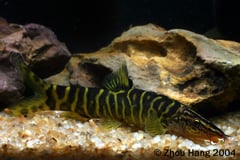
Sinibotia pulchraGolden Zebra Loach
Botiidae · (Wu, 1939)
The golden zebra loach, Sinibotia pulchra, is a botiid loach from the Zhu Jiang (Pearl River) system in southern China. It is also sold as the 'golden Chinese loach' or '12-banded Chinese loach' and, with S. robusta, is the most commonly traded Sinibotia, the two often imported in mixed batches. It is reclusive but very peaceful, and the gregarious nature of the genus means 3-4 should be the minimum purchase.
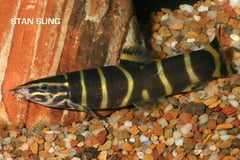
Sinibotia reevesae
Botiidae · (Chang, 1944)
Sinibotia reevesae is a botiid loach described from the middle Yangtze in Luxian County, Sichuan Province, and still known only from that area. It is apparently rare in nature and seldom seen in the trade, arriving occasionally as bycatch in shipments of S. pulchra or S. robusta. It has 7-8 dark vertical bars, and the head lacks the brown vermiform markings of S. pulchra.
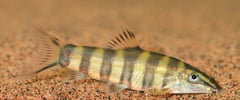
Sinibotia robustaKansu Loach
Botiidae · (Wu, 1939)
The Kansu loach, Sinibotia robusta, is a botiid loach from the Zhu Jiang (Pearl River) system in Guangxi, southern China. Its deeper, stockier body separates it from other Sinibotia. With S. pulchra it is the most commonly traded member of the genus, and the two are often imported in mixed batches. Young fish have around 6 dark bars that usually bifurcate as they mature.
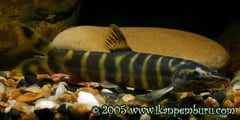
Sinibotia superciliaris
Botiidae · (Günther, 1892)
Sinibotia superciliaris is a botiid loach from the middle Yangtze River drainage in Sichuan and Guizhou provinces, western China. It is rarely seen in the trade, with exports sporadic. It looks very similar to S. pulchra but lacks the brownish markings and spots on the side of the head, and in the wild it was collected from swiftly-flowing stretches with rocky substrates.
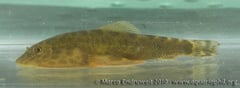
Sinogastromyzon tonkinensis
Balitoridae · Pellegrin & Chevey, 1935
Sinogastromyzon tonkinensis is a hillstream loach that appears endemic to the lower Red River drainage in southern China and northern Vietnam. It is poorly known in the hobby but appears to have been exported on a handful of occasions. It occurs alongside three congeners, which are most easily separated by the barbels and mouth width, and it dwells in swiftly-flowing streams and headwaters.
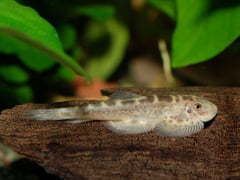
Sinogastromyzon wui
Balitoridae · Fang, 1930
Sinogastromyzon wui is a hillstream loach known only from parts of the Xi Jiang (West River) watershed in Guangxi and Guangdong, southern China. Probably the most common member of the genus in the aquarium trade, it is still not often exported in numbers and more often arrives in mixed shipments with Beaufortia or Pseudogastromyzon. It lives in shallow riffles and rapids with swift currents.
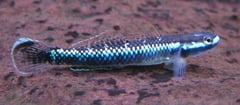
Stiphodon atropurpureusBlue Neon Goby
Gobiidae · (Herre, 1927)
The blue neon goby, Stiphodon atropurpureus, is a stream-dwelling goby from southern Japan, Taiwan, southern China, the Philippines and Malaysia. It is available occasionally but often under the wrong name, including S. elegans and 'Sumatran blue neon goby', though it is not found on Sumatra. In males the bright blue-green lateral stripe combined with a reddish outer edge to the first dorsal fin is unique within the genus.
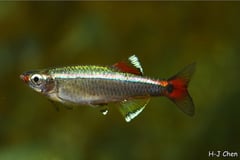
Tanichthys albonubesWhite Cloud Mountain Minnow
Cyprinidae · Lin, 1932
The White Cloud Mountain minnow, Tanichthys albonubes, is a small cyprinid from Guangdong and Hainan in southern China and from northeastern Vietnam. It appears to have been extirpated from White Cloud Mountain itself and is considered endangered in China, but all the fish on sale are commercially bred. Inbreeding among farm-bred stock has left many genetically weak and prone to disease or deformity, and permanent exposure to warmer conditions is likely to shorten its life.
Xiphophorus helleriiGreen Swordtail
Poeciliidae · Heckel, 1848
The green swordtail, Xiphophorus hellerii, is a livebearer native to southeastern Mexico, Guatemala, Belize and Honduras. Among the world's most recognisable aquarium fishes, it is ubiquitous in the trade, where selective breeding and hybridisation with X. maculatus and X. variatus have produced a bewildering array of ornamental forms. The name is often misspelled X. helleri.
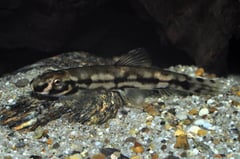
Yaoshania pachychilusPanda Loach
Balitoridae · (Chen, 1980)
The panda loach, Yaoshania pachychilus, is a balitorid loach from headwater streams draining the Dayao Mountain in Guangxi, southern China. The name comes from the black-and-white-striped juvenile pattern, which fades in older fish, so only young fish tend to be traded, sometimes labelled 'panda goby'. It needs clean, well-oxygenated, fast-flowing water, and though often marketed for them it is not suitable for tiny 'nano' aquaria.
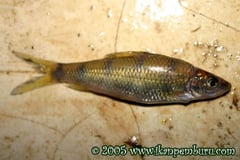
Acrossocheilus iridescens
Cyprinidae · (Nichols & Pope, 1927)
Acrossocheilus iridescens is a barred cyprinid known from Laos, northern Vietnam, Yunnan province in southwestern China and Hainan Island. Adults carry wide black vertical bars on the flanks, each six to eight scales across, and lack the filament on the dorsal fin seen in its closest relative, A. longipinnis. Some populations are of questionable taxonomic status, and the species sensu stricto may be restricted to Hainan, where the type locality lies.

Anabas testudineusClimbing Perch
Anabantidae · (Bloch, 1792)
The climbing perch, Anabas testudineus, is a labyrinth fish found from Pakistan and Sri Lanka east to southern China, Indonesia and Singapore. It lives in almost every kind of lowland water from rice paddies to main river channels, and can cross several hundred metres of land provided it stays moist. Its taxonomy is confused, and additional taxa probably exist. Its size and predatory nature make it unsuitable for the general community.
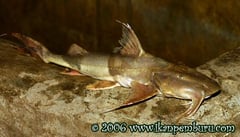
Bagarius rutilus
Sisoridae · Ng & Kottelat, 2000
Bagarius rutilus is a sisorid catfish from the Red River and other drainages of northern Vietnam and Yunnan in southern China, possibly also Laos. Reaching 700 to 1000 mm SL, it is clearly unsuitable for the home aquarium, and small numbers are only occasionally exported. It has orange fins in life. Adults live in fast, turbulent rapids in large river channels and perform spawning migrations when rivers swell between March and June.
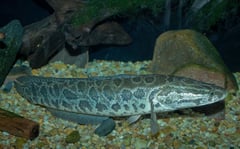
Channa argusNorthern Snakehead
Channidae · (Cantor, 1842)
The northern snakehead, Channa argus, is a large snakehead native to eastern China, southeastern Russia and the Korean peninsula. Growing to 850 mm, it is largely unsuitable for the home aquarium given its size and natural behaviour. Introduced populations, first intended for aquaculture, are now established in Japan, the United States, central Asia and parts of eastern Europe.

Channa maruliusBullseye Snakehead
Channidae · (Hamilton, 1822)
The bullseye snakehead, Channa marulius, is a large snakehead recorded from Pakistan across southern Asia to southern China, Laos and Vietnam. Also called the 'giant', 'cobra' or 'Indian' snakehead, it is widely accepted to represent a complex of related species in need of further research. Reports of 120-180 cm remain to be proven, with 500-600 mm a more common adult size, and it is suitable only for public installations or the very largest private aquaria.

Ctenopharyngodon idellaGrass Carp
Cyprinidae · (Valenciennes, 1844)
The grass carp, Ctenopharyngodon idella, is a large cyprinid native to the Amur River system in eastern Russia and northeastern China. Adults typically reach 800 to 1200 mm, making it a wholly unsuitable aquarium subject, though an albino form is traded. Widely introduced for aquaculture and weed control, it has caused serious damage to natural waters, and unwanted fish should never be released.

Hampala macrolepidotaHampala Barb
Cyprinidae · Kuhl & van Hasselt, 1823
The hampala barb, Hampala macrolepidota, is a cyprinid ranging from Myanmar through Thailand to the Mekong, and south to Borneo, Sumatra and Java. Also known as 'jungle perch' or 'sidebar barb', it can grow to over 2 feet and 5 kg and is a powerful, pelagic predator and not an aquarium subject in all but the most extreme circumstances. Prized as a food and sport fish, it has been introduced to numerous water bodies.

Hemibagrus wyckioidesAsian Red Tailed Catfish
Bagridae · (Fang & Chaux, 1949)
The Asian red tailed catfish, Hemibagrus wyckioides, is a bagrid from the Mekong system in China, Laos, Vietnam, Cambodia and Thailand. It also occurs in the Chao Phraya drainage. The largest bagrid in central Indochina, it reaches at least 900–1000 mm and 70–80 kg, and the largest specimen known measured 1300 mm. Juveniles are sometimes sold, but buying them is strongly discouraged given its size, aggression and a lifespan of several decades.

Incisilabeo behri
Cyprinidae · (Fowler, 1937)
Incisilabeo behri is a large cyprinid native to the Mekong river system in southern China, Laos, Thailand, Vietnam and Cambodia. Growing to 450 to 550 mm, it is patently unsuitable for the home aquarium, though juveniles are available on a relatively regular basis. The only member of its genus, it is separated from Bangana by a conspicuous transverse notch across the top of the head, and migrates seasonally up the Sekong, Sesan and Srepok rivers.

Macrochirichthys macrochirusGiant Sword Minnow
Cyprinidae · (Valenciennes, 1844)
The giant sword minnow, Macrochirichthys macrochirus, is a large pelagic cyprinid widespread in Southeast Asia, from the Mekong to Borneo and Sumatra. Growing to 600 to 800 mm and becoming increasingly piscivorous as it grows, it is unsuitable for the majority of private aquaria, although juveniles are traded on occasion. It is thought to have been extirpated from the Chao Phraya, Mae Klong, Lake Songkhla and Java, and the Mekong populations have been drastically reduced.
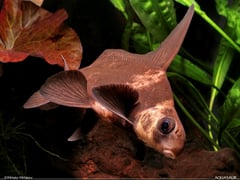
Myxocyprinus asiaticusChinese Sailfin Sucker
Catostomidae · (Bleeker, 1864)
The Chinese sailfin sucker, Myxocyprinus asiaticus, is a catostomid endemic to the upper and middle Yangtze River system in China, including the Min. The only Asian member of its family, it is traded as juveniles under names such as 'Chinese banded shark', almost always without mention of an adult size of almost a metre or a lifespan of 25 years or more. Wild populations are threatened by dams, pollution, overfishing and introduced species.
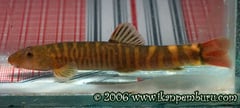
Schistura yingjiangensis
Nemacheilidae · (Zhu, 1982)
Schistura yingjiangensis is a nemacheilid loach known only from the Daying River, an Irrawaddy tributary in Yingjiang County, Yunnan, China. It appears never to have been exported for the aquarium hobby. Normally listed in Nemacheilus, it appears under Schistura in Kottelat (2012), as it does in Chen & Neely (2012) and Endruweit (2014).
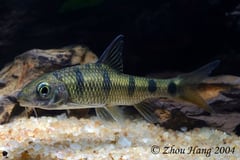
Acrossocheilus beijiangensis
Cyprinidae · Wu & Lin, 1977
Acrossocheilus beijiangensis is a barred cyprinid from Fujian, Guangdong and Guangxi in southern China, plus the islands of Hainan and Hong Kong. With A. clivosius it is one of only two species in the genus always to have five dark vertical bars on each flank. Wild fish feed on small benthic invertebrates and graze biofilm from rocks and other solid surfaces.
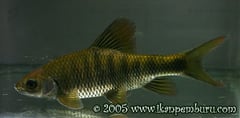
Acrossocheilus monticola
Cyprinidae · (Günther, 1888)
Acrossocheilus monticola is a barred cyprinid that is apparently endemic to the upper Yangtze River basin in China. It alone in the genus has seven or eight dark vertical bars on each flank, each one to three scales wide. The type locality is a mountain stream flowing into the Ichang gorge, and wild fish feed on small benthic invertebrates and graze biofilm from rocks and other solid surfaces.
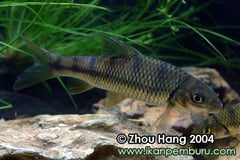
Acrossocheilus parallens
Cyprinidae · (Nichols, 1931)
Acrossocheilus parallens is a barred cyprinid from Guangdong and Hainan provinces in southern China, plus the island of Taiwan. It has five or six dark vertical bars on each flank, each two scales wide, a pattern it shares with A. paradoxus and several other congeners. Wild fish feed on small benthic invertebrates and graze biofilm from rocks and other solid surfaces.
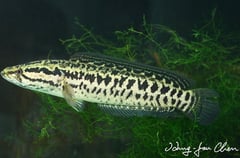
Channa maculataBlotched Snakehead
Channidae · (Lacepède, 1801)
The blotched snakehead, Channa maculata, is a snakehead from coastal drainages of southeastern China, including Hong Kong, and northern Vietnam. It is frequently confused with C. argus but has fewer fin rays and lateral line scales and carries 2-3 rounded blotches on the caudal peduncle. An important food fish, it has become established in Japan, Taiwan, the Philippines, Madagascar and Hawaii, and hybrids with C. argus appear to be quite common in aquaculture.
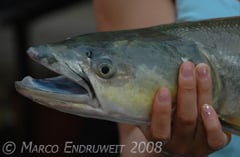
Elopichthys bambusa
Cyprinidae · (Richardson, 1845)
Elopichthys bambusa is a large predatory cyprinid of eastern Asia, from the Amur River in Russia to the Lam drainage in northern Vietnam. Growing to 2 m and 40 kg, it is entirely unsuitable for the home aquarium, though young individuals appear in the ornamental trade on an irregular basis. The only species in its genus, it is an important food fish over much of its range.

Garra bispinosa
Cyprinidae · Zhang, 2005
Garra bispinosa is a cyprinid known only from its type locality, the Daying Jiang in the Irrawaddy basin, Yunnan Province, China. It is distinguished from other Garra in Southeast Asia and China by a quadrate proboscis on the snout, each lobe tipped with a single large tubercle. Nothing specific is recorded of its habitat.

Garra imberba
Cyprinidae · Garman, 1912
Garra imberba is a cyprinid without barbels from the upper Yangtze, Mekong and Red River basins in southern China, and the upper Red in Vietnam. Records from the Salween system result from confusion with the similarly-named G. imberbis. With G. micropulvinus it is placed in the Semilabeoina, for which the name Ageneiogarra has been suggested. It tends to inhabit swiftly-flowing headwaters and tributaries.

Garra mirofrontis
Cyprinidae · Chu & Cui, 1987
Garra mirofrontis is a cyprinid native to the upper Mekong (Lancangjiang) basin in Yunnan province, China. It is characterised by a transverse groove on the snout directly in front of the eyes, and a bifurcate proboscis with a conical keratinised tubercle at each tip. A typical habitat is a strongly-flowing river about 25 m across with a predominantly rocky substrate.

Garra notata
Cyprinidae · (Blyth, 1860)
Garra notata is a cyprinid known with certainty from the Salween basin in Myanmar, China and Thailand, and the Tenasserim drainage. Records from the Western Ghats of southern India are unlikely to be accurate, and a report from the upper Irrawaddy needs confirmation. It lacks both a transverse groove and a proboscis on the snout, and has dark spots at the base of the dorsal-fin rays.
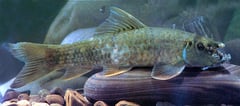
Garra orientalis
Cyprinidae · Nichols, 1925
Garra orientalis is a cyprinid widely distributed in southern China, with records from the Pearl River (Zhu Jiang) and Min Jiang watersheds. Earlier records from the Salween and upper Irrawaddy are now known to represent other species. It shares a forward-projecting, trilobed proboscis with G. salweenica and G. fuliginosa but lacks their dark blotch on the caudal peduncle. It tends to inhabit rocky, swiftly-flowing headwaters.
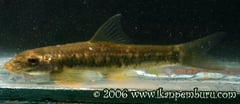
Garra qiaojiensis
Cyprinidae · Wu & Yao, 1977
Garra qiaojiensis is a cyprinid known only from a handful of localities in the upper Irrawaddy (Yiluowadi Jiang) basin in Yunnan province, China. It may also occur in northern Myanmar, and was collected from clear, flowing mountain streams over rock and gravel. It is similar to G. rotundinasus but has a quadrate, heavily tuberculated proboscis, a longer head and a deeper body. It grows to around 175 mm SL.
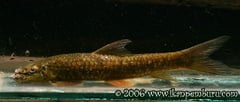
Garra rotundinasus
Cyprinidae · Zhang, 2006
Garra rotundinasus is a cyprinid native to the Yiluowadi Jiang, the upper Irrawaddy river system, in Yunnan province, southern China. Before its description it was confused with a congener now accepted to occur only in the Salween and Manipur basins. Both have a weakly-developed proboscis, but G. rotundinasus has a broadly rounded snout and more lateral line scales. It grows to around 185 mm SL.

Garra salweenica
Cyprinidae · Hora & Mukerji, 1934
Garra salweenica is a cyprinid found throughout the Salween River system in Yunnan province, China, Myanmar and western Thailand. It has a brownish body with longitudinal stripes on the rear half, a trilobed proboscis on the blunt snout, and a dark marking at the tip of the upper caudal-fin lobe. It tends to inhabit swiftly-flowing headwaters and tributaries, and grows to around 175 mm SL.

Gymnostomus lineatus
Cyprinidae · (Smith, 1945)
Gymnostomus lineatus is a riverine cyprinid from the middle to lower Mekong basin and the Chao Phraya, in China, Laos, Thailand and Cambodia. It is most often collected in mid-to-large channels, although in the Mekong basin it also enters smaller tributaries and inundated fields. It has a pair of small maxillary barbels and 5-6 faint, thin stripes along each flank, and has been placed in Henicorhynchus, Cirrhinus, Bangana and Labeo in the last few decades.
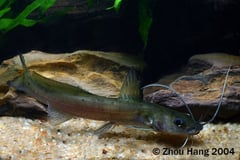
Hemibagrus macropterus
Bagridae · Bleeker, 1870
Hemibagrus macropterus is a bagrid catfish from the Zhujiang (Pearl River), Changjiang (Yangtze) and Qiantang Jiang in central and southern China. It inhabits swiftly-flowing rivers and tributaries with rocky substrates and grows to 408 mm SL. Virtually unknown in the aquarium trade, it is fished for food, and dam construction and pollution have affected it in parts of its range, where it may be locally extirpated.
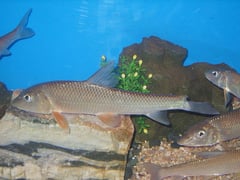
Hemibarbus labeoBarbel Steed
Cyprinidae · (Pallas, 1776)
The barbel steed, Hemibarbus labeo, is a cyprinid widespread in eastern Asia between the Yangtze and Amur river basins. A predominantly riverine fish of clear, well-oxygenated running water, it forms schools just above the substrate as an adult, and some populations make annual spawning migrations. Adults lack dark spots on the body and have a long snout and well-developed lips.
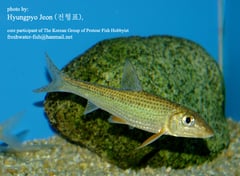
Hemibarbus longirostris
Cyprinidae · (Regan, 1908)
Hemibarbus longirostris is a cyprinid native to far eastern Asia, including northeastern China, southeastern Russia, the Korean peninsula and Japan. A predominantly riverine fish, it lives in clear, well-oxygenated running water over sand, gravel, rock or mud, and adults tend to form schools just above the substrate in slower-moving sections.
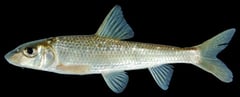
Hemibarbus maculatusSpotted Steed
Cyprinidae · Bleeker, 1871
The spotted steed, Hemibarbus maculatus, is a cyprinid widespread in eastern Asia between the Yangtze and Amur basins, including Taiwan and Hainan. It has 7–11 large blackish spots on each flank and a deep body with a clearly convex dorsal profile. A riverine fish of clear, well-oxygenated running water, it breeds in May and June, depositing its eggs among aquatic vegetation. It has probably been introduced to Vietnam and Laos, or records from there represent another species.

Hypsibarbus salweenensis
Cyprinidae · Rainboth, 1996
Hypsibarbus salweenensis is a large cyprinid endemic to the Salween river system in Yunnan province, China, eastern Myanmar and northwestern Thailand. It has been collected from submontane headwater streams, larger tributaries and main river channels, and appears to be abundant on a seasonal basis in the lower Salween, suggesting a migratory lifestyle. Growing to at least 300 mm, it belongs to a genus of valued food fishes.

Labeo calbasuOrangefin Labeo
Cyprinidae · (Hamilton, 1822)
The orangefin labeo, Labeo calbasu, is a large cyprinid from Pakistan, Nepal, India, Bangladesh, Myanmar and southern China. Growing to 800 mm, it is an important food and game fish across its native range and is not a suitable subject for the home aquarium. It is known as 'black rohu' in parts of India and Bangladesh, and inhabits the lower reaches of major rivers, lakes and reservoirs.

Labeo pierrei
Cyprinidae · (Sauvage, 1880)
Labeo pierrei is a large cyprinid from the Mekong river system in southern China, Laos, Thailand, Cambodia and Vietnam, and the Dong Nai in Vietnam. It grows to 800 mm and inhabits main river channels and large, deep tributaries. It migrates seasonally, moving upstream into the Sekong, Sesan and Srepok rivers at the onset of the wet season and returning downstream in the dry months.
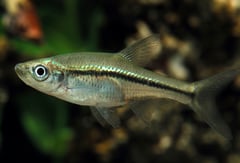
Metzia formosae
Cyprinidae · (Oshima, 1920)
Metzia formosae is a small cyprinid from northern Taiwan, Hainan, Hong Kong, southern China and northern Vietnam. It is identified by its upturned mouth and a black stripe along the flank from the gill opening to the caudal-fin base. It inhabits slow-moving to still, well-vegetated waters, including streams, rice paddies, ditches and canals. The genus remains unresolved in taxonomic terms.
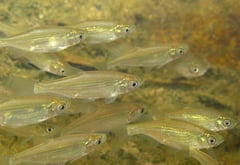
Metzia lineata
Cyprinidae · (Pellegrin, 1907)
Metzia lineata is a cyprinid from southern China, Hainan, Hong Kong and the Red River basin of northern Vietnam. Populations from the upper Pearl River and from Vietnam differ from those elsewhere, which suggests several species may be included under the name. It lives in slow-moving to still, well-vegetated waters. It has been introduced to other river systems in China and to northern Laos.

Mystacoleucus lepturus
Cyprinidae · Huang, 1979
Mystacoleucus lepturus is a riverine cyprinid known only from the upper Mekong basin in southern China, Laos and Thailand. It favours clear, well-oxygenated running water over sand or gravel. The body is relatively slender, with a black margin on the dorsal fin and many crescent-marked scales. Records from Vietnam and Hainan Island refer to other species. Like all Mystacoleucus it has a forward-pointing predorsal spine that can snag in a net.