Region · Indonesia, Papua New Guinea
New Guinea
Only species with a profile on Seriously Fish are counted.
- Species
- 6
- Countries
- 2
- Photographed
- 6 of 6
- Difficulty rated
- 6 of 6
Split acrossspecies recorded with the country given
One more species is recorded from New Guinea without a country, so it is not in these figures.
Countries here
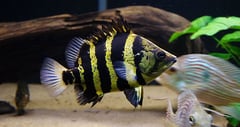
Datnioides campbelliNew Guinea Tiger Perch
Datnioididae · Whitley, 1939
The New Guinea tiger perch, Datnioides campbelli, is a large tiger perch from southern New Guinea, recorded mostly from the lower Fly River basin. A golden yellow base colour with 4 to 6 wide, diffuse dark bars separates it from its congeners. The species is euryhaline, found in brackish tidal creeks as well as in tributaries and swamps at least 900 km from the sea, and it grows to 350 mm SL.
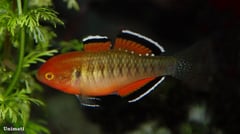
Hypseleotris compressaEmpire Gudgeon
Eleotridae · Krefft, 1864
The empire gudgeon, Hypseleotris compressa, is an eleotrid from northern and eastern Australia and southern New Guinea. Breeding is rarely achieved in aquaria because of its complex amphidromous strategy: adults spawn in freshwater streams, but the larvae are washed downstream to the sea and develop there. Plenty of cover and broken lines of sight let weaker individuals escape the attention of dominant fish.
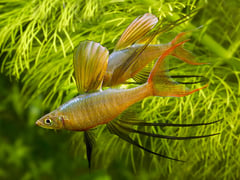
Iriatherina werneriThreadfin Rainbowfish
Melanotaeniidae · Meinken, 1974
The threadfin rainbowfish, Iriatherina werneri, is a small rainbowfish from southern New Guinea, Cape York in Queensland and the Northern Territory. Although widely traded and produced on a commercial scale, it is quite delicate with rather specific care requirements and is not a recommended beginner's fish. Easily outcompeted for food, and with long-finned males that some common species nip, it is best kept alone or with fishes of comparable size and disposition.
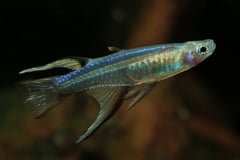
Pseudomugil cyanodorsalisNeon Blue-eye
Pseudomugilidae · Allen & Sarti, 1983
The neon blue-eye, Pseudomugil cyanodorsalis, is a euryhaline blue-eye from coastal northern Australia and possibly southern New Guinea. Males are told apart from the rest of the genus by the bright metallic blue upper portion of the body, the source of the alternative name 'blueback blue-eye'. It has been recorded from full marine conditions to pure fresh water, and is generally considered to do better in brackish water. Timid and easily outcompeted, it is unsuitable for the general community.
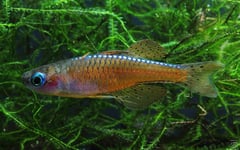
Pseudomugil sp. 'red neon'
Pseudomugilidae · authority not recorded
Pseudomugil sp. 'red neon' is an undescribed blue-eye, possibly collected near Timika in Papua province, Indonesia. It first appeared in the hobby in 2011 under names including P. sp. cf. paskai and P. 'iriani'. Initially suspected to be a hybrid or selectively-bred form of P. paskai, it has been shown by DNA sequencing to be an undescribed species close to P. gertrudae and P. paskai. Peaceful but easily outcompeted, it suits a densely-planted aquarium.
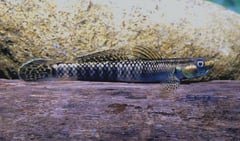
Stiphodon atratus
Gobiidae · Watson, 1996
Stiphodon atratus is a stream-dwelling goby from Indonesia, northern New Guinea and islands east to Vanuatu and New Caledonia. Males are blackish, especially on the unpaired fins, and large males appear entirely black between the second dorsal and anal fins. It has been maintained by a few private collectors. Like other Stiphodon it is a specialised algal grazer with an amphidromous life cycle.