River
Capivari
Only species with a profile on Seriously Fish are counted.
- Species
- 4
- Families
- 2
- Photographed
- 4 of 4
- Difficulty rated
- 4 of 4
Basin
Also in the Parana basinspecies recorded from both
Shares fishes with rivers elsewherespecies recorded from both
Runs through
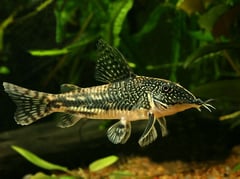
Scleromystax barbatusBanded 'Cory'
Callichthyidae · Quoy & Gaimard, 1824
The banded 'cory', Scleromystax barbatus, is an armoured catfish from coastal rivers in south-east Brazil, between Rio de Janeiro and Santa Catarina. At 90-100 mm it is the largest of the Corydoradinae, and it was formerly included in Corydoras. The hobby also knows it as 'bearded cory', 'checkerboard cory' and 'filigree cory'. Males are aggressively territorial towards one another and cannot be kept together in smaller aquaria.
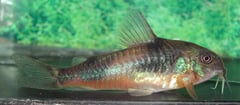
Hoplisoma ehrhardti
Callichthyidae · (Steindachner, 1910)
Hoplisoma ehrhardti, long known as Corydoras ehrhardti, is an armoured catfish from eastern Brazil, known from southern São Paulo to northern Santa Catarina states. It inhabits minor rivers and small streams with soft substrates, a number of them modified by human activity. It is rarely traded and resembles several congeners, including H. carlae, H. paleatum and H. steindachneri.
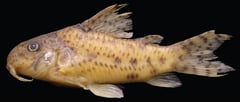
Hoplisoma flaveolum
Callichthyidae · (Ihering, 1911)
Hoplisoma flaveolum, long known as Corydoras flaveolus, is an armoured catfish from tributaries of the rio Tietê in the upper rio Paraná basin, São Paulo state, Brazil. It is exceptionally rare in the hobby. Its closest congener is H. lacrimostigmata, from which it differs in having more serrations on the pectoral- and dorsal-fin spines, a rounded snout and flanks and fins densely patterned with spots and bars.

Hyphessobrycon bifasciatusYellow Tetra
Characidae · Ellis, 1911
The yellow tetra, Hyphessobrycon bifasciatus, is a characid from coastal rivers of southeastern Brazil between Espírito Santo and Rio Grande do Sul. It also occurs in parts of the upper Paraná basin, in floodplain tributaries, lakes and streams, usually under forest cover. Two vertically elongate humeral spots, the front one more prominent, help separate it from similar congeners. Generally peaceful, it is best kept as a group of 8-10 or more.