River
Citarum
Only species with a profile on Seriously Fish are counted.
- Species
- 3
- Families
- 2
- Photographed
- 3 of 3
- Difficulty rated
- 3 of 3
Basin
Shares fishes withspecies recorded from both
Runs through
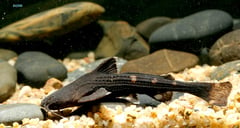
Acrochordonichthys rugosusAsian Banjo Catfish
Akysidae · Bleeker, 1846
The Asian banjo catfish, Acrochordonichthys rugosus, is an akysid catfish from Java, Sumatra, Borneo, Peninsular Malaysia and southern Thailand. The most commonly encountered member of the genus in the trade, it is still by no means common, and body colouration varies widely even among fish from a single locality. Like its congeners it can secrete a milky substance from the axillary pore when stressed, and this can quickly kill other fishes in the confines of an aquarium.

Hemibagrus wyckiiCrystal-eyed Catfish
Bagridae · Bleeker, 1858
The crystal-eyed catfish, Hemibagrus wyckii, is a bagrid with an enormous distribution across central Indochina and western Indonesia. Juveniles are sometimes available in the aquarium trade, but buying them is strongly discouraged: it reaches 710 mm SL, is aggressively territorial and can live for several decades. Despite the common name, the blue eye is not given as a distinguishing character in any diagnosis we've seen.
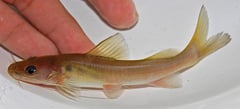
Hemibagrus planiceps
Bagridae · Valenciennes, 1840
Hemibagrus planiceps is a bagrid catfish endemic to western Java, known only from seven river systems including the Citarum and Ciliwung. It occurs in the upper parts of river basins, in clear, fast-flowing water over rock or sand. It has been confused in the past with H. gracilis, H. velox and H. bongan, and the population once thought to inhabit northwestern Peninsular Malaysia has been described as H. divaricatus.