River
Rajang
Only species with a profile on Seriously Fish are counted.
- Species
- 32
- Families
- 13
- Photographed
- 32 of 32
- Difficulty rated
- 32 of 32
Basin
Shares fishes withspecies recorded from both
Runs through
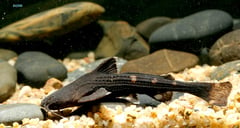
Acrochordonichthys rugosusAsian Banjo Catfish
Akysidae · Bleeker, 1846
The Asian banjo catfish, Acrochordonichthys rugosus, is an akysid catfish from Java, Sumatra, Borneo, Peninsular Malaysia and southern Thailand. The most commonly encountered member of the genus in the trade, it is still by no means common, and body colouration varies widely even among fish from a single locality. Like its congeners it can secrete a milky substance from the axillary pore when stressed, and this can quickly kill other fishes in the confines of an aquarium.

Barbonymus gonionotus
Cyprinidae · Bleeker, 1849
Barbonymus gonionotus is a large cyprinid with an enormous distribution across Southeast Asia, from the Mekong to Java and Sumatra. It inhabits larger, slow-moving rivers and their floodplains, moving into flooded forest to feed and spawn, and is increasingly found in man-made canals and lakes. Plain grey caudal and dorsal fins and pale yellow pelvic and anal fins separate it from congeners. Populations in Peninsular Malaysia appear to be introduced.

Barbonymus schwanefeldiiTinfoil barb
Cyprinidae · Bleeker, 1854
The tinfoil barb, Barbonymus schwanefeldii, is a large cyprinid found across much of Southeast Asia, from the Mekong to Borneo and Sumatra. Usually sold at 50 to 75 mm, it grows to 355 mm SL, and tinfoil barbs are among the species most often returned to shops having outgrown their aquarium. Selectively-bred 'golden' and 'blushing' strains exist, and the species has also been subjected to artificial dyeing.
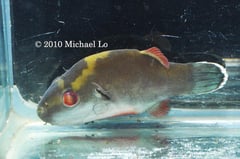
Carinotetraodon borneensis
Tetraodontidae · Regan, 1903
Carinotetraodon borneensis is a small red-eyed puffer known only from southern Sarawak, Malaysia (Borneo), in the Sarawak, Sadong and Rajang rivers. Uncommon in the hobby, it is sometimes mixed among shipments of C. salivator, which has distinct dark bars on the head and body in both sexes. Males in particular tend to be territorial, but a group can be kept where there is enough cover and space.
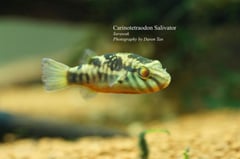
Carinotetraodon salivator
Tetraodontidae · Lim & Kottelat, 1995
Carinotetraodon salivator is a small red-eyed puffer known only from Sarawak, Borneo, in the Lupar, Sarawak and Rajang river systems. Sometimes traded as the 'striped redeye puffer' or 'zebra puffer', it has distinct dark bars on the head and body in both sexes, a colour pattern unique within the genus. Unlike most congeners, there is evidence that it prefers flowing water.

Channa gachuaDwarf Snakehead
Channidae · Hamilton, 1822
The dwarf snakehead, Channa gachua, is a snakehead recorded across an enormous range from Iran to Taiwan and Bali. There is significant evidence that C. gachua as currently understood is a complex of similar-looking species in need of taxonomic review. A mouthbrooder bred regularly in captivity, it can share a well-chosen community with peaceful fishes too large to be prey, but populations should not be mixed as some may hybridise.

Channa luciusForest Snakehead
Channidae · Cuvier, 1831
The forest snakehead, Channa lucius, is a predatory snakehead from Indochina, Peninsular Malaysia and the Greater Sunda Islands. Also referred to as the 'splendid' or 'shiny' snakehead, it occurs on Sumatra, Borneo and Java, grows to 400 mm SL and favours forest swamps and tributaries. Like others in the genus it breathes atmospheric air, and it needs a dimly-lit tank with plenty of cover and a tightly-fitting lid, since Channa spp. are notorious for their ability to escape.

Cyclocheilichthys armatus
Cyprinidae · Valenciennes, 1842
Cyclocheilichthys armatus is a cyprinid ranging from the Mekong region through Thailand and Peninsular Malaysia to Borneo, Sumatra and Java. It forages from mid-water to the bottom of rivers in the dry season and is thought to migrate into flooded forest to breed. Rarely imported in numbers and most often arriving as bycatch, it makes a peaceful, unusual addition to larger aquaria in a group of at least six.

Datnioides polotaSilver Tiger Perch
Datnioididae · Hamilton, 1822
The silver tiger perch, Datnioides polota, is a tiger perch widely distributed in southeastern Asia, from India and Bangladesh east to Indonesia. Mostly found in brackish habitats such as estuaries, mangroves and coastal lagoons, it has a highly variable colour pattern with up to 7 dark bars. The name D. quadrifasciatus is sometimes applied to it, but that name is a junior homonym and polota takes precedence.
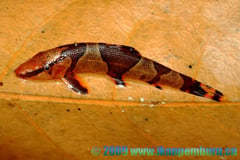
Homaloptera orthogoniataSaddle-back Loach
Balitoridae · Vaillant, 1902
The saddle-back loach, Homaloptera orthogoniata, is a 'lizard' loach endemic to Borneo, known from rivers in Sarawak and Kalimantan. It was historically said to occur across much of Indochina. It is rare in the hobby, and most images online and in the literature show H. confuzona or H. parclitella. It always has three large, saddle-shaped markings on the back, the third between the dorsal and caudal fins.
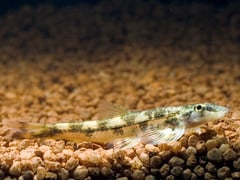
Homalopteroides nebulosus
Balitoridae · Alfred, 1969
Homalopteroides nebulosus is a small hillstream loach described from the Sok River in northern Peninsular Malaysia and since recorded from Borneo. Poorly known in the aquarium hobby, it may never have been exported for the ornamental trade. Its eyes sit in a comparatively raised position on the head, as in H. tweediei, but it has more lateral line scales. Little is known of its habitat, which is presumed to be swiftly-flowing streams and headwaters.
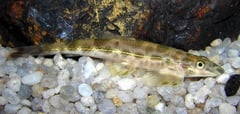
Homalopteroides stephensoni
Balitoridae · Hora, 1932
Homalopteroides stephensoni is a hillstream loach from Borneo, recorded from Kalimantan in Indonesia and from Sabah and Sarawak in Malaysia. Poorly known in the aquarium hobby, it may never have been exported for the ornamental trade. Originally described in Homaloptera, it was placed in Balitoropsis by Kottelat (2012), who subsequently followed Randall and Page (2012) in treating it as a Homalopteroides. Like its congeners it inhabits swiftly-flowing, clear, oxygen-saturated streams.

Kryptopterus bicirrhis
Siluridae · Valenciennes, 1840
Kryptopterus bicirrhis is a silurid catfish from much of Southeast Asia, including the Mekong and Chao Phraya and the Greater Sunda Islands. Uncommon in the aquarium trade, its name was widely misapplied to K. vitreolus in older literature, but the two are easily told apart because K. bicirrhis does not have a transparent body in life. It tends to form schools, so four or more should be kept.
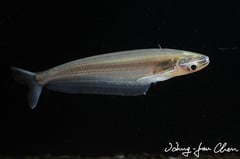
Kryptopterus cryptopterusBlue Sheatfish
Siluridae · Bleeker, 1851
The blue sheatfish, Kryptopterus cryptopterus, is a silurid catfish from the Malay Peninsula, Singapore, Sumatra, Borneo and Java. It inhabits flowing rivers and larger streams with turbid water, and is sometimes traded as 'smokey glass catfish'. Populations from Thailand, Cambodia, Laos and Vietnam once considered conspecific are now referred to K. geminus, its closest relative, from which it differs in having a wider head and a shorter snout and anal fin.

Kryptopterus limpok
Siluridae · Bleeker, 1852
Kryptopterus limpok is a silurid catfish widely distributed through Southeast Asia, including the Mekong and the Greater Sunda Islands. It can be told from its congeners by an extremely long mental barbel extending beyond the tip of the pectoral fin. It inhabits flowing rivers and larger streams with turbid water, grows to 260 mm and is almost unheard of in the ornamental trade.
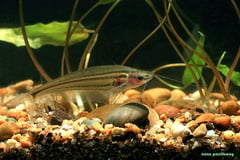
Kryptopterus macrocephalusStriped Glass Catfish
Siluridae · Bleeker, 1858
The striped glass catfish, Kryptopterus macrocephalus, is a silurid catfish from Thailand, Malaysia, Singapore and the Greater Sunda Islands. A stenotypic inhabitant of peat swamp forests and associated blackwater streams, it is also known as the false, mottled or tawny glass catfish. Striped and mottled colour forms exist that may or may not be conspecific, and the similar K. piperatus has a pale brown body with scattered dark spots.
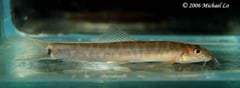
Nemacheilus saravacensis
Nemacheilidae · Boulenger, 1894
Nemacheilus saravacensis is a nemacheilid loach from Borneo, recorded from drainages in Sarawak (Malaysia) and West Kalimantan (Indonesia). It inhabits clear, tea-coloured forest streams with low mineral hardness and pH. Rare in the aquarium hobby, it may only have appeared as bycatch, and it carries 13-17 irregular dark blotches along the lateral line with a similar number of saddles across the back.
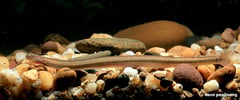
Pangio anguillaris
Cobitidae · Vaillant, 1902
Traded as 'eel loach', Pangio anguillaris is a cobitid loach from Borneo, Sumatra, Peninsular Malaysia and the Chao Phraya and Mekong basins. It has an extremely elongated, worm-like body with 69-71 vertebrae and no nasal barbels, and is most commonly available as bycatch among shipments of other fishes. The species as currently recognised appears to represent a complex of closely-related taxa.
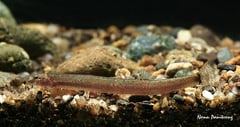
Pangio piperata
Cobitidae · Kottelat & Lim, 1993
Pangio piperata is a slender kuhli loach from Peninsular Malaysia, Riau Province in Sumatra and the Rajang river drainage in Sarawak. Its yellowish-brown body is peppered with small dark spots forming a rough stripe along the lateral line. Some populations of the variable P. shelfordii look similar and the two often occur together, but P. piperata is generally plainer and has fewer vertebrae. It is exported occasionally, most often as bycatch among congeners.
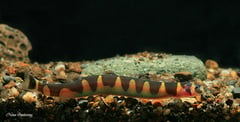
Pangio semicincta'Kuhli' Loach
Cobitidae · Fraser-Brunner, 1940
Usually sold as the 'kuhli' loach, Pangio semicincta is a cobitid loach from Peninsular Malaysia, Sumatra and Borneo. It lives in shallow forest streams and swamps, often in black water, and is typically abundant in leaf litter. P. kuhlii itself is currently considered endemic to Java and has possibly never been seen in aquaria, so the common aquarium 'kuhli' is more likely to be this species or an unidentified relative.

Parosphromenus allani
Osphronemidae · Brown, 1987
Parosphromenus allani is a liquorice gourami from Sarawak in Borneo, East Malaysia, to which it appears endemic. Its type description was a hobbyist-magazine announcement with limited diagnostic information, and fish from around Lundu with a different fin pattern, known to aquarists as P. sp. 'Stunggang' or P. sp. 'Lundu', may or may not be the same species. Much of its habitat has been lost and it is considered in grave danger of extinction.
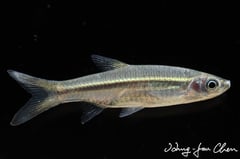
Rasbora argyrotaeniaSilver Rasbora
Cyprinidae · (Bleeker, 1849)
The silver rasbora, Rasbora argyrotaenia, is a cyprinid from Peninsular Malaysia, Singapore, Sumatra, Java, Borneo and the Palawan islands. One of the larger rasboras at up to 140 mm TL, it is a plain, silvery fish with a faint dark stripe, and fish pictured under this name with a bold black stripe are probably a regional variant of R. daniconius. A DNA barcode study found two mitochondrial lineages under the name, and the species as currently recognised is likely to be split.

Systomus orphoides
Cyprinidae · Valenciennes, 1842
Systomus orphoides is a large cyprinid ranging from Myanmar to Vietnam and south through Peninsular Malaysia to Borneo, Sumatra and Java. It mostly inhabits flowing tributaries and large streams, moving onto inundated farmland and forest in the wet season to feed and spawn. Not often available in the trade and usually seen as bycatch, it grows to 250 mm SL, is quite boisterous, and needs more-or-less spotless water.

Cyclocheilos enoplos
Cyprinidae · Bleeker, 1849
Cyclocheilos enoplos is a large cyprinid from the Mekong region and Thailand south through Peninsular Malaysia to Borneo, Sumatra and Java. Growing to around 750 mm SL, it is clearly unsuitable for aquaria and scarce to non-existent in the ornamental trade. In the Mekong it makes long seasonal migrations, and adults move upstream above Khone Falls in what appear to be spawning migrations.

Hampala macrolepidotaHampala Barb
Cyprinidae · Kuhl & van Hasselt, 1823
The hampala barb, Hampala macrolepidota, is a cyprinid ranging from Myanmar through Thailand to the Mekong, and south to Borneo, Sumatra and Java. Also known as 'jungle perch' or 'sidebar barb', it can grow to over 2 feet and 5 kg and is a powerful, pelagic predator and not an aquarium subject in all but the most extreme circumstances. Prized as a food and sport fish, it has been introduced to numerous water bodies.

Hemibagrus wyckiiCrystal-eyed Catfish
Bagridae · Bleeker, 1858
The crystal-eyed catfish, Hemibagrus wyckii, is a bagrid with an enormous distribution across central Indochina and western Indonesia. Juveniles are sometimes available in the aquarium trade, but buying them is strongly discouraged: it reaches 710 mm SL, is aggressively territorial and can live for several decades. Despite the common name, the blue eye is not given as a distinguishing character in any diagnosis we've seen.

Macrochirichthys macrochirusGiant Sword Minnow
Cyprinidae · Valenciennes, 1844
The giant sword minnow, Macrochirichthys macrochirus, is a large pelagic cyprinid widespread in Southeast Asia, from the Mekong to Borneo and Sumatra. Growing to 600 to 800 mm and becoming increasingly piscivorous as it grows, it is unsuitable for the majority of private aquaria, although juveniles are traded on occasion. It is thought to have been extirpated from the Chao Phraya, Mae Klong, Lake Songkhla and Java, and the Mekong populations have been drastically reduced.

Phalacronotus apogon
Siluridae · Bleeker, 1851
Phalacronotus apogon is a large silurid catfish from much of Southeast Asia, including Thailand, the Mekong basin and the Greater Sunda Islands. It reaches 700 mm and arguably should not be considered a home aquarium subject at all, but juveniles are sometimes sold as 'blue neon sheatfish' or 'metallic cheatfish' without adequate information on long-term care. It is an important food fish across much of its native range.

Scleropages formosusAsian Arowana
Osteoglossidae · Müller & Schlegel, 1840
The Asian arowana, Scleropages formosus, is an osteoglossid from the Mekong system, eastern Thailand, Peninsular Malaysia, Sumatra and Borneo. Highly valued in the aquarium trade since the 1970s and listed on Appendix I of CITES since 1975, it is now extirpated across much of its range. It occurs in several colour forms, such as the 'super red' of the upper Kapuas, and three were described as species in 2003, though the majority view treats all of them as S. formosus pending review.
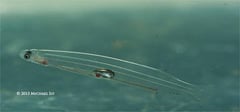
Sundasalanx microps
Sundasalangidae · Roberts, 1981
Sundasalanx microps is a miniature clupeiform from Borneo, in Indonesia and Malaysia, described from the Kapuas River. Adults are sexually mature at less than 20 mm SL and resemble the larval form of their larger ancestors. It has a small eye, less than 4% of SL. Sundasalanx species inhabit turbid, slow to moderately flowing water over silt, sand or mud in the lower parts of river basins, and little else is known of their ecology.
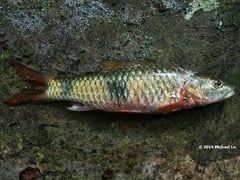
Hampala bimaculata
Cyprinidae · Popta, 1905
Hampala bimaculata is a large riverine cyprinid endemic to Borneo, recorded from Sarawak, Sabah, East Kalimantan and Brunei. Its adult size of up to 500 mm SL more-or-less precludes it as an aquarium fish, and it is poorly known in the ornamental trade. Of the Hampala species with two body blotches, it has saddle-shaped markings, with the anterior blotch beneath the posterior half of the dorsal-fin.
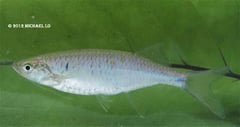
Nematabramis steindachnerii
Cyprinidae · Popta, 1905
Nematabramis steindachnerii is a cyprinid endemic to northern and central Borneo, in Sarawak, Sabah, Brunei and North and East Kalimantan. It has barbels longer than the head but not reaching beyond the pectoral-fin base, and a relatively slender body with a short head.