River
Khwae Noi
Only species with a profile on Seriously Fish are counted.
- Species
- 9
- Families
- 6
- Photographed
- 9 of 9
- Difficulty rated
- 9 of 9
Basin
Also in the Mae Klong basinspecies recorded from both
Shares fishes with rivers elsewherespecies recorded from both
Runs through
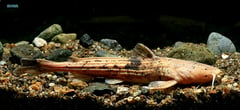
Acrochordonichthys septentrionalisMae Klong Chameleon Catfish
Akysidae · Ng & Ng, 2001
The Mae Klong chameleon catfish, Acrochordonichthys septentrionalis, is an akysid from western Thailand, possibly endemic to the Mae Klong drainage. It differs from other members of the A. ischnosoma group in its almost uniformly cream body with a few small brown spots, though colouration in the genus is variable. Like its congeners it can secrete a milky substance from the axillary pore when stressed, and this can quickly kill other fishes in an aquarium.
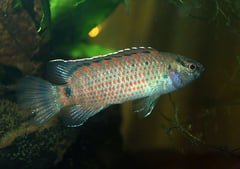
Badis khwae
Badidae · Kullander & Britz, 2002
Badis khwae is a badid that appears to be endemic to the Khwae Noi River basin in western Thailand, close to the border with Myanmar. It is most easily confused with B. ruber and B. siamensis, but lacks the rows of dark spot-like markings both have on the flanks. Its restricted range means it is unlikely ever to be available in large numbers. It lives in small forest streams with sluggish to moderate flow, usually in marginal areas or still pools.
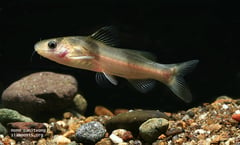
Batasio tigrinus
Bagridae · Ng & Kottelat, 2001
Batasio tigrinus is a small bagrid catfish that appears endemic to the Khwae Noi basin, often called the River Kwai, in western Thailand. The Khwae Noi is part of the larger Mae Klong watershed. Like its congeners it is an obligate inhabitant of shallow, fast-flowing, highly-oxygenated headwater streams, and it is largely unsuitable for the 'general' community aquarium.
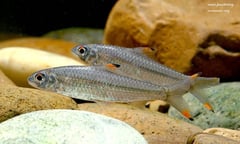
Discherodontus halei
Cyprinidae · Duncker, 1904
Discherodontus halei is a cyprinid with an apparently disjunct range: Pahang in Peninsular Malaysia, and the Mae Klong and Chao Phraya in Thailand. It inhabits clear, fast-flowing minor rivers and forest streams, and orange pigmentation in the dorsal and caudal fins helps separate it from congeners. Like others in the genus it is notoriously delicate and difficult to ship, losing scales very easily when removed from the water.

Microdevario kubotai
Cyprinidae · Kottelat & Witte, 1999
Microdevario kubotai is a miniature cyprinid from peninsular Thailand and the Salween drainage in southern Myanmar. Relatively common in the ornamental trade, it is sold under names including 'green neon rasbora' and 'yellow neon rasbora'. It apparently inhabits calm to moderately-flowing, well-oxygenated headwaters and minor tributaries. In nature it typically occurs in groups of 20-50, and at least 8-10 are recommended.
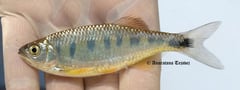
Opsarius signicaudus
Cyprinidae · Tejavej, 2012
Opsarius signicaudus is a cyprinid known only from headwater tributaries of the Mae Klong River in western Thailand. It inhabits well-oxygenated, moderate to fast-moving rivers and streams over gravel, cobbles and boulders, and is intolerant of organic wastes. A large, elongated blotch at the caudal-fin base helps separate it from congeners. It may have been exported for aquaria, though probably not under the correct name.
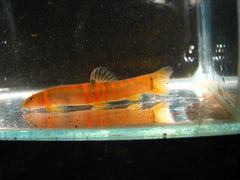
Schistura aurantiaca
Nemacheilidae · Plongsesthee, Page & Beamish, 2011
Schistura aurantiaca is a small nemacheilid loach known only from the Mae Khlong basin in Kanchanaburi Province, western Thailand. It is told apart from congeners solely by its colour pattern of 3-9 vertical orange bars on each flank. It inhabits riffles in clear, well-oxygenated headwater streams shaded by forest, and is possibly exported alongside similar-looking species such as S. cf. balteata.

Channa micropeltesGiant Snakehead
Channidae · Cuvier, 1831
The giant snakehead, Channa micropeltes, is a predatory fish from Southeast Asia that grows to well over a metre. Juveniles are sold as 'red' or 'redline' snakehead, but it is suitable only for public installations or the very largest private aquaria. Unlike most Channa species it is pelagic and needs plenty of room to swim, and adults become aggressive at sexual maturity.
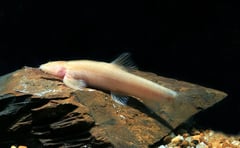
Nemacheilus troglocataractus
Nemacheilidae · Kottelat & Géry, 1989
Nemacheilus troglocataractus is a blind cave loach known only from the Tham Sai Yok Noi cave system in Kanchanaburi Province, Thailand. Most specimens have no externally visible eyes and all are entirely depigmented. It is protected by Thai law and illegal to remove from its habitat, so the profile includes it for interest only.