Batasio tigrinus
Last revised 2012Edit this page
On this page12 sections
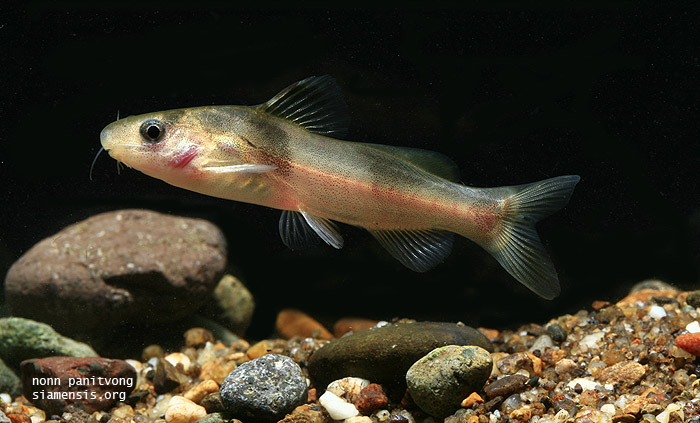
Quick factsEdit
Difficulty6 of 8 measures
- Space
- large tank
- Water
- needs a steady pH
- Temp
- needs cool water
- Diet
- unknown
- Temperament
- unknown
- Social
- needs to be in a group
- Compatibility
- fine with others
Other demands
Each of these can raise the rating on its own, whatever the measures above say.
- Hardiness
- needs a well-established tank
Batasio tigrinus is a small bagrid catfish that appears endemic to the Khwae Noi basin, often called the River Kwai, in western Thailand. The Khwae Noi is part of the larger Mae Klong watershed. Like its congeners it is an obligate inhabitant of shallow, fast-flowing, highly-oxygenated headwater streams, and it is largely unsuitable for the 'general' community aquarium.
Distribution
EditAppears endemic to the Mae Nam (river) Khwae Noi basin, often referred to as the River Kwai, with type locality between the settlements of Sangkhla Buri and Thong Pha Phum, Kanchanaburi province, western Thailand. The Khwae Noi is part of the larger Mae Klong watershed, merging with the Khwae Yai at the town of Kanchanaburi.
Habitat
Write a noteEditBatasio spp. are obligate inhabitants of headwater streams and the upper reaches of smaller rivers characterised by shallow, fast-flowing, highly-oxygenated stretches of riffles and runs broken up by pools or cascades in some cases.
Substrates are normally composed of smaller rocks, sand and gravel with jumbles of boulders or exposed bedrock, and while riparian/stream-side vegetation and patches of submerged leaf litter are common features aquatic plants aren't usually present. During periods of high rainfall some such streams may become temporarily turbid due to suspended material dislodged by increased (sometimes torrential) flow rate and water depth.
Aquarium size
Write a noteEditA tank with base dimensions of 120 ∗ 30 cm48 ∗ 12 in or equivalent should be the smallest considered.
Maintenance
Write a noteEditNot difficult to maintain under the correct conditions but largely unsuitable for the 'general' community aquarium. We recommend keeping it in a set-up designed to resemble a flowing river with a substrate of variably-sized rocks, gravel and some large water-worn boulders. This can be further furnished with driftwood branches, roots and tough aquatic plants such as Microsorum, Bolbitis or Anubias spp., which can be grown attached to the décor.
Like many species that naturally inhabit running waters it's intolerant to the accumulation of organic wastes and requires spotless water at all times in order to thrive. It's also essential to provide sufficient levels of dissolved oxygen and water movement using a combination of canister filters, powerheads, etc., particularly if the aim is for the fish to breed. Weekly water changes of 30-50% should also be considered mandatory.
Water conditions
EditThese recommendations come from this profile’s own figures. They contain affiliate links, so we may earn a commission.
Diet
Write a noteEditLikely to feed small aquatic crustaceans, worms, insect larvae and other zooplankton in nature, and the captive diet should therefore comprise largely of small live and/or frozen chironomid larvae (bloodworm), Tubifex, Artemia, mosquito larvae, etc. Some success has also been had using prepared, sinking foods though newly-imported wild specimens may refuse them initially.
Behaviour and compatibility
Write a noteEditNot especially competitive and should not be kept with much larger or more aggressive fishes. Suitably-sized, peaceful, schooling cyprinids are ideal, or if geography isn't an issue many characids and livebearers should also work. Akysid or sisorid catfishes from genera such as Erithistes, Erethistoides, Hara, Pseudolaguvia and many Glyptothorax spp. are recommended for the lower levels.
In addition, balitorid loaches from genera such as Gastromyzon, Pseudogastromyzon and Homaloptera are suitable, and some members of the families Cobitidae and Nemacheilidae should also be ok but proper research is essential as some can be excessively aggressive/territorial or simply grow too large.
Sexual dimorphism
Write a noteEditIn some congeners males are reported to possess a clearly visibly, elongate genital papilla anterior to the anal fin.
Reproduction
Write a noteEditSuccess has been achieved with at least two other members of the genus. Spawning can apparently be triggered by performing one or more large, 50-70%, water changes with cool water once the fish appear to be in spawning condition. The eggs are scattered randomly and take approximately 2 days to hatch.
Notes
EditMembers of the genus Batasio are characterised by the following combination of characters; laterally-compressed body shape; presence of large sensory pores on the head; a narrow mental region; a pair of prominent posterior processes on the anterior portion of the vomer; a transversely elongated, bar-like entopterygoid; metapterygoid in close contact with quadrate but not connected to the hyomandibular.
References
- Darshan, A. , N. Anganthoibi, and W. Vishwanath (2011). Batasio convexirostrum, a new species of catfish (Teleostei: Bagridae) from Koladyne basin, India. Zootaxa 2901, 52-58
Species images · 2
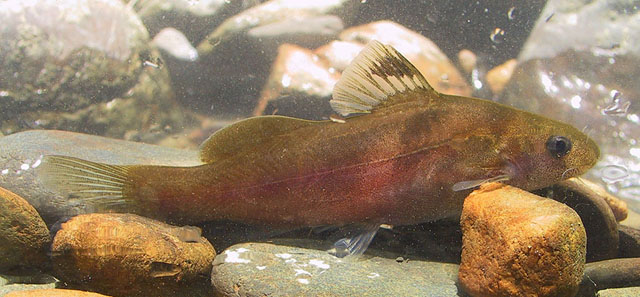
These photographs are used with each photographer's permission.
Send a photographDistribution
Profile completeness20 of 24
83% complete
Also missing: a common name, water condition notes, etymology.
Community
Questions about Batasio tigrinus?
Ask on Discord