River
Lupar
Only species with a profile on Seriously Fish are counted.
- Species
- 3
- Families
- 3
- Photographed
- 3 of 3
- Difficulty rated
- 3 of 3
Shares fishes withspecies recorded from both
Runs through
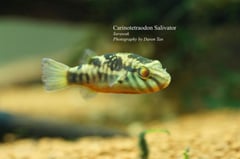
Carinotetraodon salivator
Tetraodontidae · Lim & Kottelat, 1995
Carinotetraodon salivator is a small red-eyed puffer known only from Sarawak, Borneo, in the Lupar, Sarawak and Rajang river systems. Sometimes traded as the 'striped redeye puffer' or 'zebra puffer', it has distinct dark bars on the head and body in both sexes, a colour pattern unique within the genus. Unlike most congeners, there is evidence that it prefers flowing water.
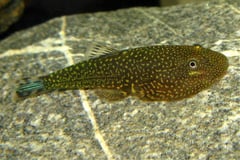
Gastromyzon stellatus
Gastromyzontidae · Tan, 2006
Gastromyzon stellatus is a hillstream loach from the Sarawak, Sadong and Lupar River drainages in southern Sarawak, Malaysian Borneo. Its dark brown head and body carry many small yellow spots. It forms a pair of cryptospecies with G. zebrinus and is often confused with it, since both show intermediate colour patterns. One of the more commonly-traded members of the genus, it usually arrives in mixed shipments labelled 'Borneo sucker' or 'Hong Kong pleco'.
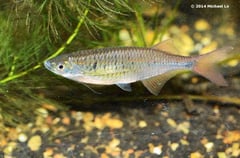
Nematabramis everetti
Cyprinidae · Boulenger, 1894
Nematabramis everetti is a cyprinid endemic to Borneo, known from Sarawak and Sabah plus East and North Kalimantan. It has a distinctive dark, vertically-elongate humeral marking, more prominent than in other Nematabramis species. Juveniles and subadults appear to favour fast-moving water, while adults are found in deeper, slower stretches of minor tributaries.