River
Mentaya
Only species with a profile on Seriously Fish are counted.
- Species
- 7
- Families
- 2
- Photographed
- 7 of 7
- Difficulty rated
- 7 of 7
Shares fishes withspecies recorded from both
Runs through

Belontia hasseltiJava Combtail
Osphronemidae · (Cuvier, 1831)
The Java combtail, Belontia hasselti, is a labyrinth fish from peninsular Thailand, Peninsular Malaysia, Singapore, Sumatra, Borneo and Java. Also known as the 'Malay combtail', it mostly inhabits acidic forest peat swamps with little water movement. It differs from its only congener, B. signata, in its brownish grey body and the mosaic pattern in its unpaired fins. Growing to 200 mm SL, it will eat very small fishes and is not recommended for the average community aquarium.

Betta foerschi
Osphronemidae · Vierke, 1979
Betta foerschi is a paternal mouthbrooding labyrinth fish from a handful of localities in Central and West Kalimantan, Indonesian Borneo. It lends its name to the B. foerschi group, whose members have iridescent blue or green unpaired fins and two reddish-yellow bars on the opercle. Fish traded as B. foerschi are often the closely-related B. mandor, and the two can be difficult to tell apart.
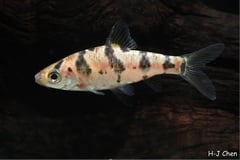
Desmopuntius foerschi
Cyprinidae · (Kottelat, 1982)
Sometimes traded as the 'boomerang barb' or 'Foersch's fire barb', Desmopuntius foerschi is a cyprinid from East and Central Kalimantan, Borneo. Extra dark blotches between the second, third and fourth vertical bars, and a mark at the rear of the dorsal-fin base, set it apart from other vertically-striped congeners. It probably inhabits peat swamps and associated blackwater streams, and information on its range is scarce.
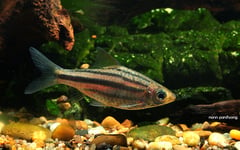
Desmopuntius johorensisStriped Barb
Cyprinidae · (Duncker, 1904)
The striped barb, Desmopuntius johorensis, is a cyprinid from southern Thailand, Peninsular Malaysia, Singapore, Sumatra and Borneo. Juveniles have 4 dark vertical bars and develop 5 or 6 broad lateral stripes as they grow, a pattern change shared with D. gemellus and D. trifasciatus. Before Kottelat (1992) it was referred to as Puntius eugrammus, while the name 'Puntius johorensis' was misapplied to D. hexazona. It lives mainly in peat swamps and black water streams.
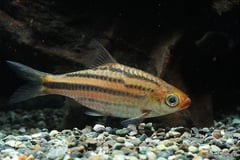
Desmopuntius trifasciatus
Cyprinidae · (Kottelat, 1996)
Desmopuntius trifasciatus is a cyprinid from Borneo, described from the Kapuas basin in West Kalimantan and also known from southern Sarawak. Like D. gemellus and D. johorensis, juveniles have 4 dark vertical bars, and fish over 40 mm have 3 or 4 broad lateral stripes, the central one broadest. It may also be confused with Striuntius lineatus.

Sphaerichthys acrostomaGiant Chocolate Gourami
Osphronemidae · Vierke, 1979
The giant chocolate gourami, Sphaerichthys acrostoma, is a small gourami known only from the Mentaya River drainage in Indonesian Borneo. It is far from common in the hobby and is traded under several other names, including 'sharp-nosed gourami'. Its colour pattern sets it apart from the other members of the genus. A paternal mouthbrooder, it chiefly inhabits peat swamps and associated black water streams.

Sphaerichthys selatanensisCrossband Chocolate Gourami
Osphronemidae · Vierke, 1979
The crossband chocolate gourami, Sphaerichthys selatanensis, is a small labyrinth fish from southern Borneo, Indonesia. It probably inhabits peat swamps and associated black water streams, and is only occasionally seen in the hobby, sometimes sold as 'cherry chocolate gourami'. Originally described as a subspecies of S. osphromenoides, it differs in fin-ray counts and an additional light vertical bar on each flank.