River
Mahakam
Only species with a profile on Seriously Fish are counted.
- Species
- 21
- Families
- 7
- Photographed
- 21 of 21
- Difficulty rated
- 21 of 21
Shares fishes withspecies recorded from both
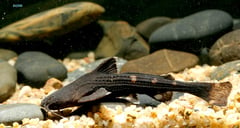
Acrochordonichthys rugosusAsian Banjo Catfish
Akysidae · Bleeker, 1846
The Asian banjo catfish, Acrochordonichthys rugosus, is an akysid catfish from Java, Sumatra, Borneo, Peninsular Malaysia and southern Thailand. The most commonly encountered member of the genus in the trade, it is still by no means common, and body colouration varies widely even among fish from a single locality. Like its congeners it can secrete a milky substance from the axillary pore when stressed, and this can quickly kill other fishes in the confines of an aquarium.

Barbonymus schwanefeldiiTinfoil barb
Cyprinidae · Bleeker, 1854
The tinfoil barb, Barbonymus schwanefeldii, is a large cyprinid found across much of Southeast Asia, from the Mekong to Borneo and Sumatra. Usually sold at 50 to 75 mm, it grows to 355 mm SL, and tinfoil barbs are among the species most often returned to shops having outgrown their aquarium. Selectively-bred 'golden' and 'blushing' strains exist, and the species has also been subjected to artificial dyeing.

Betta balunga
Osphronemidae · Herre, 1940
Betta balunga is a mouthbrooding labyrinth fish from Borneo, found from Tawau in Sabah, Malaysia, south to the Sebuku and Mahakam basins in Indonesia. A member of the Betta akarensis group, it has a reddish-orange iris in life. In the Sebuku it lives in very shallow forest streams among roots and leaf litter, and in the Mahakam basin in sluggish blackwater streams among submerged marginal vegetation.

Betta channoidesSnakehead Betta
Osphronemidae · Kottelat & Ng, 1994
The snakehead betta, Betta channoides, is a small mouthbrooding labyrinth fish from the Mahakam basin in East Kalimantan, Indonesian Borneo. It inhabits shallow forest streams with brownish, acidic water, among leaf litter and marginal plant roots. With the very similar B. albimarginata it forms the Betta albimarginata group, and displaying males are scarlet, with an almost entirely red dorsal fin edged by a thin white band.

Betta unimaculata
Osphronemidae · Popta, 1905
Betta unimaculata is a large mouthbrooding labyrinth fish from the upper Kayan and Mahakam river drainages in East Kalimantan, Borneo, Indonesia. Growing to around 115 mm SL, it has been collected from clear, flowing streams, elevated headwater pools and more turbid forest streams. Populations differ in colour and pattern and will hybridise, so they are labelled by locality and should never be kept together. Fish from 'Tawau' once thought to be this species have been described as B. ocellata.

Channa luciusForest Snakehead
Channidae · Cuvier, 1831
The forest snakehead, Channa lucius, is a predatory snakehead from Indochina, Peninsular Malaysia and the Greater Sunda Islands. Also referred to as the 'splendid' or 'shiny' snakehead, it occurs on Sumatra, Borneo and Java, grows to 400 mm SL and favours forest swamps and tributaries. Like others in the genus it breathes atmospheric air, and it needs a dimly-lit tank with plenty of cover and a tightly-fitting lid, since Channa spp. are notorious for their ability to escape.
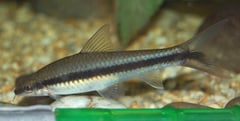
Crossocheilus nigriloba
Cyprinidae · Popta, 1904
Crossocheilus nigriloba is a cyprinid endemic to Borneo, known from the Kapuas, Belayan and Mahakam rivers in Indonesian Kalimantan. Rarely seen, it is among the near-identical congeners traded as 'Siamese algae-eater' or 'SAE' but is simple to identify: the lower caudal-fin lobe carries dark pigment suffused with red, which gave rise to the trade name 'penguin flying fox'. The lateral stripe breaks into blotches when the fish are sparring, stressed or sleeping.
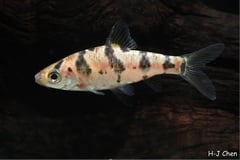
Desmopuntius foerschi
Cyprinidae · Kottelat, 1982
Sometimes traded as the 'boomerang barb' or 'Foersch's fire barb', Desmopuntius foerschi is a cyprinid from East and Central Kalimantan, Borneo. Extra dark blotches between the second, third and fourth vertical bars, and a mark at the rear of the dorsal-fin base, set it apart from other vertically-striped congeners. It probably inhabits peat swamps and associated blackwater streams, and information on its range is scarce.
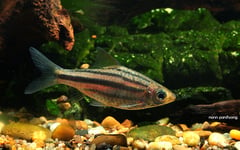
Desmopuntius johorensisStriped Barb
Cyprinidae · Duncker, 1904
The striped barb, Desmopuntius johorensis, is a cyprinid from southern Thailand, Peninsular Malaysia, Singapore, Sumatra and Borneo. Juveniles have 4 dark vertical bars and develop 5 or 6 broad lateral stripes as they grow, a pattern change shared with D. gemellus and D. trifasciatus. Before Kottelat (1992) it was referred to as Puntius eugrammus, while the name 'Puntius johorensis' was misapplied to D. hexazona. It lives mainly in peat swamps and black water streams.

Helostoma temminkiiKissing Gourami
Helostomatidae · Cuvier, 1829
The kissing gourami, Helostoma temminkii, is an anabantoid from southern Indochina and the Malay Archipelago, and the sole member of its family. The widely traded pinkish-white form is a leucistic variant bred for ornamental purposes, and the 'balloon' variety is intentionally disfigured and much shorter-lived. Its often belligerent behaviour, adult size and life span of over 20 years make it unsuitable for most home aquaria. The 'kissing' appears at least in part related to establishing social dominance.
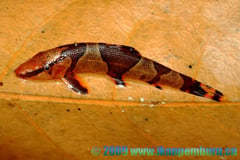
Homaloptera orthogoniataSaddle-back Loach
Balitoridae · Vaillant, 1902
The saddle-back loach, Homaloptera orthogoniata, is a 'lizard' loach endemic to Borneo, known from rivers in Sarawak and Kalimantan. It was historically said to occur across much of Indochina. It is rare in the hobby, and most images online and in the literature show H. confuzona or H. parclitella. It always has three large, saddle-shaped markings on the back, the third between the dorsal and caudal fins.
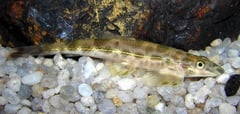
Homalopteroides stephensoni
Balitoridae · Hora, 1932
Homalopteroides stephensoni is a hillstream loach from Borneo, recorded from Kalimantan in Indonesia and from Sabah and Sarawak in Malaysia. Poorly known in the aquarium hobby, it may never have been exported for the ornamental trade. Originally described in Homaloptera, it was placed in Balitoropsis by Kottelat (2012), who subsequently followed Randall and Page (2012) in treating it as a Homalopteroides. Like its congeners it inhabits swiftly-flowing, clear, oxygen-saturated streams.

Labiobarbus leptocheilus
Cyprinidae · Valenciennes, 1842
Labiobarbus leptocheilus is a large cyprinid widespread in Southeast Asia, from the Mekong and Salween to the Greater Sunda Islands. Different populations vary somewhat in appearance, and it may turn out to represent a group of closely-related species. The Cambodian Mekong population has been considered a distinct species, Labiobarbus lineatus, and that name is widely used in the ornamental trade although it is currently a synonym. It grows to 260 mm SL and needs spotless, well-oxygenated water.
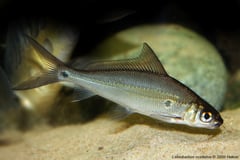
Labiobarbus ocellatus
Cyprinidae · Heckel, 1843
Labiobarbus ocellatus is a cyprinid from Peninsular Malaysia, Sumatra and Borneo, with a black spot on the shoulder and one on the caudal peduncle. It is occasionally available in the ornamental trade, typically under a name such as 'Bornean eye-spot silver shark' or the invalid scientific name Cirrhinus chinensis. A pelagic species of rivers and some lakes, it moves into seasonally inundated floodplains and forest during the wet season, and grows to 180 mm SL.
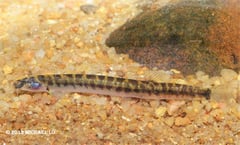
Pangio shelfordii
Cobitidae · Popta, 1903
Pangio shelfordii is a variably patterned kuhli loach from Peninsular Malaysia, Singapore, Sumatra and Borneo. Its patterning varies within and between populations, and as currently understood the species represents an assemblage containing a number of unidentified taxa. Some Sumatran and Bornean populations resemble P. piperata, which often occurs alongside it. It is exported occasionally, often as bycatch among shipments of congeners.
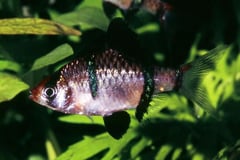
Puntigrus pulcher
Cyprinidae · Rendahl, 1922
Puntigrus pulcher is a small cyprinid endemic to the Indonesian part of eastern Borneo, with records from the Kayan and Mahakam rivers. Considered a synonym of P. anchisporus for decades following Alfred (1963), it was revalidated by Kottelat and Tan (2011). It has an incomplete lateral line, an entirely black dorsal fin and black pelvic fins, and occasionally appears in the hobby, though the trade relies largely on commercially-produced 'tiger barbs'.

Macrochirichthys macrochirusGiant Sword Minnow
Cyprinidae · Valenciennes, 1844
The giant sword minnow, Macrochirichthys macrochirus, is a large pelagic cyprinid widespread in Southeast Asia, from the Mekong to Borneo and Sumatra. Growing to 600 to 800 mm and becoming increasingly piscivorous as it grows, it is unsuitable for the majority of private aquaria, although juveniles are traded on occasion. It is thought to have been extirpated from the Chao Phraya, Mae Klong, Lake Songkhla and Java, and the Mekong populations have been drastically reduced.
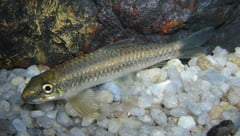
Garra borneensis
Cyprinidae · Vaillant, 1902
Garra borneensis is a cyprinid endemic to northern and western Borneo, in Kalimantan, Brunei, Sabah and Sarawak. No other member of the genus is known from the island. An obligate dweller of swiftly-flowing streams and headwaters, it lives in clear, oxygen-saturated water over gravel, rocks and bedrock carpeted with biofilm.
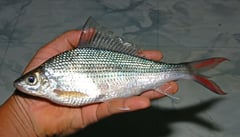
Labiobarbus fasciatus
Cyprinidae · Bleeker, 1853
Labiobarbus fasciatus is a labeonin cyprinid from the Pahang River system in Peninsular Malaysia and the islands of Sumatra and Borneo. It has a red caudal fin with a thin dark stripe along each lobe, and longitudinal stripes formed by spots on the scales. Like other Labiobarbus it has two pairs of well-developed barbels and an extremely long dorsal fin, and the genus was known as Dangila for over 100 years.
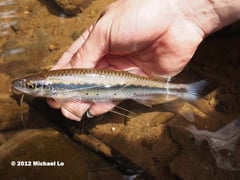
Luciosoma pellegrinii
Cyprinidae · Popta, 1905
Luciosoma pellegrinii is a slender, pike-like cyprinid endemic to Borneo, ranging from the Kapuas in West Kalimantan to Sabah. It is scarcely known in the aquarium trade because it comes from an area where very few commercial collections take place, but its name is misapplied on a regular basis. It has 4 to 8 distinct dark spots on the lateral line and appears to develop longer pelvic-fin filaments than any other member of the genus.
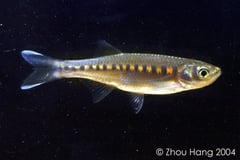
Luciosoma spilopleura
Cyprinidae · Bleeker, 1855
Luciosoma spilopleura is a small cyprinid known only from Sumatra and the Indonesian part of Borneo, where it prefers fast-flowing headwater streams. The species is poorly known and is not present in the ornamental trade, although its name has been widely misapplied to other Luciosoma species for decades. The largest known specimen measured 81.9 mm, so it appears to grow much smaller than its congeners.