River
Pa Sak
Only species with a profile on Seriously Fish are counted.
- Species
- 4
- Families
- 3
- Photographed
- 4 of 4
- Difficulty rated
- 4 of 4
Basin
Also in the Chao Phraya basinspecies recorded from both
Shares fishes with rivers elsewherespecies recorded from both
Runs through

Lobocheilos melanotaenia
Cyprinidae · (Fowler, 1935)
Lobocheilos melanotaenia is a grazing cyprinid from the Mekong in Laos, Thailand, Cambodia and Vietnam, plus the Dong Nai, Chao Phraya and Mae Klong. One of the most abundant species in the seasonal cyprinid migrations of the mainstream Mekong, it is available on a sporadic basis. It is told from L. rhabdoura by its deeper body, narrower mouth and a dark area in the dorsal-fin. It can be aggressive at feeding times and is not particularly tolerant of conspecifics.
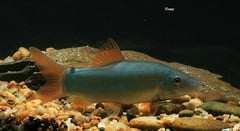
Yasuhikotakia modestaRedtail Loach
Botiidae · (Bleeker, 1864)
The redtail loach, Yasuhikotakia modesta, is a botiid loach from the middle and lower Mekong and the Chao Phraya and Mae Klong drainages of Thailand. One of the more commonly encountered botiids in the hobby, it is also sold as 'blue', 'orange-finned' or 'red-finned' botia. Some fish are dyed and sold as 'blueberry' or 'raspberry' loach, and their health is normally compromised by the process. Deeper-bodied than the similar Y. lecontei, it grows to 250 mm and needs an aquarium with a base of at least 150 ∗ 45 cm.

Channa micropeltesGiant Snakehead
Channidae · (Cuvier, 1831)
The giant snakehead, Channa micropeltes, is a predatory fish from Southeast Asia that grows to well over a metre. Juveniles are sold as 'red' or 'redline' snakehead, but it is suitable only for public installations or the very largest private aquaria. Unlike most Channa species it is pelagic and needs plenty of room to swim, and adults become aggressive at sexual maturity.

Gymnostomus lineatus
Cyprinidae · (Smith, 1945)
Gymnostomus lineatus is a riverine cyprinid from the middle to lower Mekong basin and the Chao Phraya, in China, Laos, Thailand and Cambodia. It is most often collected in mid-to-large channels, although in the Mekong basin it also enters smaller tributaries and inundated fields. It has a pair of small maxillary barbels and 5-6 faint, thin stripes along each flank, and has been placed in Henicorhynchus, Cirrhinus, Bangana and Labeo in the last few decades.