River
Xe Bang Fai
Only species with a profile on Seriously Fish are counted.
- Species
- 27
- Families
- 8
- Photographed
- 27 of 27
- Difficulty rated
- 27 of 27
Basin
Also in the Mekong basinspecies recorded from both
Shares fishes with rivers elsewherespecies recorded from both
Runs through

Akysis variusVariable Stream Catfish
Akysidae · Ng & Kottelat, 1998
The variable stream catfish, Akysis varius, is a small akysid catfish from the Mekong drainage in Laos, Thailand and Cambodia. The number of serrations on its pectoral spine varies, and in contrast to other Akysis with serrated spines, the larger specimens examined had fewer or none. Members of the genus live almost exclusively in swiftly flowing streams and rivers over sand, gravel and rocks.

Barbodes aurotaeniatus
Cyprinidae · (Tirant, 1885)
Barbodes aurotaeniatus is a small cyprinid from the middle and lower Mekong basin in Laos, Vietnam, Cambodia and Thailand. Uncommon in the aquarium trade, it has a single pair of maxillary barbels, lacking the rostral barbels of other Barbodes, and usually four small vertical black markings on the flanks. It inhabits streams, irrigation canals and ditches, and is apparently very peaceful, best kept in a mixed-sex group of 6 to 10.

Barbonymus gonionotus
Cyprinidae · (Bleeker, 1849)
Barbonymus gonionotus is a large cyprinid with an enormous distribution across Southeast Asia, from the Mekong to Java and Sumatra. It inhabits larger, slow-moving rivers and their floodplains, moving into flooded forest to feed and spawn, and is increasingly found in man-made canals and lakes. Plain grey caudal and dorsal fins and pale yellow pelvic and anal fins separate it from congeners. Populations in Peninsular Malaysia appear to be introduced.

Channa gachuaDwarf Snakehead
Channidae · (Hamilton, 1822)
The dwarf snakehead, Channa gachua, is a snakehead recorded across an enormous range from Iran to Taiwan and Bali. There is significant evidence that C. gachua as currently understood is a complex of similar-looking species in need of taxonomic review. A mouthbrooder bred regularly in captivity, it can share a well-chosen community with peaceful fishes too large to be prey, but populations should not be mixed as some may hybridise.

Crossocheilus reticulatus
Cyprinidae · (Fowler, 1934)
Usually offered as the reticulated or fishnet flying fox, Crossocheilus reticulatus is a cyprinid from the Chao Phraya and Mekong basins. A silvery body, dark-edged scales and a dark caudal peduncle blotch set it apart from similar congeners. Patterning varies with collection locality, which led to several names now treated as synonyms. A fish of flowing streams, it is best kept in a group of six or more, since weaker individuals can be bullied in smaller numbers.

Datnioides undecimradiatusMekong Tiger Perch
Datnioididae · (Roberts & Kottelat, 1994)
The Mekong tiger perch, Datnioides undecimradiatus, is known only from the middle and lower Mekong basin in Thailand, Laos, Cambodia and Vietnam. An efficient, largely piscivorous predator of large, deep lowland rivers, it is marked with 4 relatively thin dark bars. The names 'Siamese tiger fish' and 'gold datnoid' are sometimes applied to it, but more typically belong to D. pulcher.

Epalzeorhynchos frenatumRainbow Shark
Cyprinidae · (Fowler, 1934)
The rainbow shark, Epalzeorhynchos frenatum, is a cyprinid reportedly native to Thailand, Laos and Cambodia. Recorded from the Mae Klong, Chao Phraya and Mekong basins, many of its wild populations have dwindled or vanished, and large numbers are farmed for the trade, including an albino and an anerythristic form sometimes misidentified as E. munense. It becomes increasingly territorial as it grows and can live for over 15 years.

Epalzeorhynchos munense
Cyprinidae · (Smith, 1934)
Epalzeorhynchos munense is a cyprinid from the Mun river and other tributaries of the middle Mekong in Thailand and Laos. It resembles E. bicolor and E. frenatum but has a black head, body and anal fin, red caudal and dorsal fins, and black margins on the pelvic and pectoral fins. A record from the Tonlé Sap system may refer to E. frenatum.

Esomus metallicusStriped Flying Barb
Cyprinidae · Ahl, 1923
The striped flying barb, Esomus metallicus, is a cyprinid found from the Salween basin in Myanmar east across Thailand to Laos and Cambodia. It is abundant over most of this range and moves into rice paddies and other flooded ground at the onset of the wet season, returning to permanent water when the flooding recedes. Its lateral stripe grows more intense towards the tail and ends at the caudal-fin base.

Garra fasciacauda
Cyprinidae · Fowler, 1937
Garra fasciacauda is a cyprinid native to the Mekong river system in Thailand, Laos, Vietnam and Cambodia, including the Tonlé Sap basin. It has a black submarginal stripe on both caudal lobes and a plain dorsal fin. It inhabits swiftly-flowing water and migrates seasonally, with many fish moving from the Tonlé Sap system to the Khone Falls in the dry season.

Hypsibarbus vernayi
Cyprinidae · (Norman, 1925)
Hypsibarbus vernayi is a cyprinid widespread in mainland Southeast Asia, from the Mekong basin in southern China to northern Peninsular Malaysia. Very similar to H. wetmorei, it has yellow pectoral, pelvic and anal fins (orange to red in H. wetmorei), so yellow-finned fish sold as H. wetmorei or 'lemon fin barb' appear likely to be this species. It prefers flowing water with abundant riparian vegetation and migrates seasonally.

Labiobarbus leptocheilus
Cyprinidae · (Valenciennes, 1842)
Labiobarbus leptocheilus is a large cyprinid widespread in Southeast Asia, from the Mekong and Salween to the Greater Sunda Islands. Different populations vary somewhat in appearance, and it may turn out to represent a group of closely-related species. The Cambodian Mekong population has been considered a distinct species, Labiobarbus lineatus, and that name is widely used in the ornamental trade although it is currently a synonym. It grows to 260 mm SL and needs spotless, well-oxygenated water.

Lobocheilos melanotaenia
Cyprinidae · (Fowler, 1935)
Lobocheilos melanotaenia is a grazing cyprinid from the Mekong in Laos, Thailand, Cambodia and Vietnam, plus the Dong Nai, Chao Phraya and Mae Klong. One of the most abundant species in the seasonal cyprinid migrations of the mainstream Mekong, it is available on a sporadic basis. It is told from L. rhabdoura by its deeper body, narrower mouth and a dark area in the dorsal-fin. It can be aggressive at feeding times and is not particularly tolerant of conspecifics.

Mystacoleucus greenwayi
Cyprinidae · Pellegrin & Fang, 1940
Mystacoleucus greenwayi is a riverine cyprinid from the middle Mekong basin in Thailand and Laos and the Chao Phraya watershed. It favours clear, well-oxygenated running water over sand or gravel, often in rock and boulder-filled headwater streams. A schooling fish, it should be kept in a group of six or more alongside similarly-sized cyprinids, loaches and other riverine fishes, and like all Mystacoleucus it has a forward-pointing predorsal spine that can snag in a net.

Opsarius koratensis
Cyprinidae · (Smith, 1931)
Opsarius koratensis is a cyprinid of the middle and lower Mekong in Thailand, Laos and Cambodia, and the Chao Phraya, Mae Klong and Dong Nai systems. It apparently inhabits larger, deeper and more turbid rivers than many congeners. Genetic evidence from Tang et al. (2010) suggests it may represent a distinct genus, and it occasionally appears in the ornamental trade.

Opsarius pulchellus
Cyprinidae · (Smith, 1931)
Traded as 'butterfly barb' or 'mackerel barb', Opsarius pulchellus is a cyprinid from the Chao Phraya and mid-to-lower Mekong basins. It occurs in Thailand, Laos, Cambodia and Vietnam, typically in submontane headwaters and fast-flowing minor rivers and streams. Also sold as 'royal opsarius', it carries 7-10 elongate vertical bars on each flank, and like its congeners is too fast and vigorous a feeder for the general community.
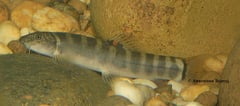
Schistura nicholsi
Nemacheilidae · (Smith, 1933)
Schistura nicholsi is a nemacheilid loach widespread in the Mekong basin in Laos and Thailand, and it may also occur in Cambodia. It is sometimes traded for aquaria, but its name also appears to have been widely misapplied to other fishes. It has 8-10 quite regular dark bars wider than the light interspaces. It has been bred in an aquarium, although the adults seem to consume both eggs and fry.
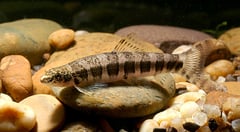
Serpenticobitis zonata
Serpenticobitidae · Kottelat, 1998
Serpenticobitis zonata is a small loach from the Xe Bangfai and Xe Bang Hiang drainages in Laos, and Chanthaburi province in south-eastern Thailand. Fish sold under this name are sporadically available, but the majority appear to be the congener S. octozona. S. zonata has a pale body with 7-8 regular dark vertical bars, sometimes with thin dark bars on the interspaces. It inhabits shallow, fast-flowing, highly-oxygenated headwaters and minor tributaries.

Bagarius yarrelliGoonch
Sisoridae · Sykes, 1839
The goonch, Bagarius yarrelli, is a very large sisorid catfish recorded from the Indus in Pakistan east through Indochina to Sumatra and Borneo. Also known as the 'giant devil catfish' and 'sand shark', it reaches 1300 to 2000 mm and is fished for food across much of its range. That wide distribution appears doubtful, and Indian and Southeast Asian populations may prove not to be conspecific. It lives among boulders in the fast, turbulent rapids of large rivers.

Channa micropeltesGiant Snakehead
Channidae · (Cuvier, 1831)
The giant snakehead, Channa micropeltes, is a predatory fish from Southeast Asia that grows to well over a metre. Juveniles are sold as 'red' or 'redline' snakehead, but it is suitable only for public installations or the very largest private aquaria. Unlike most Channa species it is pelagic and needs plenty of room to swim, and adults become aggressive at sexual maturity.

Chitala blanciRoyal Featherback
Notopteridae · (d'Aubenton, 1965)
The royal featherback, Chitala blanci, is a very large notopterid endemic to the Mekong drainage in Laos, Thailand, Vietnam and Cambodia. Also sold as the 'royal knifefish', it reaches 1200 mm SL and arguably has no place in the ornamental hobby, being suitable only for public installations or the very largest private aquaria. Many small dark spots on the front of the body merge into oblique stripes, and it is thought to be threatened by dam construction.

Datnioides pulcherSiamese Tiger Perch
Datnioididae · (Kottelat, 1998)
The Siamese tiger perch, Datnioides pulcher, is a large tiger perch from the Mae Klong, Chao Phraya, Mekong and Dong Nai river systems. Wild populations are hypothesised to have declined by more than 90% since the mid-1980s, and it has been locally extinct in Thailand since the 1990s. Highly sought after by aquarists, it usually has 4 broad dark bars, and D. microlepis is sometimes sold as D. pulcher to raise prices.

Hampala macrolepidotaHampala Barb
Cyprinidae · Kuhl & van Hasselt, 1823
The hampala barb, Hampala macrolepidota, is a cyprinid ranging from Myanmar through Thailand to the Mekong, and south to Borneo, Sumatra and Java. Also known as 'jungle perch' or 'sidebar barb', it can grow to over 2 feet and 5 kg and is a powerful, pelagic predator and not an aquarium subject in all but the most extreme circumstances. Prized as a food and sport fish, it has been introduced to numerous water bodies.

Labeo chrysophekadionBlack Shark
Cyprinidae · (Bleeker, 1849)
The black shark, Labeo chrysophekadion, is a large cyprinid from Southeast Asia, including the Mekong, Chao Phraya and the Greater Sunda Islands. Also known as the black sharkminnow, it reaches 600 mm and is aggressively territorial towards conspecifics and similarly-shaped fishes. It continues to be sold despite its patent unsuitability for the home aquarium, and an albino form has been selectively bred for the trade.

Mekongina erythrospila
Cyprinidae · Fowler, 1937
Mekongina erythrospila is a large cyprinid endemic to the middle and lower Mekong River system in Laos, Thailand, Cambodia and Vietnam. It tends to inhabit medium to large river channels with fast-flowing water and rocky beds. Occasionally in the ornamental trade, it grows to 400 to 450 mm and is unsuitable for most private aquaria. It can be aggressively territorial towards conspecifics and similarly-shaped fishes.

Gymnostomus lineatus
Cyprinidae · (Smith, 1945)
Gymnostomus lineatus is a riverine cyprinid from the middle to lower Mekong basin and the Chao Phraya, in China, Laos, Thailand and Cambodia. It is most often collected in mid-to-large channels, although in the Mekong basin it also enters smaller tributaries and inundated fields. It has a pair of small maxillary barbels and 5-6 faint, thin stripes along each flank, and has been placed in Henicorhynchus, Cirrhinus, Bangana and Labeo in the last few decades.

Mystacoleucus atridorsalis
Cyprinidae · Fowler, 1937
Mystacoleucus atridorsalis is a pelagic cyprinid considered endemic to the lower Mekong basin in Laos, Thailand and Cambodia. It favours flowing lowland river channels and moves into flooded forest during the wet season. A triangular blotch at the tip of the dorsal fin helps separate it from congeners, and like all Mystacoleucus it has a forward-pointing predorsal spine that can become entangled in an aquarium net.