River
Periyar
Only species with a profile on Seriously Fish are counted.
- Species
- 10
- Families
- 5
- Photographed
- 10 of 10
- Difficulty rated
- 10 of 10
Shares fishes withspecies recorded from both
Runs through

Barilius bakeri
Cyprinidae · Day, 1865
Barilius bakeri is a fast-swimming cyprinid endemic to the Western Ghats of southwestern India, with records from many rivers in Kerala and Karnataka. It is traded as 'royal danio', 'blue-spotted hill trout' and 'blue-dotted mirror fish', and has a single row of bluish-green spots that get smaller with age. Its well-oxygenated, fast-flowing rivers are being polluted and degraded by exotic species and sand mining.

Barilius gatensisMalabar Baril
Cyprinidae · (Valenciennes, 1844)
The Malabar baril, Barilius gatensis, is a cyprinid endemic to the Western Ghats of southern India, in Karnataka, Kerala and Tamil Nadu. Occasionally seen in the trade, it has 13 to 15 dark blue vertical bars that often almost break up in adults. It inhabits well-oxygenated, fast-flowing rivers and streams, apparently favouring slower runs and pools, and its speed and vigorous feeding make it unsuitable for the general community.
Bhavania australis
Balitoridae · (Jerdon, 1849)
Bhavania australis is a balitorid loach endemic to the Western Ghats mountains of southern India, recorded from Kerala, Tamil Nadu and Karnataka. An obligate dweller of shallow, fast-flowing, highly-oxygenated headwaters and minor tributaries, it has a flattened head and body and horizontally extended paired fins that form a powerful sucking cup for clinging to rocks. It is very rarely seen in the international aquarium trade but is maintained by a number of Indian aquarists.

Laubuka fasciataMalabar Hatchet Chela
Cyprinidae · (Silas, 1958)
The Malabar hatchet chela, Laubuka fasciata, is a cyprinid endemic to the state of Kerala in southwestern India. A dark stripe runs from the eye to the caudal peduncle, and it favours slow-moving, shallow margins of rivers and streams over rock and gravel. It is occasionally available in the aquarium trade, apparently collected only in small numbers, and is an accomplished jumper.
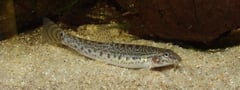
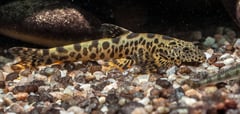
Lepidocephalichthys thermalis
Cobitidae · (Valenciennes, 1846)
Lepidocephalichthys thermalis is a cobitid loach from Sri Lanka and Peninsular India, described from the hot waters of Cania, Sri Lanka. Available sporadically, it makes an excellent choice for those new to keeping loaches. Unlike most of the genus it shows a preference for headwaters and clear, flowing streams. It was for a number of years included in Lepidocephalus until Havird and Page (2010) placed it in Lepidocephalichthys.

Pseudetroplus maculatusOrange Chromide
Cichlidae · (Bloch, 1795)
The orange chromide, Pseudetroplus maculatus, is a euryhaline cichlid native to peninsular India and Sri Lanka. It mostly inhabits brackish estuaries, coastal lagoons and the lower reaches of rivers, and can be kept in fresh or brackish water so long as acidic conditions are avoided. Wild examples are rarely seen in the hobby, where selectively bred strains traded as 'red' or 'yellow' chromide are widely available.

Pseudosphromenus dayiBrown Spike-tailed Paradise Fish
Osphronemidae · (Engman, 1909)
The brown spike-tailed paradise fish, Pseudosphromenus dayi, is a small labyrinth fish from coastal drainages of the Western Ghats in Kerala, India. It is known only from the Chalakkudy, Muvattupuzha and Periyar rivers, though it may be more widely distributed. Two dark, irregular lateral stripes on the head and body, and a more extended caudal fin in males, separate it from its only congener, P. cupanus. A secretive bubble nester, it is peaceful but small and timid.

Puntius mahecola
Cyprinidae · (Valenciennes, 1844)
Puntius mahecola is a cyprinid from rivers draining much of the Western Ghats mountains in Kerala, Karnataka and Tamil Nadu states, southern India. The name was misapplied to members of Dawkinsia for over a century, while the fish itself was widely misidentified as P. amphibius. A relatively plain fish, it has a single dark blotch on the caudal peduncle behind the anal fin. D. assimilis and other Dawkinsia species appear on trade lists as 'mahecola barb'.

Garra hughiCardamom Garra
Cyprinidae · Silas, 1955
The Cardamom garra (Garra hughi) is a cyprinid from the Anamalai, Cardamom, Palani and Ashambu Hills of the Western Ghats, southern India. It appears occasionally in the ornamental trade, where it may be labelled 'chocolate algae eater'. The flanks are grey and the belly yellowish-white, with a conspicuous dark lateral band running to the caudal-fin base. It inhabits swiftly-flowing headwaters and tributaries.

Garra surendranathanii
Cyprinidae · Shaji, Arun & Easa, 1996
Garra surendranathanii is a cyprinid known only from the Chalakkudy, Periyar and Pamba river basins in Kerala, southwestern India. It has appeared in the aquarium trade on a handful of occasions, marketed as 'green algae-eater'. The body is elongate and shallow, with black-edged scales and a black spot at the upper extremity of the opercle. It grows to around 150 mm SL.