River
Sadong
Only species with a profile on Seriously Fish are counted.
- Species
- 8
- Families
- 5
- Photographed
- 8 of 8
- Difficulty rated
- 8 of 8
Shares fishes withspecies recorded from both
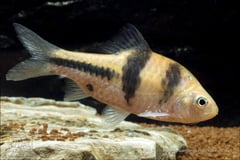
Barbodes lateristrigaSpanner Barb
Cyprinidae · Valenciennes, 1842
The spanner barb or 'T-barb', Barbodes lateristriga, is a cyprinid from peninsular Thailand, Peninsular Malaysia, Singapore, Sumatra and Java. Its colour pattern varies with locality, and the form most commonly seen in the trade corresponds most closely to fish from Johor. The species may prove to be a complex of closely-related taxa. Quite boisterous, it can intimidate more timid species with its size and activity, especially at feeding times.
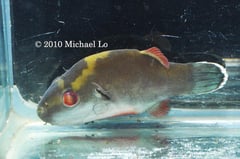
Carinotetraodon borneensis
Tetraodontidae · Regan, 1903
Carinotetraodon borneensis is a small red-eyed puffer known only from southern Sarawak, Malaysia (Borneo), in the Sarawak, Sadong and Rajang rivers. Uncommon in the hobby, it is sometimes mixed among shipments of C. salivator, which has distinct dark bars on the head and body in both sexes. Males in particular tend to be territorial, but a group can be kept where there is enough cover and space.
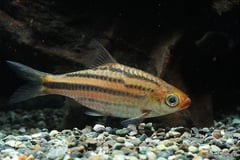
Desmopuntius trifasciatus
Cyprinidae · Kottelat, 1996
Desmopuntius trifasciatus is a cyprinid from Borneo, described from the Kapuas basin in West Kalimantan and also known from southern Sarawak. Like D. gemellus and D. johorensis, juveniles have 4 dark vertical bars, and fish over 40 mm have 3 or 4 broad lateral stripes, the central one broadest. It may also be confused with Striuntius lineatus.
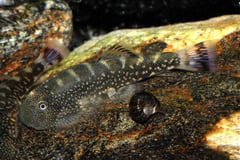
Gastromyzon farragus
Gastromyzontidae · Tan & Leh, 2006
Gastromyzon farragus is a small gastromyzontid loach from swift hill streams in the Sadong River basin of southern Sarawak, Malaysian Borneo. It is dark brown with thin cream bars across the back and a red caudal fin, and is very close to G. ocellatus. One of the more commonly traded members of the genus, it often arrives in mixed shipments labelled 'Borneo sucker' or 'Hong Kong pleco', and needs clean, well-oxygenated water with strong flow.
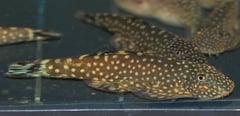
Gastromyzon scitulus
Gastromyzontidae · Tan & Leh, 2006
Gastromyzon scitulus is a hillstream loach endemic to tributaries of the Sungai Sadong basin in southern Sarawak, Malaysian Borneo. One of the more commonly-traded members of the genus, it usually arrives in mixed shipments labelled 'Borneo sucker' or 'Hong Kong pleco' regardless of species. It forms a pair of cryptospecies with the very similar G. ctenocephalus, and intermediate forms of both mean identification can sometimes be tricky.
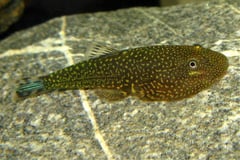
Gastromyzon stellatus
Gastromyzontidae · Tan, 2006
Gastromyzon stellatus is a hillstream loach from the Sarawak, Sadong and Lupar River drainages in southern Sarawak, Malaysian Borneo. Its dark brown head and body carry many small yellow spots. It forms a pair of cryptospecies with G. zebrinus and is often confused with it, since both show intermediate colour patterns. One of the more commonly-traded members of the genus, it usually arrives in mixed shipments labelled 'Borneo sucker' or 'Hong Kong pleco'.
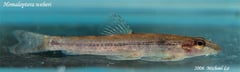
Homalopteroides weberi
Balitoridae · Hora, 1932
Homalopteroides weberi is a hillstream loach from Sarawak in Malaysian Borneo, described from the Akar River and possibly endemic to the state. Poorly known in the aquarium hobby, it was questioned as a possible synonym of Balitoropsis stephensoni by Kottelat (2012), but Randall and Page consider it distinct. It inhabits swiftly-flowing streams and headwaters with clear, oxygen-saturated water.
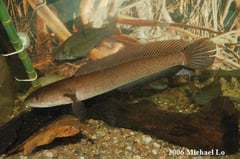
Channa baramensisBaram Snakehead
Channidae · Steindachner, 1901
The Baram snakehead, Channa baramensis, is a snakehead endemic to Borneo, known from Sarawak, western Sabah and Brunei. It was treated as a synonym of C. melasoma until its revalidation by Ng et al. (1996). A black spot in the centre of many body scales and, in fish over 120 mm SL, a barred caudal fin separate it from C. melasoma and the similar C. cyanospilos.