River
Johor
Only species with a profile on Seriously Fish are counted.
- Species
- 9
- Families
- 3
- Photographed
- 9 of 9
- Difficulty rated
- 9 of 9
Shares fishes withspecies recorded from both
Runs through
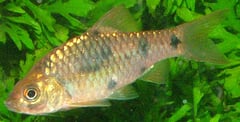
Barbodes banksi
Cyprinidae · Herre, 1940
Barbodes banksi is a cyprinid from Peninsular Malaysia, Singapore and western Borneo, plus the Anambas and Natuna islands of Indonesia. It is tentatively considered distinct from the closely related B. binotatus, differing in a dark, wedge-shaped marking below the dorsal fin in place of a midlateral spot, though the two may be colour forms of a single species. Occasionally exported as bycatch, it lives in habitats from fast hill streams to canals and floodplain ponds.
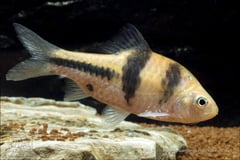
Barbodes lateristrigaSpanner Barb
Cyprinidae · Valenciennes, 1842
The spanner barb or 'T-barb', Barbodes lateristriga, is a cyprinid from peninsular Thailand, Peninsular Malaysia, Singapore, Sumatra and Java. Its colour pattern varies with locality, and the form most commonly seen in the trade corresponds most closely to fish from Johor. The species may prove to be a complex of closely-related taxa. Quite boisterous, it can intimidate more timid species with its size and activity, especially at feeding times.

Betta pugnax
Osphronemidae · Cantor, 1849
Betta pugnax is a paternal mouthbrooding labyrinth fish from much of Peninsular Malaysia and Singapore, described from Penang. It lends its name to the B. pugnax complex. Populations inhabit shallow, flowing clear-water hill streams as well as stiller forest swamps. It is not among the more aggressive members of the genus and can be maintained in a pair or group.
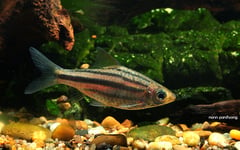
Desmopuntius johorensisStriped Barb
Cyprinidae · Duncker, 1904
The striped barb, Desmopuntius johorensis, is a cyprinid from southern Thailand, Peninsular Malaysia, Singapore, Sumatra and Borneo. Juveniles have 4 dark vertical bars and develop 5 or 6 broad lateral stripes as they grow, a pattern change shared with D. gemellus and D. trifasciatus. Before Kottelat (1992) it was referred to as Puntius eugrammus, while the name 'Puntius johorensis' was misapplied to D. hexazona. It lives mainly in peat swamps and black water streams.
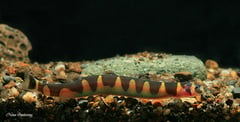
Pangio semicincta'Kuhli' Loach
Cobitidae · Fraser-Brunner, 1940
Usually sold as the 'kuhli' loach, Pangio semicincta is a cobitid loach from Peninsular Malaysia, Sumatra and Borneo. It lives in shallow forest streams and swamps, often in black water, and is typically abundant in leaf litter. P. kuhlii itself is currently considered endemic to Java and has possibly never been seen in aquaria, so the common aquarium 'kuhli' is more likely to be this species or an unidentified relative.
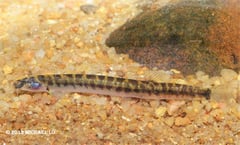
Pangio shelfordii
Cobitidae · Popta, 1903
Pangio shelfordii is a variably patterned kuhli loach from Peninsular Malaysia, Singapore, Sumatra and Borneo. Its patterning varies within and between populations, and as currently understood the species represents an assemblage containing a number of unidentified taxa. Some Sumatran and Bornean populations resemble P. piperata, which often occurs alongside it. It is exported occasionally, often as bycatch among shipments of congeners.

'Puntius' lineatusLined Barb
Cyprinidae · Duncker, 1904
The lined barb, 'Puntius' lineatus, is a laterally-striped cyprinid from Peninsular Malaysia, Sumatra and Borneo, found mostly in peat swamps. It is most often confused with 'P.' johorensis, the two being the most common of the striped species in the trade, but it has no more than one pair of barbels, lacks vertical bars as a juvenile and grows smaller. Its habitats include black water streams stained brown with humic acids, with pH as low as 3.0 or 4.0.

Sphaerichthys osphromenoidesChocolate Gourami
Osphronemidae · Canestrini, 1860
The chocolate gourami, Sphaerichthys osphromenoides, is a small gourami from Peninsular Malaysia, Sumatra and Borneo. By far the best known member of the genus, it mostly inhabits peat swamps and black water streams where the pH can drop to 3.0 or 4.0. A maternal mouthbrooder, it is slow-moving and easily outcompeted for food by more boisterous tankmates.
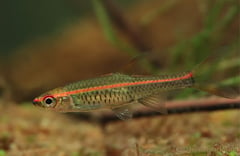
Trigonopoma pauciperforatumGlowlight Rasbora
Cyprinidae · Weber & de Beaufort, 1916
The glowlight rasbora, Trigonopoma pauciperforatum, is a small cyprinid from Peninsular Malaysia, Singapore, Borneo and Sumatra. Also sold as the 'redline' rasbora, its lateral stripe varies from deep orange to golden with locality, diet, condition and mood. It inhabits blackwater streams associated with peat swamps, where the pH can drop as low as 3.0 or 4.0, and the name R. agilis is a junior synonym of it.