Results for “aquarium”
Type a name: scientific, common, or one a species used to go by. Or narrow the catalogue with the filters.
Filters
Synodontis granulosa
authority not recorded
Max length270mm SL11in SLTank150 × 60cm60 × 24inTemp24–28°C75–82°FpH7.8–8.5One of the most stunning and sought after species of Synodontis and though the cost of ownership has dropped slightly, it still commands a high price. Its natural deep water habitat, limited range and solitary lifestyle make collection for the hobby difficult and so it is rarely seen for sale. It also appears that the areas of the lake in which it occurs are threatened with ecological disaster. In the aquarium S. granulosa is intelligent and can develop into a real character, with many speci...
Synodontis notataOne-spot Synodontis
authority not recorded
Max length275mm SL11in SLTank120 × 30cm48 × 12inTemp22–25°C72–77°FpH6.5–7.5Also known as the Domino Synodontis or the One-spot Squeaker, several regional variants of S. notata are known, some of which have 3, 6 or 12 spots and others none at all. Some of these are seen for sale under the invalid name S. ocellata. It is also often imported with similar species such as S. nummifer or S.congica. These are usually then all sold as notata. S. notata is more active during the day than many Syno species and therefore makes a good addition to aquariums with more boisterous...
Synodontis petricolaDwarf Lake Synodontis
authority not recorded
Max length130mm SL5in SLTank90 × 30cm36 × 12inTemp24–28°C75–82°FpH7.5–8.5One of our favourite Synos and highly recommended for any Tanganyikan community aquarium. The dwarf form can even be kept in a South American community.
Synodontis schall
authority not recorded
Max length375mm SL15in SLTank120 × 60cm48 × 24inTemp22–27°C72–81°FpH6.0–8.0S. schall is regarded as the 'bad boy' of the genus in aquarium circles. It is randomly aggressive and not particularly attractive. It is often confused with other similar species of Synodontis such as S. budgetti or S. clarias but can be distinguished by the length of thewhich, in this species, is very long and runs from just past the base of the to just before the caudal fin. It is an important food fish in some of its native countries....
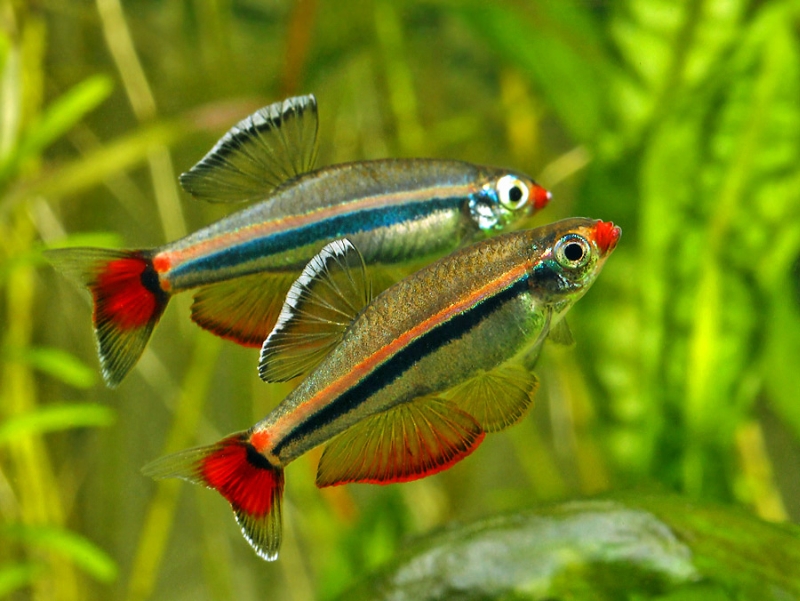
Tanichthys micagemmae
Freyhof & Herder, 2001
Max length30mm SL1.2in SLTank45 × 30cm18 × 12inTemp18–23°C64–73°FpH6.5–7.5This species only became available in the aquarium hobby during the early 21st century but has already achieved a measure of popularity since it's attractive, easy to maintain and usually quite cheaply-priced. You may see it on sale under various trade names including 'Vietnamese minnow', 'cardinal minnow', 'royal white cloud', 'dwarf cardinal' and others. We've obtained images of what is said to be a naturally-occurring form with extremely elong...
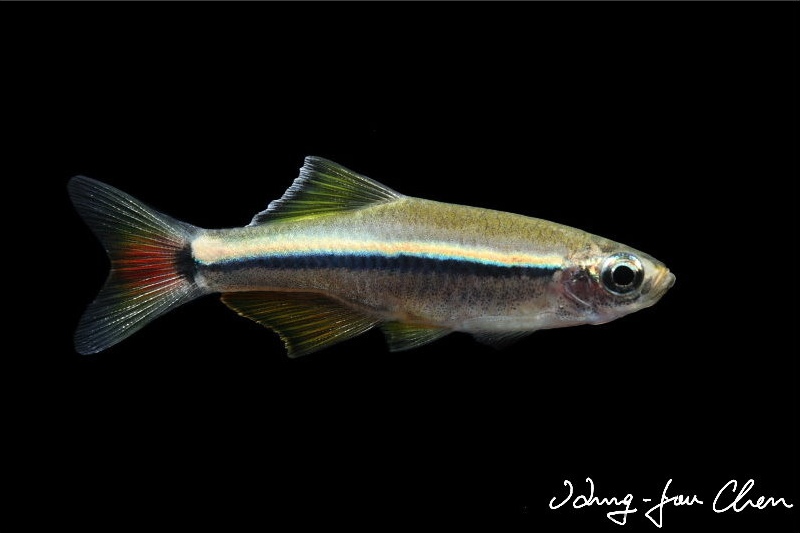
Tanichthys sp. 'Vietnam'
authority not recorded
Max length30mm SL1.2in SLTank45 × 30cm18 × 12inTemp18–25°C64–77°FpH6.0–7.5This fish was first collected in 2009 and limited numbers have been available in the aquarium trade. Though additional exports may be unlikely it's proven easy to breed in captivity and there's a fair chance it will become established in the hobby. It's sold under several names including T. sp. 'lemon' or 'yellow white cloud', and has also been misidentified as the congener T. thacbaensis, a valid species occurring much further north in Vietnam.
Tetraodon baileyiHairy Puffer
authority not recorded
Max length120mm SL5in SLTank75 × 30cm30 × 12inTemp23–27°C73–81°FpHnot recordedPuffer fish are so called as they have the ability to inflate their elastic stomachs with water or air. This is usually a response to some kind of threat, although in the aquarium many specimens appear to inflate themselves for no apparent reason. The fish becomes 2 or 3 times it's normal size, which makes the fish both big enough to scare away many potential predators, and difficult to swallow. Many parts of the body of puffers contain the deadly neurotoxin tetrodoxin. This is the same ...
Tetraodon biocellatusFigure Eight Puffer
authority not recorded
Max length80mm SL3.1in SLTank75 × 30cm30 × 12inTemp22–26°C72–79°FpH6.5–7.5Puffer fish are so called as they have the ability to inflate their elastic stomachs with water or air. This is usually a response to some kind of threat, although in the aquarium many specimens appear to inflate themselves for no apparent reason. The fish becomes 2 or 3 times its normal size, big enough to scare away many potential predators, or difficult to swallow. Puffers also have several other interesting adaptations. They are one of the few fish that can actually blink or close their ...
Tetraodon cochinchinensisFang's Puffer
authority not recorded
Max length70mm SL2.8in SLTank45 × 30cm18 × 12inTemp24–28°C75–82°FpH6.5–7.8Puffer fish are so called as they have the ability to inflate their elastic stomachs with water or air. This is usually a response to some kind of threat, although in the aquarium many specimens appear to inflate themselves for no apparent reason. The fish becomes 2 or 3 times it's normal size, which makes the fish both big enough to scare away many potential predators, and difficult to swallow. Many parts of the body of puffers contain the deadly neurotoxin tetrodoxin. This is the same ...
Tetraodon fluviatilisGreen Puffer
authority not recorded
Max length170mm SL7in SLTank120 × 30cm48 × 12inTemp24–28°C75–82°FpH7.8–9.0Puffer fish are so called as they have the ability to inflate their elastic stomachs with water or air. This is usually a response to some kind of threat, although in the aquarium many specimens appear to inflate themselves for no apparent reason. The fish becomes 2 or 3 times its normal size, big enough to scare away many potential predators, or difficult to swallow. Puffers also have several other interesting adaptations. They are one of the few fish that can actually blink or close their ...
Tetraodon lineatusFahaka Puffer
authority not recorded
Max length430mm SL17in SLTanknot recordedTemp24–26°C75–79°FpH6.5–7.5Puffer fish are so called as they have the ability to inflate their elastic stomachs with water or air. This is usually a response to some kind of threat, although in the aquarium many specimens appear to inflate themselves for no apparent reason. The fish becomes 2 or 3 times it's normal size, big enough to scare away many potential predators, or difficult to swallow. Puffers are also one of the few fish that can actually blink or close their eyes. Many parts of the body of puffers cont...
Tetraodon mbuGiant Puffer
authority not recorded
Max length750mm SL30in SLTank240 × 90cm96 × 36inTemp24–26°C75–79°FpH7.0–8.0Puffer fish are so called as they have the ability to inflate their elastic stomachs with water or air. This is usually a response to some kind of threat, although in the aquarium many specimens appear to inflate themselves for no apparent reason. The fish becomes 2 or 3 times its normal size, big enough to scare away many potential predators, or difficult to swallow. Puffers also have several other interesting adaptations. They are one of the few fish that can actually blink or close their ...
Tetraodon miurusCongo Puffer
authority not recorded
Max length150mm SL6in SLTank75 × 30cm30 × 12inTemp24–28°C75–82°FpH6.8–7.5Puffer fish are so called as they have the ability to inflate their elastic stomachs with water or air. This is usually a response to some kind of threat, although in the aquarium many specimens appear to inflate themselves for no apparent reason. The fish becomes 2 or 3 times its normal size, big enough to scare away many potential predators, or difficult to swallow. Puffers also have several other interesting adaptations. They are one of the few fish that can actually blink or close their ...
Tetraodon nigroviridisGreen Spotted Puffer
authority not recorded
Max length170mm SL7in SLTank120 × 30cm48 × 12inTemp24–28°C75–82°FpH7.5–8.5Puffer fish are so called as they have the ability to inflate their elastic stomachs with water or air. This is usually a response to some kind of threat, although in the aquarium many specimens appear to inflate themselves for no apparent reason. The fish becomes 2 or 3 times it's normal size, which makes the fish both big enough to scare away many potential predators, and difficult to swallow. Many parts of the body of puffers contain the deadly neurotoxin tetrodoxin. This is the same ...
Tetraodon palembangensisHumpback Puffer
authority not recorded
Max length195mm SL8in SLTank120 × 30cm48 × 12inTemp24–28°C75–82°FpH6.8–7.6Puffer fish are so called as they have the ability to inflate their elastic stomachs with water or air. This is usually a response to some kind of threat, although in the aquarium many specimens appear to inflate themselves for no apparent reason. The fish becomes 2 or 3 times it's normal size, which makes the fish both big enough to scare away many potential predators, and difficult to swallow. Many parts of the body of puffers contain the deadly neurotoxin tetrodoxin. This is the same ...
Tetraodon suvattiiArrowhead Puffer
authority not recorded
Max length150mm SL6in SLTanknot recordedTemp22–26°C72–79°FpH6.5–7.5Puffer fish are so called as they have the ability to inflate their elastic stomachs with water or air. This is usually a response to some kind of threat, although in the aquarium many specimens appear to inflate themselves for no apparent reason. The fish becomes 2 or 3 times its normal size, big enough to scare away many potential predators, or difficult to swallow. Puffers also have several other interesting adaptations. They are one of the few fish that can actually blink or close their ...
Theraps bocourtiChisel-tooth cichlid
authority not recorded
Max length300mm SL12in SLTank150 × 60cm60 × 24inTemp26–28°C79–82°FpHnot recordedA rather elusive species in the hobby, this beautiful cichlid is sometimes referred to as the "Chisel-toothed" cichlid. Despite being described in 1902 it was not until the mid-1990s that it appeared in the aquarium trade, wild specimens being collected by American aquarists Ross Socolof, Harry Specht, and Rusty Wessel in 1994....
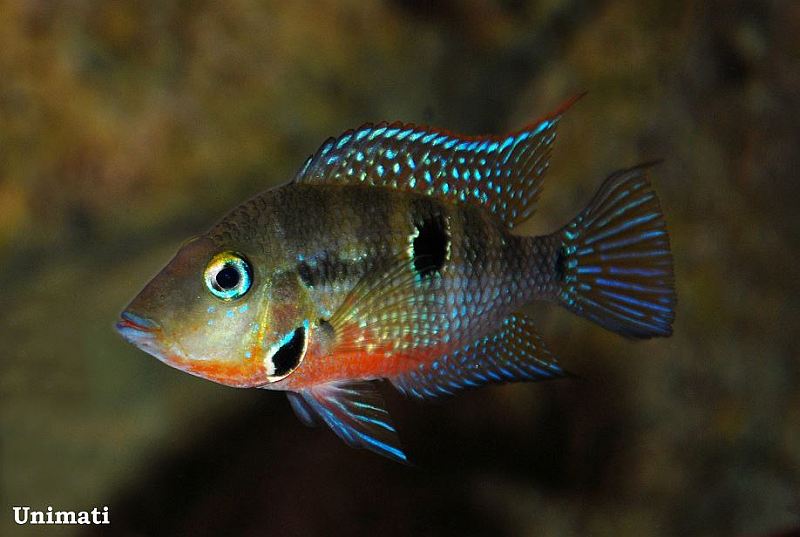
Thorichthys meekiFiremouth Cichlid
Brind, 1918
Max length120mm SL5in SLTank120 × 30cm48 × 12inTemp20–32°C68–90°FpH6.5–8.5This species has been a popular aquarium fish for a considerable period and virtually all fish traded are now raised commercially for the purpose. It is easily identified by the characteristic bright red or orange underside of the head, which is more pronounced in adults. Following Miller and Taylor (1984), the genus Thorichthys is identified...
Tramitichromis intermedius
authority not recorded
Max length160mm SL6in SLTank120 × 38cm48 × 15inTemp24–28°C75–82°FpH7.6–8.8Sand dwelling Malawian cichlid species such as this can be somewhat delicate in the aquarium. A rigorous tank maintenance schedule is recommended to keep them in top shape; with small, regular partial water changes a necessity. Also take care with feeding as discussed above. It is likely this species will eventually be assigned to a different genus, as there is some confusion surrounding Tramitichromis and it's scientific validity. The fish included in the genus differ from Lethrinops sp...
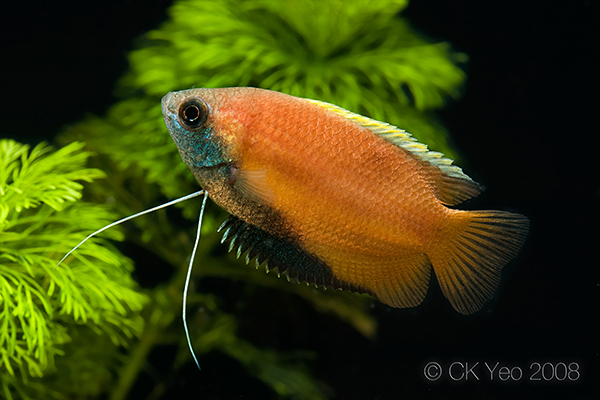
Trichogaster chunaHoney Gourami
Hamilton, 1822
Max length55mm SL2.2in SLTank60 × 30cm24 × 12inTemp22–27°C72–81°FpH6.0–7.5This species is readily available in the aquarium trade and is a good subject for those new to the hobby given its peaceable nature and relative adaptability in terms of water chemistry. It's sold under various names including A number of selectively-bred ornamental strains have also been produced including 'red', 'sunset', and 'golden', for which care is identical to the natural form.