Tetraodon fluviatilis
Green Puffer
Last revised 2026Edit this page
On this page11 sections
Quick factsEdit
Difficulty4 of 8 measures
- Space
- large tank
- Water
- needs alkaline water
- Temp
- needs a steady temperature
- Diet
- needs snails to wear down its teeth
- Temperament
- unknown
- Social
- unknown
- Compatibility
- unknown
Other demands
Each of these can raise the rating on its own, whatever the measures above say.
- Hardiness
- unknown
The green puffer, Tetraodon fluviatilis, is a widespread puffer from South and Southeast Asia, found in slow-moving rivers and estuaries. It is often confused with T. nigroviridis and T. schoutedeni but has a more slender, streamlined shape. Though often sold in freshwater, it is a true brackish species and needs a specific gravity of around 1.005 to 1.010 to survive long term.
Distribution
EditHabitat
Write a noteEditTends to inhabit slow-moving parts of rivers and estuaries, where it's most usually found around
Aquarium size
Write a noteEdit120 ∗ 30 ∗ 30 cm48 ∗ 12 ∗ 12 in - ~108 litres~29 US gal.
Maintenance
Write a noteEditRequires brackish water to a sg of around 1.005-1.010, although it can also tolerate full marine conditions. Some cover in the form of rocks and pieces of driftwood should be provided, along with a sandy substrate. It also enjoys plant cover, and tough species such as java fern may survive for a good while in mildly saline water. Plastic plants also make a fine alternative. It's very sensitive to deteriorating water conditions, so regular partial water changes are a must.
Water conditions
EditTemperature: 24 – 28 °C75 – 82 °F
pH: 7.8-9.0
Hardness: 10-30°H
These recommendations come from this profile’s own figures. They contain affiliate links, so we may earn a commission.
Diet
Write a noteEditRelishes all kinds of shellfish, as well as worms and other live and frozen foods. It should be fed snails and unshelled shellfish (such as crab legs, mussels etc.) regularly, in order to maintain its sharp teeth. As with other puffers, these grow continuously and become a problem for the fish if they're not kept ground down.
Behaviour and compatibility
Write a noteEditA somewhat intolerant species, the green puffer is not a particularly good community fish. It will often harass and nip the fins of tankmates, particularly if they're slow-moving or long-finned. In a large aquarium, possible choices include robust, active species such as scats, archerfish, Arius catfish and perhaps monos.
It's not a good idea to keep more than one of these per tank unless a lot of space is available, as they're usually pretty belligerent toward conspecifics.
Sexual dimorphism
Write a noteEditUnknown.
Reproduction
Write a noteEditHas been spawned in aquaria, but little information is available. The female lays her eggs on a flat surface, and these are then guarded by the male until they hatch.
Notes
EditPuffer fish are so called as they have the ability to inflate their elastic stomachs with water or air. This is usually a response to some kind of threat, although in the aquarium many specimens appear to inflate themselves for no apparent reason. The fish becomes 2 or 3 times its normal size, big enough to scare away many potential predators, or difficult to swallow.
Puffers also have several other interesting adaptations. They are one of the few fish that can actually blink or close their eyes, which only serves to add further charm to what is already a fish with bags of character. They also have beak-like mouthparts, which are formed by a fusing of 2 teeth from each jaw (hence Tetraodon). These are used to crush shelled invertebrates, the favourite food of most puffers.
Many parts of the body of puffers contain the deadly neurotoxin tetrodoxin. This is the same poison found in the notorious blue-ringed octopus. When ingested in sufficient quantities, it can cause paralysis and death. As yet, there is no known antitoxin and to humans it is over 1000 times deadlier than cyanide. Grotesquely, the victim usually remains conscious as he or she becomes paralysed. It's a famous delicacy in Japan, but is prepared only by highly-trained chefs, and even then many people have died from eating it. This need not worry you, but if you need to get rid of your puffer, sell it on: getting the barbecue out is not recommended!
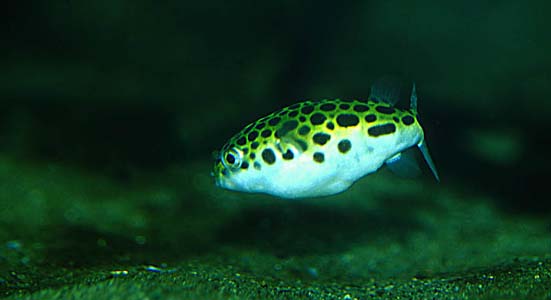
T. fluviatilis is often confused with its similar looking relatives T. nigroviridis, and T. schoutedeni. It can be distinguished by its more slender, streamlined (for a puffer!) shape. Additionally, T. schoutedini is more brownish in colour than the other two, which are primarily green. Schoutedini also has clear spines on its belly. Try to be sure which species you're buying, as only fluviatilis is a true brackish species. Despite this, it's often seen for sale in freshwater, but should be acclimatised to brackish if it's to survive long term.
Species images · 1
These photographs are used with each photographer's permission.
Send a photographProfile completeness17 of 24
Community
Questions about Tetraodon fluviatilis?
Ask on Discord