Trichogaster chuna
Honey Gourami
Formerly Trichopodus chuna Hamilton, 1822 · Colisa chuna Hamilton, 1822 · Trichopodus sota Hamilton, 1822 · Colisa sota Hamilton, 1822
Last revised 2026Edit this page
On this page13 sections
Quick factsEdit
Difficulty5 of 8 measures
- Space
- medium tank
- Water
- flexible
- Temp
- flexible
- Diet
- unknown
- Temperament
- unknown
- Social
- best in a pair
- Compatibility
- fine with others
Other demands
Each of these can raise the rating on its own, whatever the measures above say.
- Hardiness
- unknown
Before you buy
Needs a tight-fitting lid as this species is known to jump
Keep the tank well-covered and do not fill it to the top as like all osphronemids it requires occasional access to the layer of humid air that will form above the water surface, and may jump on occasion.
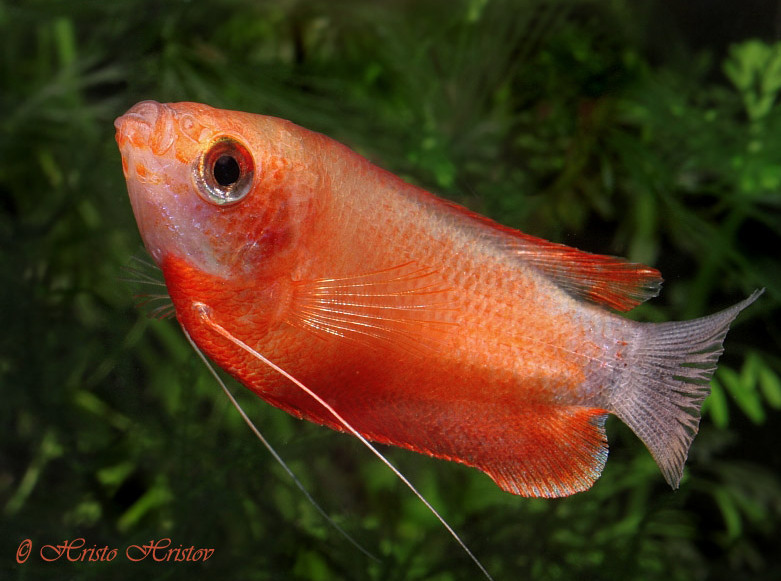
The honey gourami, Trichogaster chuna, is a labyrinth fish from the Ganges and Brahmaputra systems of India and Bangladesh, with records from Nepal. Virtually all fish on sale are commercially produced, and ornamental strains such as 'red', 'sunset' and 'golden' exist. Slow-moving and easily outcompeted, it needs peaceful tankmates and does best in a group of four to six.
Etymology
EditTrichogaster: from the Ancient Greek θρίξ (thriks), meaning 'hair', and γαστήρ (gastḗr), meaning 'belly, stomach', in reference to the thread-like pelvic fins in members of this genus.
chuna: appears to be derived from a local name for the fish.
Distribution
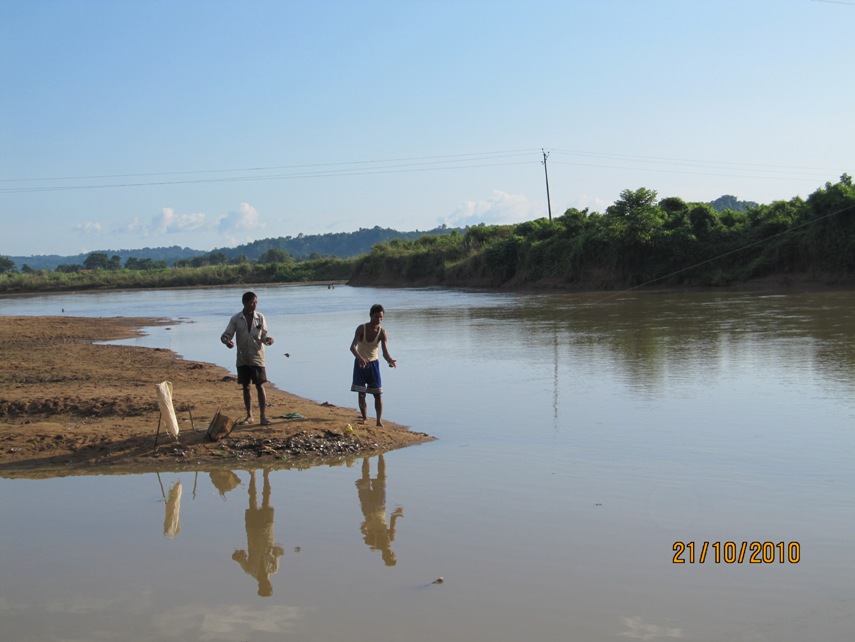
EditKnown from the Ganges River in northern India, including its floodplain and delta in Bangladesh, plus the Brahmaputra system in the states of Assam, Manipur, Meghalaya, and Arunachal Pradesh, with additional records from Nepal.
Type locality is given simply as 'Gangetic provinces, India'.
Wild examples are rare in the aquarium hobby with virtually all fish on sale produced commercially for the purpose.
Habitat
Write a noteEditAquarium size
Write a noteEditAn aquarium with base dimensions of 60 ∗ 30 cm24 ∗ 12 in or equivalent is suffient to house a pair or small group.
Maintenance
Write a noteEditFares best in a well-planted, shady set-up with plenty of surface cover in the form of tall stem or floating plants.
Driftwood can also be used and other plants such as Microsorum or Taxiphyllum spp. can be attached to it. Small clay plant pots, lengths of plastic piping or empty camera film cases can also be included to provide further shelter.
The addition of some dried leaf litter (beech, oak or Ketapang almond leaves are all suitable) is also recommended. In addition to offering additional shelter for the fish it brings with it the establishment of microbe colonies as decomposition occurs. These microorganisms can provide a valuable secondary food source for fry, whilst the tannins and other chemicals released by the decaying leaves are also thought beneficial.
As it naturally inhabits sluggish waters filtration should not be too strong, with an air-powered sponge filter set to turn over gently adequate. Keep the tank well-covered and do not fill it to the top as like all osphronemids it requires occasional access to the layer of humid air that will form above the water surface, and may jump on occasion.
Water conditions
EditThese recommendations come from this profile’s own figures. They contain affiliate links, so we may earn a commission.
Diet
Write a noteEditLikely to prey on insects and other small invertebrates in nature. Captive fish will accept dried products but should also be offered plenty of small live or frozen foods such as Daphnia, Artemia, or bloodworm regularly to ensure development of optimal colour and condition.
Small insects such as micro-crickets or Drosophila fruit flies are also suitable to use; it's best to fill the stomachs of these by feeding them fish flakes or some kind of vegetable matter before offering them to the fish.
Behaviour and compatibility
Write a noteEditTankmates must be chosen with care since this species is slow-moving and will easily be intimidated or outcompeted for food by larger or more vigorous tankmates.
Peaceful, pelagic cyprinids make good choices as do less active loaches such as Pangio spp. or certain nemacheilids. Territorial or otherwise aggressive species are best omitted.
Though not gregarious in the sense of schooling fishes it does seem to require interaction with conspecifics and displays more interesting behaviour when maintained in numbers, meaning the purchase of no less than 4-6 specimens is recommended. Groups develop noticeable hierarchies and you'll often see dominant individuals chasing away their rivals at feeding time or when occupying their favourite spot.
Sexual dimorphism
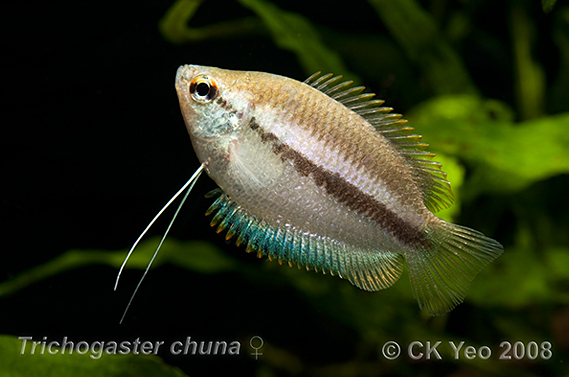
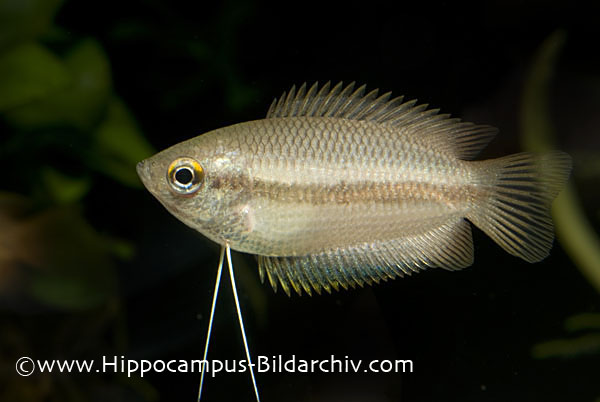
Write a noteEditAdult females are brownish in colour, noticeably larger than males and possess a broad, brownish midlateral stripe extending posteriorly from behind the eye to the caudal peduncle.
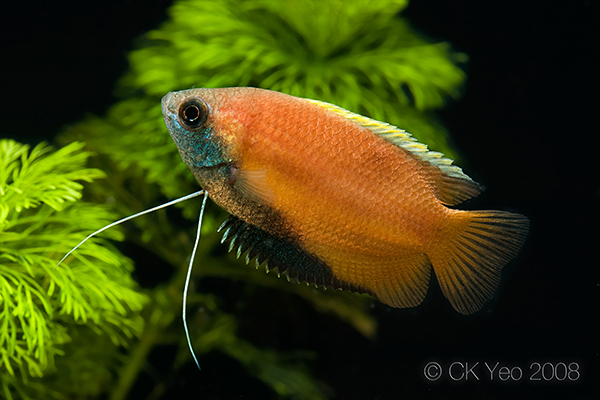
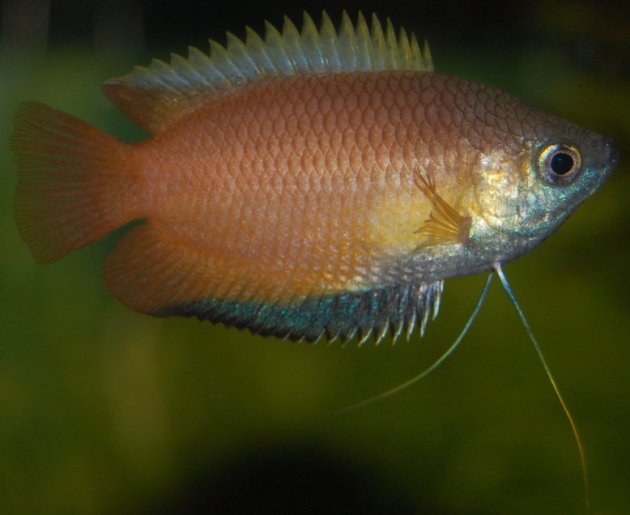
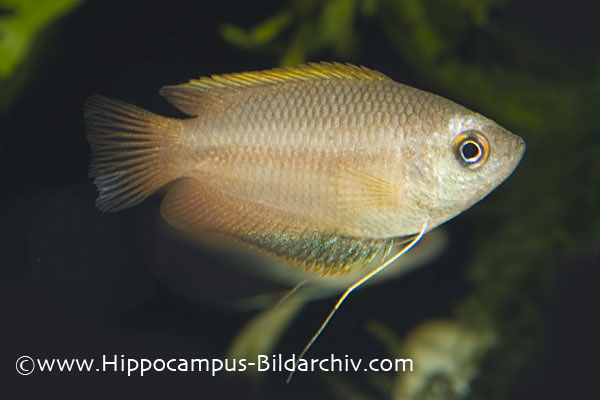
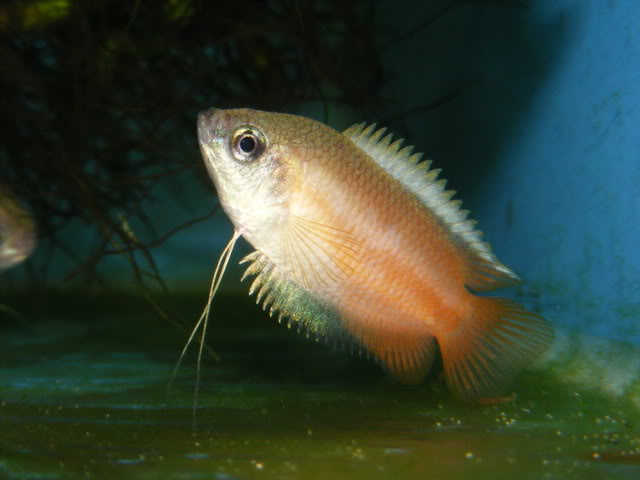
Non-nuptial males possess a similar lateral stripe but the base body colour is slightly orangish, and the anterior portion of the dorsal and anal fins have yellowish margins. In nuptial individuals the body and opercular region become bright orange with the head, anterioventral portion of the body, and spiny rays of the anal-fin coloured dark blue to black.
These changes do not occur in males of the various ornamental strains (see 'Notes').
Reproduction
Write a noteEditThis species is a bubblenester which forms temporary pair bonds. Some hobbyists prefer to isolate individual pairs for spawning purposes whereas others may maintain a small group.
Either way the tank to be used for spawning should be furnish it with plenty of floating and/or stem plants with leaves reaching the surface. Gentle filtration via an air-powered sponge filter is the best option, as it will not break up the bubblenest of the male or suck up fry.
The tank should have the tightest-fitting cover you can find (some breeders use clingfilm instead, to ensure no gaps), as the fry need access to a layer of warm, humid air without which development of the labyrinth organ can be impaired.
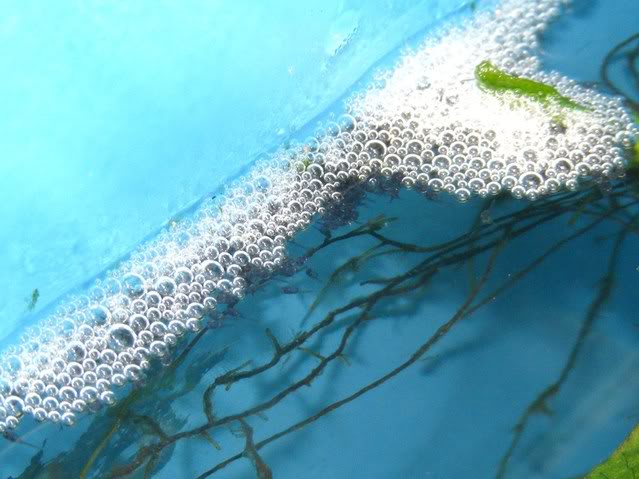
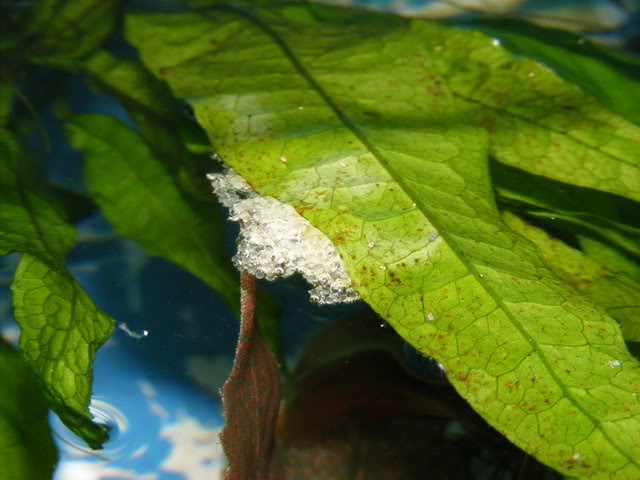
Condition the fish with plenty of small live foods and they should quickly come into spawning condition with the female appearing plump with eggs and the male assuming his nuptial colour pattern (see 'Sexual Dimorphism'). Unlike those of some related species the bubblenest does not include pieces of plant material and is usually constructed beneath a broad leaf or even in the corner of the aquarium using the glass for stability.
The male initially builds a relatively small nest and once complete will begin to display to gravid females in the vicinity. As a receptive female approaches the pair will be seen touching each other with their modified ventral fins.
Following a protracted courtship spawning occurs beneath the nest in the typical osphronemid 'embrace', the male wrapping his body around that of his mate with eggs and milt released simultaneously at the climax.
The male collects the eggs and transports them to the nest. Several more spawnings occur and when there are no more eggs the female is chased away. It is best to remove her at this point. The male then tends to the nest until the eggs hatch, usually in around 24-36 hours. The male can then also be removed. The fry become free swimming in another 24-48 hours and are very small. They should be fed infusoria or liquid fry food for the first week, after which they are large enough to accept brine shrimp nauplii or microworm. Care should be taken when performing water changes as the young are very sensitive to changes in water chemistry and temperature, and remain so for some time.
Notes
EditThis species is readily available in the aquarium trade and is a good subject for those new to the hobby given its peaceable nature and relative adaptability in terms of water chemistry.
A number of selectively-bred ornamental strains have also been produced including 'red', 'sunset', and 'golden', for which care is identical to the natural form.
In nature it's reported to dislodge insects as they come to rest on overhanging leaves and branches by 'spitting' water droplets at them.
Like others in the suborder Anabantoidei this species possesses an accessory breathing organ known as the labyrinth. So-called due to its maze-like structure this organ allows the fish to breathe atmospheric air to a certain extent. Comprising paired suprabranchial organs formed via expansion of the epibranchial (upper) section of the first gill arch and housed in a chamber above the gills, it contains many highly-vascularised, folded flaps of skin which function as a large respiratory surface. Its structure varies in complexity between species, tending to be more developed in those inhabiting harsher environments.
References
- Bagra, K., K. Kadu, K. Nebeshwar-Sharma, B. A. Laskar, U. K. Sarkar, and D. N. Das (2009). Ichthyological survey and review of the checklist of fish fauna of Arunachal Pradesh, India. Check List 5(2), 330-350
- Hamilton, F. (1822). An account of the fishes found in the river Ganges and its branches. An account of the fishes found in the river Ganges and its branches., i-vii + 1-405
Species images · 10
These photographs are used with each photographer’s permission.
Send a photograph