Tetraodon cochinchinensis
Fang's Puffer
On this page11 sections
Quick facts
Difficulty5 of 8 measures
- Space
- medium tank
- Water
- flexible
- Temp
- needs a steady temperature
- Diet
- needs snails to wear down its teeth
- Temperament
- territorial
- Social
- unknown
- Compatibility
- unknown
Other demands
Each of these can raise the rating on its own, whatever the measures above say.
- Hardiness
- unknown
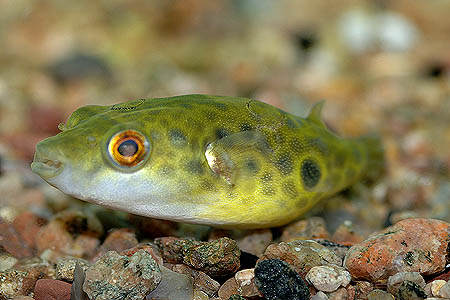
Fang's puffer, Tetraodon cochinchinensis, is a freshwater puffer from Thailand, Cambodia, Laos and Vietnam. It belongs to the 'target' puffer group, whose members share a range and look very similar, and is told from them by a clear red spot towards the rear of the body. An aggressive and intolerant fish, it should be kept alone.
Distribution
Habitat
Found in both still and slow-moving bodies of water including rivers, lakes and ponds. Some of these habitats contain brackish water.
Aquarium size
45 ∗ 30 ∗ 30 cm18 ∗ 12 ∗ 12 in - ~41 litres~11 US gal
Maintenance
Best kept in a heavily-planted setup with twisted roots and branches to provide additional cover. The use of floating plants to diffuse the light is also recommended. This species is very sensitive to deteriorating water conditions, so regular partial water changes are a must.
Water conditions
Temperature: 24 – 28 °C75 – 82 °F
pH: 6.5-7.8
Hardness: 8-15°H
These recommendations come from this profile’s own figures. They contain affiliate links, so we may earn a commission.
Diet
Relishes all kinds of shellfish, as well as worms and other meaty live and frozen foods. It should be fed snails and unshelled shellfish (such as crab legs, mussels etc.) regularly, in order to maintain its sharp teeth. As with other puffers, these grow continuously and become a problem for the fish if they are not kept ground down.
Behaviour and compatibility
A generally aggressive and intolerant species that really should be kept alone. Its beak-like mouth can easily bite chunks from other fish, or in extreme cases rip them to pieces. It's also very aggressive towards conspecifics and should never be kept in groups.
Sexual dimorphism
Unknown.
Reproduction
Has been achieved in aquaria, but little data is available. Apparently the male exhibits some degree of brood care.
Notes
Puffer fish are so called as they have the ability to inflate their elastic stomachs with water or air. This is usually a response to some kind of threat, although in the aquarium many specimens appear to inflate themselves for no apparent reason. The fish becomes 2 or 3 times it's normal size, which makes the fish both big enough to scare away many potential predators, and difficult to swallow.
Many parts of the body of puffers contain the deadly neurotoxin tetrodoxin. This is the same poison found in the notorious blue-ringed octopus. When ingested in sufficient quantities, it can cause paralysis and death. As yet there is no known antitoxin and to humans it is over 1000 times deadlier than cyanide. Grotesquely, the victim usually remains conscious as he or she becomes paralysed. It's a famous delicacy in Japan, but is prepared only by highly-trained chefs, and even then many people have died from eating it.
T. cochinchinensis is part of the 'target' puffer group, which contains 4 other species, namely T. cambodgiensis, T. leirus, T. turgidus and T. hilgendorfi. Some confusion surrounds this group, as they all hail from the same geographical area and share very similar physical characteristics. Cochinchinensis can be distinguished by the clear red spot situated towards the rear of the fish. It's one of the more frequently seen puffers in the hobby, though it is by no means common. All the Tetraodon species are ambush predators in nature.
Species images · 1
Used with the photographer’s permission. Not licensed for reuse.
Profile completeness18 of 24
75% complete
Also missing: a recorded distribution, taxonomic authority, etymology.
Community
Questions about Tetraodon cochinchinensis?
Ask on Discord