Results for “sp.”
Type a name: scientific, common, or one a species used to go by. Or narrow the catalogue with the filters.
Filters
Microsynodontis batesiiDwarf Synodontis
authority not recorded
Max length88mm SL3.5in SLTank60 × 30cm24 × 12inTemp22–26°C72–79°FpH6.7–7.5There are a dozen described species of Microsynodontis but most are not seen in the hobby. This species is one of the commoner ones however. Microsynodontis are much smaller than Synodontis species, with M. batesii being the largest. They can be distinguished from Synos and the similar Mochokiella by the rounded or slightly forked caudal fin. The is highly forked in the other genera. Interestingly in Microsynodontis the eyeball is fixed and cannot be moved unlike in Synodontis which has a moveab...
Microsynodontis polliPygmy Synodontis
authority not recorded
Max length40mm SL1.6in SLTank45 × 30cm18 × 12inTemp24–27°C75–81°FpH6.8–7.5There are a dozen described species of Microsynodontis but most are not seen in the hobby. This species is one of the commoner ones however. Microsynodontis are much smaller than Synodontis species, with M. batesii being the largest. They can be distinguished from Synos and the similar Mochokiella by the rounded or slightly forked caudal fin. The is highly forked in the other genera. Interestingly in Microsynodontis the eyeball is fixed and cannot be moved unlike in Synodontis which has a moveab...
Mimagoniates microlepisBlue Tetra
authority not recorded
Max length60mm SL2.4in SLTank60 × 38cm24 × 15inTemp18–23°C64–73°FpH6.0–7.0Not to be confused with the other species commonly sold under the name "blue tetra", Knodus borki, this species is much scarcer in the hobby. It also makes a better resident of the community tank than its cousin, being less boisterous and lacking the tendency to nip the fins of other species....
Moenkhausia cerosCeros Tetra
authority not recorded
Max length50mm SL2.0in SLTank60 × 38cm24 × 15inTemp24–26°C75–79°FpH5.5–7.0A rather rare fish in the UK hobby. It occasionally shows up as a contaminant among imports of more popular species. The taxonomic status of all species in the genus Moenkhausia is currently Incertae Sedis, meaning uncertain. The genus is currently used as something of a catch-all for a large number of small characin species. Most experts agree that a full revision is required, with the likely outcome that many of these will be placed into new or different genera....
Moenkhausia sanctaefilomenaeRed-eye Tetra
authority not recorded
Max length70mm SL2.8in SLTank90 × 38cm36 × 15inTemp22–26°C72–79°FpH6.0–8.0This species can be found swimming in most dealers' tanks and is one of the best choices for the newcomer to fishkeeping. All the fish sold in the trade have been captive bred and as such are unfussy regarding water chemistry and diet. The taxonomic status of all species in the genus Moenkhausia is currently Incertae Sedis, meaning uncertain. The genus is currently used as something of a catch-all for a large number of small characin species. Most experts agree that a full revision is re...
Nemadoras leporhinusMouse Catfish
authority not recorded
Max length80mm SL3.1in SLTank60 × 38cm24 × 15inTemp22–25°C72–77°FpH6.3–7.0Ther are currently five described species of Nemadoras (N. elongatus, N. hemipeltis, N. humeralis, N. leporhinus and N. trimaculatus). All are rare in the hobby, although this species is the one most commonly seen. As well as the occasional import, it sometimes shows up as bycatch among batches of similar-looking Hassar or Hemidoras species. Of these, it is most often confused with Hemidoras stenopeltis. These two can be easily told apart as N. leporhinus has a clearwith a dark patch at the base...
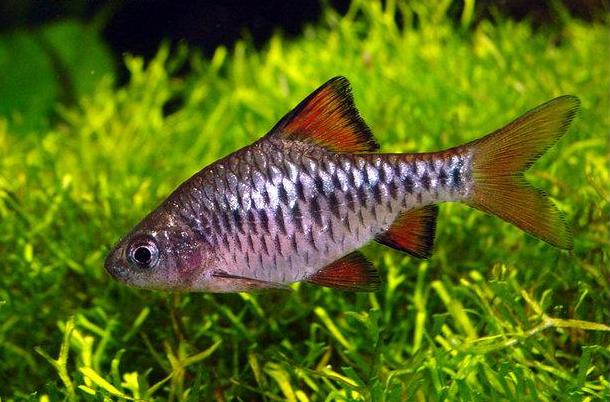
Oliotius oligolepisCheckered Barb
Bleeker, 1853
Max length45mm SL1.8in SLTank75 × 30cm30 × 12inTemp18–25°C64–77°FpH5.5–7.5This species is also traded as 'checker barb', 'checkerboard barb', or 'island barb', and is among the most ubiquitous species available in the aquarium trade. It is farmed commercially in enormous numbers with wild examples rarely, if ever, available. It was formerly included in the polyphyletic catch-all genus Puntius which contained over 100 species, but this situation has been largely resolved since the turn of the century.
Oreochromis mossambicusMozambique Mouthbrooder
authority not recorded
Max length390mm SL15in SLTank210 × 60cm84 × 24inTemp21–27°C70–81°FpH6.2–8.5One of the most invasive fish species in the world, O. mossambicus is one of the species farmed for supermarkets and restaurants across the globe. Several colour varieties have been selectively bred from the natural green fish to make the fish more appealing to consumers and unsurprisingly, it is these more brightly coloured forms which are usually seen in aquaria. Some of these variants are cross breeds with other species of Oreochromis. The destructive effect of O. mossambicus on non-nativ...
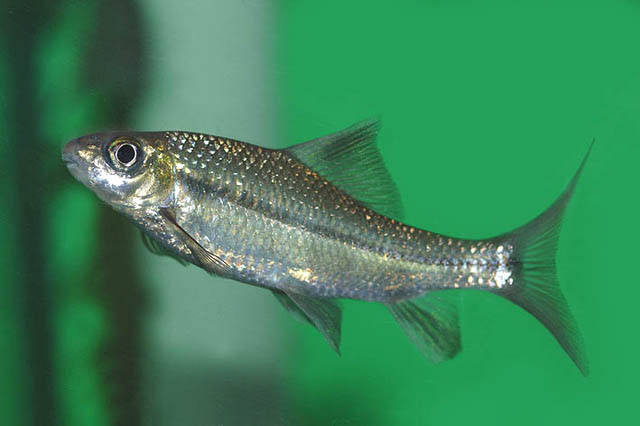
Osteochilus nashii
authority not recorded
Max length180mm SL7in SLTank120 × 45cm48 × 18inTemp22–25°C72–77°FpH6.5–7.5This species is very scarce in the trade indeed and you're most likely to see it on sale as a contaminant among import of other Indian species. There are currently 34 described species of Osteochilus although none can be considered popular in the aquarium hobby. According to Rainboth's 'Fishes of the Cambodian Mekong' members of the genus are characterised by lack of aspine, presence of 11-18rays, large rostral and maxillary barbels, papillae on both upper and lower lips,...
Papyrocranus aferArowana Knifefish
authority not recorded
Max length800mm SL31in SLTank210 × 90cm84 × 36inTemp24–28°C75–82°FpH6.5–7.5Like other members of the family Notopteridae this species differs from Gymnotiform knifefish in that its anal and caudal fins are fused together into one long, undulating fin running along the underside of the fish. There is only one other species in the genus. P. congoensis is a smaller, plain brown coloured fish found only in the Democratic Republic of Congo and is very rare in the hobby. P. afer is also infrequently imported and is one of the rarer knifefish species in the hobby. It can dev...
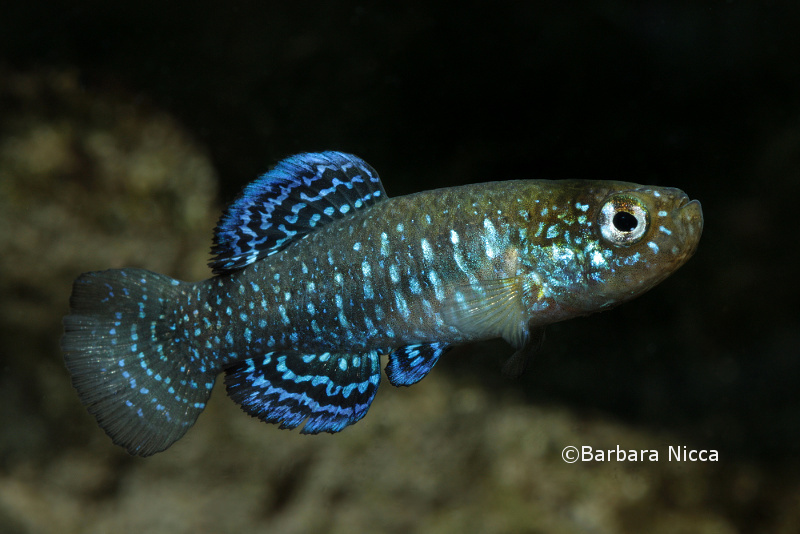
Paraphanius mentoIridescent Toothcarp
Heckel, 1843
Max length70mm SL2.8in SLTank120 × 30cm48 × 12inTemp2–30°C36–86°FpH7.5–9.0This species has something of a confused history having been previously been considered synonymous with both A. sophiae (a separate species native to Iraq and Iran) and A. cypris (currently considered a junior synonym of A. mento). Although some populations occur close to and even sympatric with other members of the genus in Turkey phylogenetic studies have shown it to be more closely-related to the Middle Eastern species A. dispar dispar, A. d. richardsoni, A. ginaonis and A. sirhani. It's...
Pelvicachromis humilisYellow Kribensis
authority not recorded
Max length125mm SL5in SLTanknot recordedTemp24–27°C75–81°FpH5.0–7.0A rare species in the hobby, P. humilis is also the largest known species in the genus. Several morphs are available, including "Guinea" and "Liberia red". Some of these may eventually be described as distinct species, as they are quite different in colouration and, to a lesser extent, morphology. This has already occured with P. rubrolabiatus and P. signatus, both of which were originally assigned to the humilis complex but have recently been reclassified. The easiest wa...
Polypterus bichir bichirNile Bichir
authority not recorded
Max length720mm SL28in SLTank180 × 60cm72 × 24inTemp22–28°C72–82°FpH6.0–8.0An incredibly hardy, nocturnal species with very poor vision, P. delhezi relies on its excellent sense of smell to locate food. This species, along with others of its genus, is one of the last surviving relatives of very ancient species. Fossils of earlier relatives have been found that date back to the Triassic Period, which occured during the early development of the dinosaurs more than 200 million years ago. They have several interesting adaptations. The swim bladder is divided into 2 par...
Polypterus delheziArmoured Bichir
authority not recorded
Max length350mm SL14in SLTank120 × 45cm48 × 18inTemp24–30°C75–86°FpH6.0–8.0An incredibly hardy, nocturnal species with very poor vision, P. delhezi relies on its excellent sense of smell to locate food. This species, along with others of its genus, is one of the last surviving relatives of very ancient species. Fossils of earlier relatives have been found that date back to the Triassic Period, which occured during the early development of the dinosaurs more than 200 million years ago. They have several interesting adaptations. The swim bladder is divided into 2 par...
Polypterus endlicheri endlicheriSaddled Bichir
authority not recorded
Max length750mm SL30in SLTank210 × 120cm84 × 48inTemp22–27°C72–81°FpH6.0–8.0An incredibly hardy, nocturnal species with very poor vision, P. endlicheri endlicheri relies on its excellent sense of smell to locate food. This species, along with others of its genus, are some of the last surviving relatives of very ancient species. Fossils of earlier relatives have been found that date back to the Triassic Period, which occured during the early development of the dinosaurs more than 200 million years ago. They have several interesting adaptations. The swim bladder is div...
Polypterus ornatapinnisOrnate Bichir
authority not recorded
Max length600mm SL24in SLTank180 × 60cm72 × 24inTemp25–28°C77–82°FpH6.0–8.0An incredibly hardy, nocturnal species with very poor vision, []iP. ornatapinnis relies on its excellent sense of smell to locate food. This species along with others of its genus are some of the last surviving relatives of very ancient species. Fossils of earlier relatives have been found that date back to the Triassic Period, which occured during the early development of the dinosaurs more than 200 million years ago. They have several interesting adaptations. The swim bladder is divided int...
Polypterus palmas palmasMarbled Bichir
authority not recorded
Max length325mm SL13in SLTank120 × 45cm48 × 18inTemp25–28°C77–82°FpH6.0–7.0An incredibly hardy, nocturnal species with very poor vision, P. delhezi relies on its excellent sense of smell to locate food. This species, along with others of its genus, is one of the last surviving relatives of very ancient species. Fossils of earlier relatives have been found that date back to the Triassic Period, which occured during the early development of the dinosaurs more than 200 million years ago. They have several interesting adaptations. The swim bladder is divided into 2 par...
Polypterus senegalus senegalusSenegal Bichir
authority not recorded
Max length500mm SL20in SLTank150 × 60cm60 × 24inTemp24–28°C75–82°FpH6.2–7.8An incredibly hardy, nocturnal species with very poor vision, P. senegalus relies on its excellent sense of smell to locate food. This species, along with others of its genus, are some of the last surviving relatives of very ancient species. Fossils of earlier relatives have been found that date back to the Triassic Period, which occured during the early development of the dinosaurs more than 200 million years ago. They have several interesting adaptations. The swim bladder is divided into 2 ...
Polypterus teugelsi
authority not recorded
Max length400mm SL16in SLTank150 × 60cm60 × 24inTemp25–28°C77–82°FpH7.0–7.5An incredibly hardy, nocturnal species with very poor vision, P. teugseli relies on its excellent sense of smell to locate food. This species along with others of its genus are some of the last surviving relatives of very ancient species. Fossils of earlier relatives have been found that date back to the Triassic Period, which occured during the early development of the dinosaurs more than 200 million years ago. They have several interesting adaptations. The swim bladder is divided into 2 parts...
Potamotrygon orbignyiSmooth-back Stingray
authority not recorded
Max length375mm SL15in SLTanknot recordedTemp24–26°C75–79°FpH6.0–7.5P. orbignyi is one of the species often labelled as "teacup ray" in dealers' tanks. It can be tricky to identify when young, and we have seen it misidentified on numerous occasions. The species it resembles most closely is P. humerosa, although these can be distinguished by examining the skin of the fish. The texture of this is typically rough in P. humerosa and noticeably smooth in P. orbignyi. Provided you're sure what you're buying, it is one of the best species for t...