Apistogramma norberti
Last revised 2026Edit this page
On this page11 sections
Quick factsEdit
Difficulty5 of 8 measures
- Space
- medium tank
- Water
- needs soft, acidic water
- Temp
- needs a steady temperature
- Diet
- unknown
- Temperament
- unknown
- Social
- best in a pair
- Compatibility
- choose tankmates carefully
Other demands
Each of these can raise the rating on its own, whatever the measures above say.
- Hardiness
- unknown
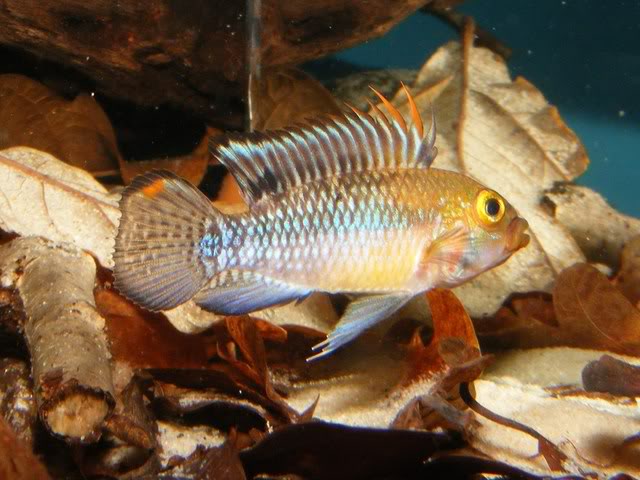
Apistogramma norberti is a dwarf cichlid from the Río Tahuayo and Río Tamshiyacu, minor Amazon tributaries south of Iquitos in northeastern Peru. Known before its description as A. sp. 'großmaul' or 'bigmouth', and coded A190, its position within the genus is unresolved and it is only tentatively placed in the A. cacatuoides group. It lives in minor jungle streams whose volume changes significantly with the season.
Distribution
EditDescribed from a brook in the Río Tahuayo basin but also occurs in the nearby Río Tamshiyacu drainage, both minor tributaries draining into the Amazon mainstream south of the city of Iquitos, Loreto Region, northeastern Peru.
Habitat
Write a noteEditMinor jungle streams which undergo significant changes in water volume depending on time of year.
Aquarium size
Write a noteEditBase dimensions around 45 ∗ 30 cm18 ∗ 12 in are acceptable for a single pair with a group requiring larger quarters.
Maintenance
Write a noteEditProvided adequate cover and structure is available this species is unfussy with regards to décor with ceramic flowerpots, lengths of plastic piping and other artificial materials all useful additions. A more natural-looking arrangement might consist of a soft, sandy substrate with wood roots and branches placed such a way that plenty of shady spots and caves are formed. The addition of dried leaf litter (beech, oak or Ketapang almond leaves are all suitable) would further emphasise the natural feel and with it bring the growth of beneficial microbe colonies as decomposition occurs. These can provide a valuable secondary food source for fry, while the tannins and other chemicals released by the decaying leaves aid in simulation of naturalistic conditions. Leaves can be left in the tank to break down fully or removed and replaced every few weeks. A net bag filled with aquarium-safe peat can also be added to the filter or suspended over the edge of the tank. Fairly dim lighting is recommended and plant species from genera such as Microsorum, Taxiphyllum, Cryptocoryne and Anubias are best since they will grow under such conditions. A few patches of floating vegetation to diffuse the light even further may also prove effective. Filtration, or at least water flow, should not be very strong and very large water changes are best avoided with 10-15% weekly adequate provided the tank is lightly-stocked.
Water conditions
EditThese recommendations come from this profile’s own figures. They contain affiliate links, so we may earn a commission.
Diet
Write a noteEditPrimarily carnivorous and feeds mostly on benthic invertebrates in nature. In the aquarium live and frozen foods such as Artemia, Daphnia and chironomid larvae (bloodworm) should be offered regularly although most specimens will also learn to accept dried alternatives with pelleted products generally preferred to flake.
Behaviour and compatibility
Write a noteEditCaptive-raised fish are the recommended choice for the community aquarium. Wild examples are best maintained alone or with small 'dither' fishes such as Nannostomus or Micropoecilia spp., and ideally should not be mixed with other Apistogramma.
Sexual dimorphism
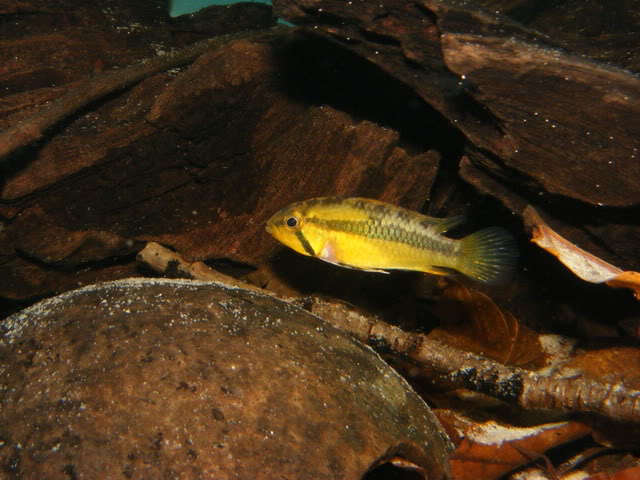
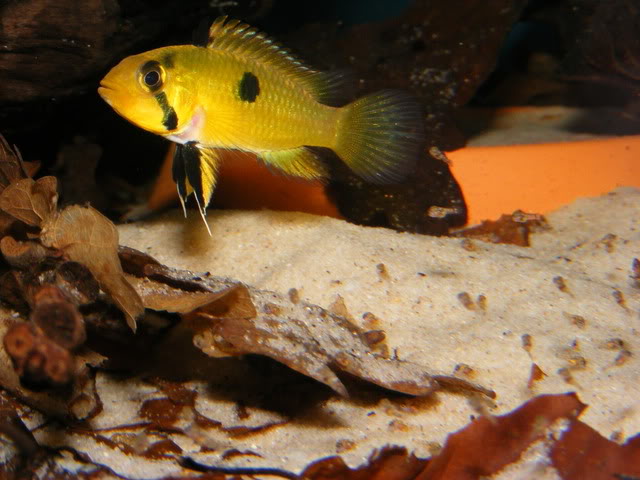
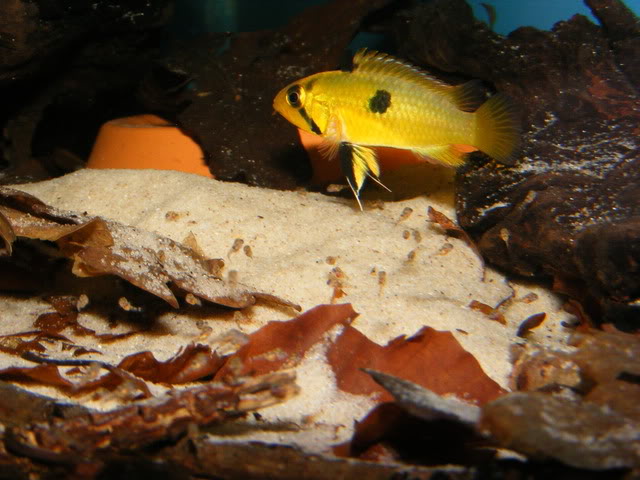
Write a noteEditMales are larger, more colourful and develop more extended fins than females.
Reproduction
Write a noteEditSubstrate spawner which normally lays its eggs in crevices or cavities among the décor. The female is responsible for post-spawning care of eggs and fry and in smaller aquaria the male may need to be removed as she may become hyper-aggressive.
Notes
EditPrior to decription this species was known as A. sp. 'großmaul' or 'bigmouth', and it has also been assigned the code A190 under the DATZ system. The genus Apistogramma is among the most speciose of South American cichlid genera with around 70 species valid at present but many more awaiting description. In addition many species exist in two or more geographical colour forms which may or may not turn out to be distinct in the future. Hobbyists tend to label these with collection data if available in order to avoid mixing them and the potential of hybridisation. Member species have also been organised into a series of species lineages, sublineages, complexes and groups by authors in order to better separate them. Such lists have been augmented by fish that have appeared in the aquarium trade and are in a state of near-constant flux. The precise position of A. norberti within this system remains unresolved, with it only tentatively placed in the A. cacatuoides group as it exhibits some characters typical of A. nijsseni group species. Kullander (1998) conducted a morphology-based phylogenetic study in which the neotropical family Cichlidae was divided into six subfamilies of which the putative subfamily Geophaginae contained 16 genera divided among three 'tribes': Acarichthyini - Acarichthys and Guianacara. Crenicaratini - Biotoecus, Crenicara, Dicrossus and Mazarunia. Geophagini - Geophagus, Mikrogeophagus, 'Geophagus' brasiliensis group, 'Geophagus' steindachneri group, Gymnogeophagus, Satanoperca, Biotodoma, Apistogramma, Apistogrammoides and Taeniacara. Later molecular studies by Farias et al. (1999, 2000, 2001) resulted in the additions of Crenicichla and Teleocichla to the Geophaginae, a result supported by López-Fernández et al. (2005) who conducted the most detailed molecular analysis of the grouping to date including 16 of the 18 genera and 30 species. However their conclusions regarding interrelationships between genera did vary somewhat from previous hypotheses and can be summarised by the following loosely-defined groups: - a weakly-supported sister group relationship between Acarichthys and Guianacara. - a well-supported "Satanoperca clade" comprising Satanoperca, Apistogramma, Apistogrammoides and Taeniacara. - a "big clade" with Geophagus, Mikrogeophagus, 'Geophagus' brasiliensis group, 'Geophagus' steindachneri group, Gymnogeophagus, Biotodoma, Crenicara and Dicrossus. - a "crenicarine clade" with Biotoecus and Crenicichla. No representatives of Teleocichla or Mazarunia were included in the study but the former is well-established as sister to Crenicichla while the latter has grouped closely with Dicrossus and Crenicara in earlier works. The other main conclusions of the paper are confirmation that Geophaginae is a monophyletic group exhibiting strong signs of having undergone rapid adaptive radiation (diversification of a species or single ancestral type into several forms that are each adaptively specialised to a specific environmental niche).
Species images · 4
These photographs are used with each photographer’s permission.
Send a photographDistribution
Profile completeness19 of 24
79% complete
Also missing: a common name, water condition notes, etymology.
Community
Questions about Apistogramma norberti?
Ask on Discord