Chanda pulcinella
Humphead Perchlet
Formerly Parambassis pulcinella
On this page11 sections
Quick facts
Difficulty4 of 8 measures
More bars, more demanding. Hardiness is not averaged with the rest.
- Space
- large tank
- Water
- mild adjustment
- Temp
- steady heat
- Diet
- unknown
- Temperament
- peaceful
- Social
- unknown
- Compatibility
- unknown
Hardiness on its own can raise the rating, whatever the measures above say.
- Hardiness
- unknown
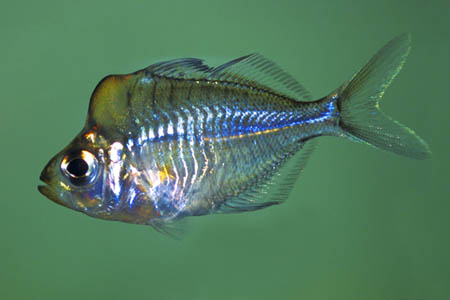
The humphead perchlet, Chanda pulcinella, is a freshwater ambassid endemic to Myanmar, where it inhabits large, fast-flowing, clear streams. Described in 2003, it takes its name from the scaleless hump on its head, formed from an extension of the spine and apparently smaller in females. Artificially dyed specimens have reached the market and should be avoided, since the process is cruel and usually shortens the fish's life considerably.
Distribution
Habitat
It inhabits large freshwater streams, typified by fast flowing, well-oxygenated, clear water. The substrate in many of these biotopes is composed of smooth, water-worn rocks and boulders of varying sizes.
Aquarium size
This is quite an active species and needs a tank of at least 90 ∗ 30 ∗ 30 cm36 ∗ 12 ∗ 12 in - ~81 litres~21 US gal.
Maintenance
Decor is not critical. Plants, rocks, driftwood etc. can all be used to your own taste. This is a freshwater species and does not require the addition of salt to it's tank.
Water conditions
Temperature: 23 – 27 °C73 – 81 °F
pH: 7.0-7.5
Hardness: 8-15°H
These recommendations come from this profile’s own figures. They contain affiliate links, so we may earn a commission.
Diet
It will accept dried pellets or flakes, but these should be supplemented with regular feedings of live and frozen foods such as bloodworm and brineshrimp.
Behaviour and compatibility
A peaceful species but it might intimidate small fish with it's active nature and adult size. Good tankmates include rainbowfish, barbs and loaches. It can be maintained in groups although they may occasionally squabble amongst themaselves. This will rarely involve anything more than a bit of chasing, however.
Sexual dimorphism
Apparently the hump is smaller in females than males.
Reproduction
Has not yet been achieved in aquaria.
Notes
A new species that was only described to science in 2003, little is known about the natural behaviour of C. pulcinella. It has started to be imported quite regularly over the last couple of years, although it is still quite expensive. Unfortunately this species has suffered the same fate as some of it's close relatives, and artificiallly dyed specimens have been making their way onto the market. These should be avoided at all costs, as the processes involved are cruel and unecessary, and usually shorten the life of the fish considerably.
The characteristic hump on the head of the fish is formed from an extension of the spine, and is scaleless.
Species images · 1
Used with the photographer’s permission. Not licensed for reuse.
How the name has changed
Moved from Parambassis pulcinella to Chanda pulcinella.
2025Morphological comparison within the glass perchlets genus Ambassis (Osteichthyes: Ovalentalia: Ambassidae), with reference to the comparison of some characters shared with other related genera
Profile completeness19 of 24
79% complete
Also missing: a recorded distribution, etymology.
Community
Questions about Chanda pulcinella?
Ask on Discord