Hobbyist group · Other groups
Glassfishes
- Species
- 6
- Families
- 1
- Genera
- 3
- Photographed
- 6 of 6
- Difficulty rated
- 6 of 6
Families
Where they come fromnative records only
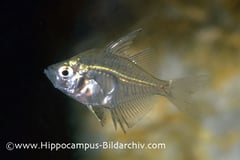
Chanda rangaIndian Glass Fish
Ambassidae · Hamilton, 1822
The Indian glass fish, Chanda ranga, is a small ambassid from South and Southeast Asia, with translucent skin that shows its bones and organs. For many years it was injected with luminous dyes on Asian fish farms and sold as 'painted' glass fish, and most injected fish do not survive more than a few months. It is found most often in freshwater, frequently soft and acidic, and needs no added salt. Parambassis lala and C. siamensis are often imported under its name.
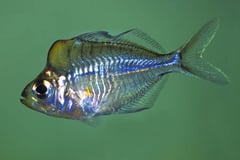
Chanda pulcinellaHumphead Perchlet
Ambassidae · (Kottelat, 2003)
The humphead perchlet, Chanda pulcinella, is a freshwater ambassid endemic to Myanmar, where it inhabits large, fast-flowing, clear streams. Described in 2003, it takes its name from the scaleless hump on its head, formed from an extension of the spine and apparently smaller in females. Artificially dyed specimens have reached the market and should be avoided, since the process is cruel and usually shortens the fish's life considerably.
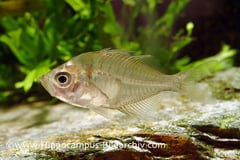
Chanda siamensis
Ambassidae · Fowler, 1937
Chanda siamensis is a small glass fish from Thailand, Laos, Cambodia, Vietnam, Malaysia, Singapore and Indonesia. An occasional import, it is sometimes sold as C. ranga, the Indian glass fish, but lacks patterning behind the eye and has a more elongate body. C. siamensis inhabits lowland rivers and flooded fields and is exclusively a freshwater fish, so it should never be kept under brackish conditions.
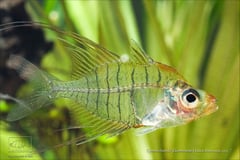
Gymnochanda filamentosa
Ambassidae · Fraser-Brunner, 1955
Gymnochanda filamentosa is a small glassfish known from Johor in southern Peninsular Malaysia and the Kapuas system in West Kalimantan, Borneo. Males carry filamentous dorsal and anal-fin rays, and the body is transparent to translucent yellowish-brown in life. It occurs in swampy, acidic waters over silt and peat, and has appeared in the ornamental trade but is evidently delicate and recommended only to experienced aquarists.
Gymnochanda verae
Ambassidae · Tan & Lim, 2011
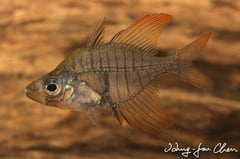
Gymnochanda verae is a small glassfish known only from the Gantung area of Belitung Island, in Indonesia's Bangka-Belitung Islands province. Mature males have extended anal and second dorsal fins forming a triangular profile, with the outer parts of those fins and of the caudal-fin lobes carmine red in life. Females have neither elongated rays nor colour. It has appeared in the ornamental trade but is evidently delicate and recommended only to experienced aquarists.
Parambassis wolffiiDuskyfin Glass Fish
Ambassidae · authority not recorded
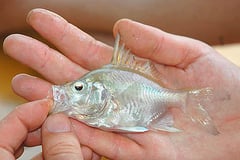
The duskyfin glass fish, Parambassis wolffii, is a large, predatory ambassid from Thailand, Laos, Cambodia, Vietnam and Indonesia. It inhabits slow-moving and standing waters, including floodplains, and is very common in its native countries, where it is used as a food fish. It grows to around 20 cm, though not usually in aquaria, and eats any small tankmates.