Herichthys pearsei
On this page11 sections
Quick facts
Difficulty4 of 8 measures
More bars, more demanding. The first 7 are averaged into the rating.
- Space
- very large tank
- Water
- tap water
- Temp
- unfussy
- Diet
- unknown
- Temperament
- peaceful
- Social
- unknown
- Compatibility
- unknown
Not averaged. It sets the lowest rating this fish can be given, whatever the measures above say.
- Hardiness
- unknown
Like many cichlids, members of the genus Herichthys share something of a confused taxonomic past. Erected in 1854 with H. cyanoguttatus the type species, its members were moved into Cichlasoma by Regan in 1905. However following a review of Cichlasoma by Kullander in 1983 it was once again deemed valid. In 1996 Kullander suggested Herichthys should only contain species "sharing a colour pattern of short vertical bars or black spots posteriorly from the middle of the side, and a unique breed...
Distribution
Habitat
Inhabits river basins and lakes, where it tends to be found in vegetated marginal areas. It's also been recorded in brackish water on occasion, although it's unknown if it withstand these conditions long term.
Aquarium size
Something in the region of 240 ∗ 60 ∗ 60 cm96 ∗ 24 ∗ 24 in - ~864 litres~228 US gal would be needed for a fully-grown adult male or pair.
Maintenance
A substrate of gravel or sand with cover in the form of large, smooth rocks and boulders is ideal. Any plants will be eaten immediately. Obviously a large biological filter is required for a fish of this size.
Water conditions
Temperature: 24 – 30 °C75 – 86 °F
pH: Neutral to alkaline water within the pH range 7.2 - 8.5 is preferred.
Hardness: 10 - 25°H
These recommendations come from this profile’s own figures. They contain affiliate links, so we may earn a commission.
Diet
Almost exclusively vegetarian. Wild fish are known to feed on a range of algae and both aquatic and terrestrial plants.
Behaviour and compatibility
Despite its large size this is actually quite a placid species and can be kept in a community of bigger fish in a suitably-sized tank. Possible tankmates include large cyprinids, characins, catfish, Loricariids and in a very large tank, other Central American cichlids. Bear in mind the hard water conditions required when choosing tankmates.
Sexual dimorphism
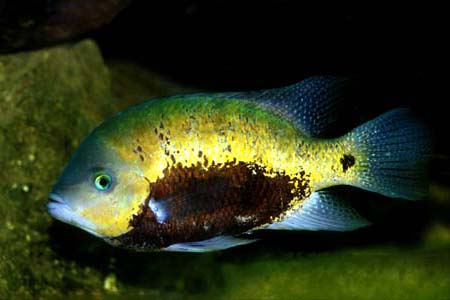
Males grow larger than females, are more brightly coloured and tend to develop a higher forehead as they mature.
Reproduction
There's not much information around on spawning H. pearsei, but it is possible. It's a bi-parental substrate spawner that lays its eggs in a pre-excavated pit constructed by the male. A good start would be a large tank containing hard, alkaline water. Buy a group of 6 or so young fish and grow them on together to give yourself the best chance of obtaining a pair, and be prepared to rehouse the other fish once a pair forms.
Notes
Like many cichlids, members of the genus Herichthys share something of a confused taxonomic past. Erected in 1854 with H. cyanoguttatus the type species, its members were moved into Cichlasoma by Regan in 1905. However following a review of Cichlasoma by Kullander in 1983 it was once again deemed valid. In 1996 Kullander suggested Herichthys should only contain species "sharing a colour pattern of short vertical bars or black spots posteriorly from the middle of the side, and a unique breeding colour pattern in which the dorsal half of the entire head and anterior flank region turns a pale greyish in contrast to black or dark grey adjacent areas orthe entire body turns pale". There are currently ten member species, with the possibility of further changes at some point in the future.
Species images · 2
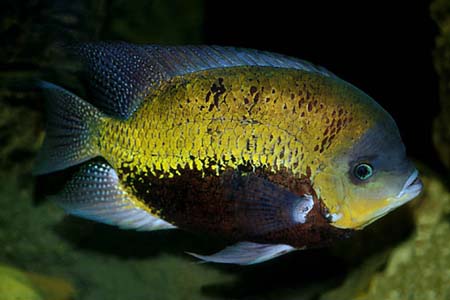
Used with the photographer’s permission. Not licensed for reuse.
Profile completeness17 of 24
71% complete
- references
- a recorded distribution
- taxonomic authority
- a common name
- social needs
- community suitability
- etymology
Community
Questions about Herichthys pearsei?
Ask on Discord