Country · North & Central America
Mexico
Only species with a profile on Seriously Fish are counted, whether native or introduced.
- Species
- 22
- Families
- 8
- Genera
- 15
- Found only here
- 8
- Photographed
- 19 of 22
Shares its fishes withspecies recorded in both
Found only here8
8 of the species on this page are recorded in Mexico and in no other country. This is not the same as being endemic.
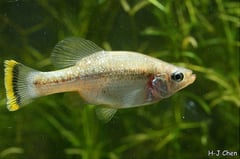
Ameca splendensButterfly Goodeid
Goodeidae · Miller & Fitzsimons, 1971
The butterfly goodeid, Ameca splendens, is a livebearer from the Río Ameca drainage in Jalisco, Mexico, and the neighbouring Sayula valley. Often referred to as extinct in the wild, it still survives at a few localities, and strong captive populations exist in the hobby. As in other goodeids, the developing young are nourished by a structure known as the trophotaenia. Males can be quite aggressive, and it is better kept in a species set-up.
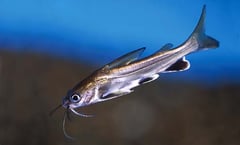
Ariopsis seemanniColombian Shark Catfish
Ariidae · (Günther, 1864)
The Colombian shark catfish, Ariopsis seemanni, is an ariid catfish from river mouths along the Pacific coast of the Americas, from Mexico to Peru. Usually sold as a silvery 2 to 3 inch juvenile, it grows to 350 mm SL and lives mostly in brackish water, so it is not recommended to those lacking the facilities to house it for life. Venom glands at the base of the first dorsal spine can cause a painful swelling.

Astyanax mexicanusBlind Cave Tetra
Characidae · (De Filippi, 1853)
The blind cave tetra, Astyanax mexicanus, is a characid found from Texas and New Mexico in the southern United States through Mexico into Guatemala. The eyeless, troglomorphic form lives only in underground caves in Mexico and is produced in huge numbers on Far Eastern farms, while the surface form is rarely seen in the hobby. The two may have diverged within the last 10,000 years, and the blind form finds its way with its lateral line.
Characodon lateralisRainbow Characodon
Goodeidae · Günther, 1866
The rainbow characodon, Characodon lateralis, is a goodeid putatively restricted to springs below the El Saltito waterfall in Durango, Mexico. Populations above the waterfall in the upper Río Mezquital appear to be the congener C. audax, and the names 'rainbow goodeid' and 'red prince' have been applied to both. Endangered in the wild, each population differs in colour and shape and should be kept separately in aquaria, never mixed with the aquarium strain of unclear origin.

Cichlasoma salviniSalvini
Cichlidae · authority not recorded
Salvin's cichlid, Cichlasoma salvini, is a Central American cichlid native to eastern parts of southern Mexico, Guatemala and Belize. It has a well-deserved reputation for aggression, especially when breeding, and will prey on any fish it can fit in its mouth. It does not need a huge tank, with males reaching around 6 inches and females 4.5, and a true pair is best obtained by growing on six juveniles.
Cichlasoma trimaculatumThree Spot Cichlid
Cichlidae · authority not recorded
The three spot cichlid or trimac, Cichlasoma trimaculatum, is a large cichlid from western Mexico, Guatemala and El Salvador. It lives mainly in sluggish waters of the Pacific coastal plains, among roots, branches and vegetation over mud and sand. A fairly aggressive fish that grows to around 40 cm, it is believed to be one of the species used to create the flowerhorn hybrid, and both parents guard the eggs and fry.

Cichlasoma urophthalmusMayan Cichlid
Cichlidae · authority not recorded
The Mayan cichlid, Cichlasoma urophthalmus, is a large cichlid native to eastern parts of Mexico, Belize, Guatemala, Honduras and Nicaragua. Also known as the Mexican mojarra, it lives in swamps, marshes and coastal lagoons, can tolerate and even breed in full marine conditions, and is often seen spawning around mangroves. Territorial and fairly aggressive, it is regarded as a potential pest fish in the USA, where introduced populations exist.
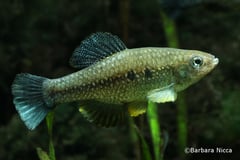
Cualac tessellatusCheckered Pupfish
Cyprinodontidae · Miller, 1956
The checkered pupfish, Cualac tessellatus, is a cyprinodontid endemic to a handful of springs in the Río Verde valley, San Luis Potosí, Mexico. Listed as Endangered by the IUCN, it lives in the shallow margins of crystal-clear, very hard spring-fed pools, including the Media Luna lagoon system. It is rarely available in the hobby, and captive breeding depends on very hard water, with the best results where chunks of gypsum rock are left to dissolve.
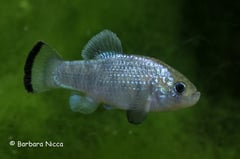
Cyprinodon alvareziPotosí Pupfish
Cyprinodontidae · Miller, 1976
The Potosí pupfish, Cyprinodon alvarezi, is a pupfish from a single isolated spring near El Potosí in Nuevo León state, northern Mexico. It has been extinct in nature since the late 1990s, after the spring-fed pond at La Hediondilla dried up through extraction of its water for irrigation and other human uses. The species now exists only in captivity, and its preservation means it is not recommended for the community fish keeper.

Rocio octofasciataJack Dempsey Cichlid
Cichlidae · (Regan, 1903)
The Jack Dempsey cichlid, Rocio octofasciata, is native to the Atlantic slope of Central America in Mexico, Belize, Guatemala and Honduras. Its name apparently comes from the American heavyweight boxer, for its 'strong facial features' and pugnacious nature. Tankmates must be too large to be viewed as prey. A bright blue strain, the 'electric blue Jack Dempsey', tends to stay smaller and may be less aggressive.

Thorichthys meekiFiremouth Cichlid
Cichlidae · Brind, 1918
The firemouth cichlid, Thorichthys meeki, is a Central American cichlid from Mexico's Atlantic slope and the Yucatán south into Belize and Guatemala. A popular aquarium fish for a long time, it is almost always commercially raised. It is easily identified by the bright red or orange underside of the head, which is more pronounced in adults. It is not especially aggressive but becomes territorial when breeding.
Xiphophorus helleriiGreen Swordtail
Poeciliidae · Heckel, 1848
The green swordtail, Xiphophorus hellerii, is a livebearer native to southeastern Mexico, Guatemala, Belize and Honduras. Among the world's most recognisable aquarium fishes, it is ubiquitous in the trade, where selective breeding and hybridisation with X. maculatus and X. variatus have produced a bewildering array of ornamental forms. The name is often misspelled X. helleri.
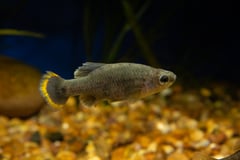
Zoogoneticus tequilaTequila Splitfin
Goodeidae · Webb & Miller, 1998
The tequila splitfin, Zoogoneticus tequila, is a goodeid endemic to the Río Teuchitlán in the Río Ameca headwaters of Jalisco, Mexico. Thought to be Extinct in the Wild when described, it has been the subject of a reintroduction project begun in 2015 by the University of Morelia, Chester Zoo and the Goodeid Working Group. A nippy livebearer, it has few suitable tankmates and needs space for females and subdominant males to escape breeding males.
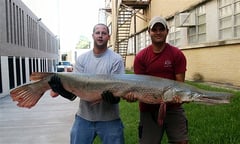
Atractosteus spatulaAlligator Gar
Lepisosteidae · (Lacepède, 1803)
The alligator gar, Atractosteus spatula, is a gar from the lower Mississippi basin and Gulf Coast states of the south-eastern USA and Mexico. One of the largest freshwater fishes in the world, it reaches a recorded 3050 mm and can live well over 50 years, so it should not be considered a home aquarium subject. Juveniles are seen for sale quite regularly, and a hybrid with Lepisosteus platostomus is known as the 'crocodile gar'.
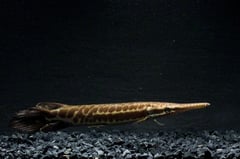
Atractosteus tropicusTropical Gar
Lepisosteidae · Gill, 1863
The tropical gar, Atractosteus tropicus, is a gar from Caribbean and Pacific-slope drainages of Central America, from southern Mexico to Costa Rica. It grows to 1250 mm SL and can live for several decades, so it should not be considered a home aquarium subject, though juveniles are occasionally offered in the trade. Like other gars it can breathe atmospheric air to a certain extent through a modified, vascularised swim bladder.

Ctenopharyngodon idellaGrass Carp
Cyprinidae · (Valenciennes, 1844)
The grass carp, Ctenopharyngodon idella, is a large cyprinid native to the Amur River system in eastern Russia and northeastern China. Adults typically reach 800 to 1200 mm, making it a wholly unsuitable aquarium subject, though an albino form is traded. Widely introduced for aquaculture and weed control, it has caused serious damage to natural waters, and unwanted fish should never be released.

Hyphessobrycon compressusMayan Tetra
Characidae · (Meek, 1904)
The Mayan tetra, Hyphessobrycon compressus, is a characid from southern Mexico, Guatemala and Belize. The type species of the genus Hyphessobrycon, it is not well known in the ornamental trade. Analysis has shown it to be more closely related to 'rosy tetra' species such as H. eques and H. pulchripinnis than to many other members of the genus. It has been collected from rivers, streams, temporal swamps and permanent lakes.
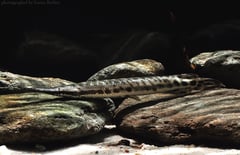
Lepisosteus oculatusSpotted Gar
Lepisosteidae · Winchell, 1864
The spotted gar, Lepisosteus oculatus, ranges from Lakes Erie and Michigan south through the Mississippi basin to the Gulf of Mexico drainages. Given its size and a lifespan of several decades it should not be considered a home aquarium subject, and only some public aquaria can maintain it long-term. A modified, vascularised swim bladder allows it to breathe atmospheric air to a certain extent.
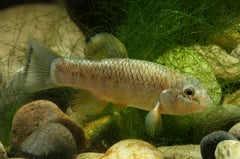
Cyprinodon pachycephalus
Cyprinodontidae · Minckley & Minckley, 1986
Cyprinodon pachycephalus is a pupfish endemic to the thermal spring of San Diego de Alcalá and its distributaries in Chihuahua state, northern Mexico. The springs produce water at a constant 43.8 °C, cooling downstream, and in the lower part of the system it forms natural hybrids with the congener C. eximius.
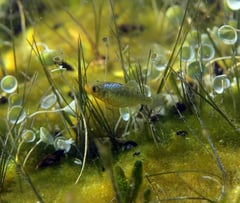
Cyprinodon variegatusSheepshead 'Minnow'
Cyprinodontidae · Lacepède, 1803
The sheepshead 'minnow', Cyprinodon variegatus, is a pupfish ranging from the northeastern U.S.A. to northeastern Mexico, the Bahamas and Antilles. It tends to be most common in brackish to hypersaline environments such as coastal salt marshes, lagoons and estuaries. On San Salvador Island in the Bahamas it appears to be the parent of a group of species living in sympatry and exploiting diverse but specific resources.
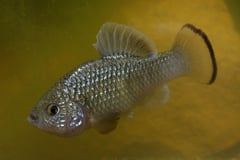
Cyprinodon veronicaeCharco Palma Pupfish
Cyprinodontidae · Lozano-Vilano & Contreras-Balderas, 1993
The Charco Palma pupfish, Cyprinodon veronicae, is a pupfish known only from the spring Ojo de Agua Charco Azul in Nuevo León, Mexico. The Bolsón de Sandia spring system has been dry since the late 1990s because of water extraction by local communities, and all four Cyprinodon species described from it are now considered extinct in the wild. Nuptial males are violaceous blue.
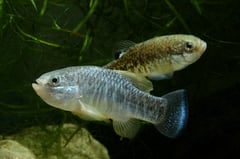
Cyprinodon julimesJulimes Pupfish
Cyprinodontidae · De la Maza-Benignos & Vela-Valladores, 2009
The Julimes pupfish, Cyprinodon julimes, is known only from a geothermal spring in the middle Río Conchos basin, Chihuahua state, northern Mexico. The water there fluctuates between 38 and 48 °C, and the spring is considered one of the hottest environments inhabited by fish in the world. Its closest relatives are C. eximius and C. pachycephalus.