Country · North & Central America
Guatemala
Only species with a profile on Seriously Fish are counted, whether native or introduced.
- Species
- 11
- Families
- 5
- Genera
- 9
- Found only here
- 0
- Photographed
- 9 of 11
Shares its fishes withspecies recorded in both
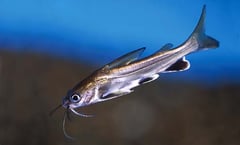
Ariopsis seemanniColombian Shark Catfish
Ariidae · (Günther, 1864)
The Colombian shark catfish, Ariopsis seemanni, is an ariid catfish from river mouths along the Pacific coast of the Americas, from Mexico to Peru. Usually sold as a silvery 2 to 3 inch juvenile, it grows to 350 mm SL and lives mostly in brackish water, so it is not recommended to those lacking the facilities to house it for life. Venom glands at the base of the first dorsal spine can cause a painful swelling.

Astyanax mexicanusBlind Cave Tetra
Characidae · (De Filippi, 1853)
The blind cave tetra, Astyanax mexicanus, is a characid found from Texas and New Mexico in the southern United States through Mexico into Guatemala. The eyeless, troglomorphic form lives only in underground caves in Mexico and is produced in huge numbers on Far Eastern farms, while the surface form is rarely seen in the hobby. The two may have diverged within the last 10,000 years, and the blind form finds its way with its lateral line.

Cichlasoma salviniSalvini
Cichlidae · authority not recorded
Salvin's cichlid, Cichlasoma salvini, is a Central American cichlid native to eastern parts of southern Mexico, Guatemala and Belize. It has a well-deserved reputation for aggression, especially when breeding, and will prey on any fish it can fit in its mouth. It does not need a huge tank, with males reaching around 6 inches and females 4.5, and a true pair is best obtained by growing on six juveniles.
Cichlasoma trimaculatumThree Spot Cichlid
Cichlidae · authority not recorded
The three spot cichlid or trimac, Cichlasoma trimaculatum, is a large cichlid from western Mexico, Guatemala and El Salvador. It lives mainly in sluggish waters of the Pacific coastal plains, among roots, branches and vegetation over mud and sand. A fairly aggressive fish that grows to around 40 cm, it is believed to be one of the species used to create the flowerhorn hybrid, and both parents guard the eggs and fry.

Cichlasoma urophthalmusMayan Cichlid
Cichlidae · authority not recorded
The Mayan cichlid, Cichlasoma urophthalmus, is a large cichlid native to eastern parts of Mexico, Belize, Guatemala, Honduras and Nicaragua. Also known as the Mexican mojarra, it lives in swamps, marshes and coastal lagoons, can tolerate and even breed in full marine conditions, and is often seen spawning around mangroves. Territorial and fairly aggressive, it is regarded as a potential pest fish in the USA, where introduced populations exist.

Rocio octofasciataJack Dempsey Cichlid
Cichlidae · (Regan, 1903)
The Jack Dempsey cichlid, Rocio octofasciata, is native to the Atlantic slope of Central America in Mexico, Belize, Guatemala and Honduras. Its name apparently comes from the American heavyweight boxer, for its 'strong facial features' and pugnacious nature. Tankmates must be too large to be viewed as prey. A bright blue strain, the 'electric blue Jack Dempsey', tends to stay smaller and may be less aggressive.

Thorichthys meekiFiremouth Cichlid
Cichlidae · Brind, 1918
The firemouth cichlid, Thorichthys meeki, is a Central American cichlid from Mexico's Atlantic slope and the Yucatán south into Belize and Guatemala. A popular aquarium fish for a long time, it is almost always commercially raised. It is easily identified by the bright red or orange underside of the head, which is more pronounced in adults. It is not especially aggressive but becomes territorial when breeding.
Xiphophorus helleriiGreen Swordtail
Poeciliidae · Heckel, 1848
The green swordtail, Xiphophorus hellerii, is a livebearer native to southeastern Mexico, Guatemala, Belize and Honduras. Among the world's most recognisable aquarium fishes, it is ubiquitous in the trade, where selective breeding and hybridisation with X. maculatus and X. variatus have produced a bewildering array of ornamental forms. The name is often misspelled X. helleri.

Amatitlania nigrofasciataConvict Cichlid
Cichlidae · (Günther, 1867)
The convict cichlid, Amatitlania nigrofasciata, is a Central American cichlid native from Guatemala to Panama. One of the most ubiquitous fish in the hobby, it is hardy and very easily bred, but aggressive and territorial, becomes violent when breeding and is best kept in a species tank. Pink, long-finned and marbled forms exist, and it has been introduced to several countries including the USA and Australia.
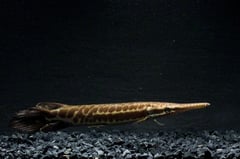
Atractosteus tropicusTropical Gar
Lepisosteidae · Gill, 1863
The tropical gar, Atractosteus tropicus, is a gar from Caribbean and Pacific-slope drainages of Central America, from southern Mexico to Costa Rica. It grows to 1250 mm SL and can live for several decades, so it should not be considered a home aquarium subject, though juveniles are occasionally offered in the trade. Like other gars it can breathe atmospheric air to a certain extent through a modified, vascularised swim bladder.

Hyphessobrycon compressusMayan Tetra
Characidae · (Meek, 1904)
The Mayan tetra, Hyphessobrycon compressus, is a characid from southern Mexico, Guatemala and Belize. The type species of the genus Hyphessobrycon, it is not well known in the ornamental trade. Analysis has shown it to be more closely related to 'rosy tetra' species such as H. eques and H. pulchripinnis than to many other members of the genus. It has been collected from rivers, streams, temporal swamps and permanent lakes.