Heros notatus
Spotted Severum
Last revised 2012Edit this page
On this page11 sections
Quick factsEdit
Difficulty4 of 8 measures
- Space
- large tank
- Water
- needs a steady pH
- Temp
- flexible
- Diet
- unknown
- Temperament
- eats smaller fish
- Social
- unknown
- Compatibility
- unknown
Other demands
Each of these can raise the rating on its own, whatever the measures above say.
- Hardiness
- unknown
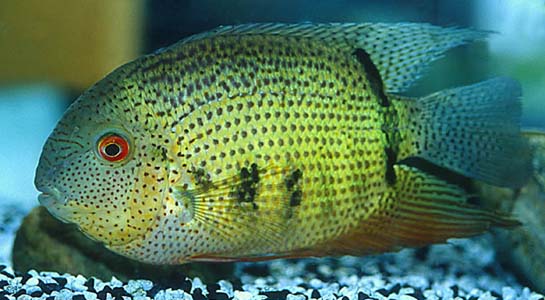
The spotted severum, Heros notatus, is a cichlid endemic to the Rio Negro basin in Brazil, where it inhabits blackwater rivers and tributaries. Rarely seen, it is occasionally offered by specialist cichlid or South American dealers. Not a particularly aggressive species, though males may squabble with conspecifics, it suits a larger cichlid community, and much smaller fish will almost certainly be eaten.
Distribution
EditHabitat
Write a noteEditBlackwater rivers and tributaries. The water in these biotopes is typically stained brown with tannins from decaying organic material and is very acidic as a result. This species is often found in marginal areas around submerged tree roots and branches.
Aquarium size
Write a noteEdit120 ∗ 38 ∗ 38 cm48 ∗ 15 ∗ 15 in - ~173 litres~46 US gal
Maintenance
Write a noteEditProvide a well planted tank with areas of open swimming space. A sand substrate is recommended as this fish likes to dig. Other decor in the form of bogwood, branches and smooth stones can also be used. Lighting levels are not critical and can be matched to the requirements of the plants used.
Water conditions
EditTemperature: 22 - 29° (72 - 84°F)
pH: 6.0 - 7.0
Hardness: Up to 10°H
These recommendations come from this profile’s own figures. They contain affiliate links, so we may earn a commission.
Diet
Write a noteEditOmnivorous. Accepts most foods in the aquarium. Feed a good quality cichlid pellet as a staple. Supplement this with foods such as bloodworm and brineshrimp or small pieces of prawn and white fish for larger severums. Will also appreciate some vegetable matter in the diet in the form of algae wafers or blanched greens.
Behaviour and compatibility
Write a noteEditSexual dimorphism
Write a noteEditMale is bigger, has more defined reddish markings on the gill covers and tends to develop longer extensions to the dorsal and anal fins.
Reproduction
Write a noteEditLimited reports of breeding in the hobby, as the fish is not often seen for sale.
Breeding is likely to follow similar patterns to heros severus where the pair will select a flat stone, or sometimes excavate a pit. Once the breeding area is prepared, eggs will be deposited by the female and then fertilised by the male. Both fish guard the eggs and when the fry hatch two to three days later, they are transferred to a pit where the parents keep them until they become free-swimming. This is usually 3 - 4 days after hatching. Both fish assume parental duties but can be easily spooked often leading to them eating the fry. It is advisable that the breeding tank be placed in a quiet location and distrubed as little as possible.
Fry can be fed on newly-hatched brineshrimp and powdered fry foods until large enough to take bigger foods.
Notes
EditA rarely seen, although attractive member of the severum family. This species is occasionally offered for sale through specialist cichild or South American dealers.
Species images · 1
These photographs are used with each photographer’s permission.
Send a photographProfile completeness18 of 24
75% complete
Also missing: a recorded distribution, taxonomic authority, etymology.
Community
Questions about Heros notatus?
Ask on Discord