Paretroplus damii
Formerly Paretrolplus damii
Last revised 2026Edit this page
On this page11 sections
Quick factsEdit
Difficulty3 of 8 measures
- Space
- very large tank
- Water
- needs a steady pH
- Temp
- needs a steady temperature
- Diet
- unknown
- Temperament
- unknown
- Social
- unknown
- Compatibility
- unknown
Other demands
Each of these can raise the rating on its own, whatever the measures above say.
- Hardiness
- unknown
- Needs a very large tank
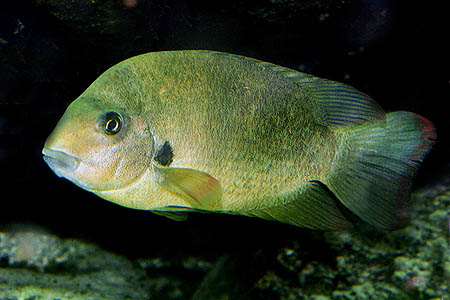
Paretroplus damii is a cichlid endemic to northwestern Madagascar, around Lake Pambilao. Moderately aggressive and growing to around 30 cm, it is best kept in groups with similarly sized cichlids of similar temperament. It digs, so plants need to be used with care.
Distribution
EditEndemic to northwestern Madagascar, around Lake Pambilao.
Habitat
Write a noteEditEndemic to northwestern Madagascar, around Lake Pambilao.
Aquarium size
Write a noteEdit180 ∗ 60 ∗ 60 cm72 ∗ 24 ∗ 24 in - ~648 litres~171 US gal for a group of adult fish.
Maintenance
Write a noteEditThe tank should be furnished with rocks and bogwood, used to form caves and territories for each fish. Plants should be used with care as this fish is a digger!
Water conditions
EditTemperature: 26 – 30 °C79 – 86 °F
pH: 7.0
Hardness: Up to 15°H
These recommendations come from this profile’s own figures. They contain affiliate links, so we may earn a commission.
Diet
Write a noteEditNot fussy in captivity. A range of foods should be offered including a good quality cichlid pellet with meaty foods such as chopped prawn and mussel being offered on a regular basis.
Behaviour and compatibility
Write a noteEditModerately aggressive cichlid. Best kept in groups and can also be kept with other similarly sized cichlids with similar temperaments, such as paratilapia polleni.
Sexual dimorphism
Write a noteEditDifficult to sex reliably.
Reproduction
Write a noteEditIf keeping this species as a group, a pair (or more than one) will inevitably form. Feeding an abundance of live foods will help bring the pair into condition. When the pair are ready to spawn they will begin excavating a series of pits in different areas of the tank. It is almost as if the fish are experimenting with different locations to see which is more secure. The pits are usually excavated between rocks or among plants to give maximum security and therefore the best chance of raising the fry.
Once the pair finally decide on a site, they enter into courtship behaviour, which can look like fighting. This happens so that the fish can "test" their potential mate to ensure that they are likely to have quality genes to pass on to the next generation.
As many as 200 eggs or more may be laid and then fertilsied by the male. The pair then take it in turns to guard the eggs with one parent remaining in the pit and the other patrolling the immediate vicinity. Eggs hatch in around three days and the fry are free-swimming around 4 - 6 days later.
Notes
EditAn attractive, if aggressive Madagascan cichlid. Not commonly available in the UK, it can occasionally be obtained through cichlid enthusiasts aor specialist dealers.
Species images · 1
These photographs are used with each photographer’s permission.
Send a photographHow the name has changed
Corrected the spelling of the genus to Paretroplus.
1868Eschmeyer's Catalog of Fishes: Paretroplus damii
Profile completeness16 of 24
67% complete
Also missing: a recorded distribution, taxonomic authority, a common name, etymology.
Community
Questions about Paretroplus damii?
Ask on Discord