Panaqolus sp.
L403
Last revised 2026Edit this page
On this page11 sections
Quick factsEdit
Difficulty6 of 8 measures
- Space
- large tank
- Water
- needs a steady pH
- Temp
- flexible
- Diet
- needs wood to graze
- Temperament
- unknown
- Social
- needs to be in a group
- Compatibility
- fine with others
Other demands
Each of these can raise the rating on its own, whatever the measures above say.
- Hardiness
- unknown
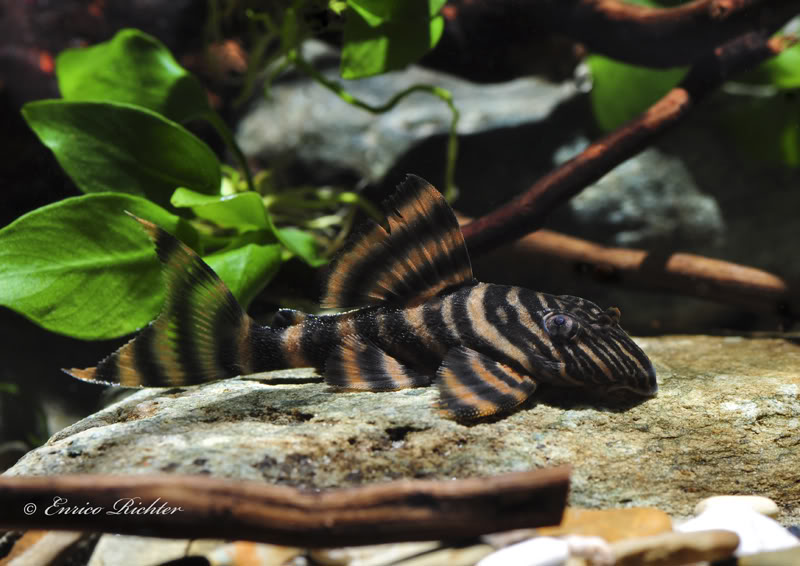
L403 is an undescribed wood-eating suckermouth catfish in the genus Panaqolus, known only from the rio Anapu in Pará state, Brazil. The species is xylophagous, feeding primarily on wood, so driftwood must be provided. It should be given a mainly vegetarian diet, with meaty foods kept to a minimum. It has been bred in aquaria.
Etymology
EditPanaqolus: a diminutive form of the generic name Panaque.
Distribution
EditAquarium size
Write a noteEditAn aquarium with base dimensions of 120 ∗ 30 cm48 ∗ 12 in or equivalent should be the smallest considered.
Maintenance
Write a noteEditNot difficult to maintain under the correct conditions; we strongly recommend keeping it in a tank designed to simulate a flowing stream with a substrate of variably-sized rocks, sand, fine gravel, and some water-worn boulders.
This can be further furnished with driftwood branches, terracotta pipes, plant pots, etc., arranged to form a network of nooks, crannies, and shaded spots, thus providing broken lines of sight.
Driftwood in particular is highly-recommended since this species feeds on wood (see 'Diet').
Water conditions
EditThese recommendations come from this profile’s own figures. They contain affiliate links, so we may earn a commission.
Diet
Write a noteEditSexual dimorphism
Write a noteEditReproduction
Write a noteEditHas been bred in aquaria.
Notes
EditThis species is currently banned from export.
References
- German, Donovan P. (2009). Inside the guts of wood-eating catfishes: can they digest wood? Journal of Comparative Physiology B 179(8), 1011-1023doi.org/10.1007/s00360-009-0381-1
- Lujan, Nathan K.; German, Donovan P.; Winemiller, Kirk O. (2011). Do wood‐grazing fishes partition their niche?: morphological and isotopic evidence for trophic segregation in Neotropical Loricariidae Functional Ecology 25(6), 1327-1338doi.org/10.1111/j.1365-2435.2011.01883.x
Species images · 1
These photographs are used with each photographer's permission.
Send a photographDistribution
Profile completeness19 of 24
79% complete
Also missing: taxonomic authority, habitat, water condition notes, behaviour and compatibility.
Community
Questions about Panaqolus sp.?
Ask on Discord