Every species
Filters

Betta tussyae
Schaller, 1985
Max length37mm SL1.5in SLTank45 × 30cm18 × 12inTemp22–27°C72–81°FpH3.0–6.0Betta tussyae is a small bubble-nesting labyrinth fish endemic to coastal Pahang and Terengganu states in eastern Peninsular Malaysia. This poorly-known member of the B. coccina group is an obligate inhabitant of peat swamps and blackwater streams, where the pH can be as low as 3.0 or 4.0. Its reddish orange body with two darker lateral stripes and faint gold vertical bars on the opercle separate it from similar group members. Populations such as Chukai and Rompin are often labelled by locality.

Betta uberis
Tan & Ng, 2006
Max length36mm SL1.4in SLTank45 × 30cm18 × 12inTemp22–27°C72–81°FpH4.0–6.0Betta uberis is a small bubble-nesting labyrinth fish from peat swamp forests in Central and West Kalimantan, Borneo, Indonesia. Most records come from between the lower Arut and Kumai rivers near Pangkalan Bun. Known to aquarists as Betta sp. 'Sukadana' or B. sp. 'Pangkalanbun' before its description, it belongs to the B. coccina group and is named for its high count of 14 to 17 dorsal-fin rays, which also separates it from its nearest neighbour in the group, B. hendra.

Betta unimaculata
(Popta, 1905)
Max length115mm SL5in SLTank80 × 30cm31 × 12inTemp21–26°C70–79°FpH5.0–7.5Betta unimaculata is a large mouthbrooding labyrinth fish from the upper Kayan and Mahakam river drainages in East Kalimantan, Borneo, Indonesia. Growing to around 115 mm SL, it has been collected from clear, flowing streams, elevated headwater pools and more turbid forest streams. Populations differ in colour and pattern and will hybridise, so they are labelled by locality and should never be kept together. Fish from 'Tawau' once thought to be this species have been described as B. ocellata.
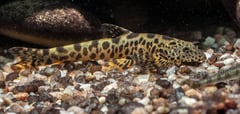
Bhavania australis
(Jerdon, 1849)
Max length100mm SL3.9in SLTank120 × 30cm48 × 12inTemp16–24°C61–75°FpH6.0–7.5Bhavania australis is a balitorid loach endemic to the Western Ghats mountains of southern India, recorded from Kerala, Tamil Nadu and Karnataka. An obligate dweller of shallow, fast-flowing, highly-oxygenated headwaters and minor tributaries, it has a flattened head and body and horizontally extended paired fins that form a powerful sucking cup for clinging to rocks. It is very rarely seen in the international aquarium trade but is maintained by a number of Indian aquarists.

Biotodoma cupidoCupid Cichlid
(Heckel, 1840)
Max length100mm SL3.9in SLTank150 × 45cm60 × 18inTemp20–30°C68–86°FpH5.0–7.0The cupid cichlid, Biotodoma cupido, is a geophagine cichlid from much of the Amazon basin, north to the Essequibo in Guyana and south to Bolivia. Also traded as the 'green-streaked eartheater', it varies in colour pattern and shape by locality, and most traded fish come from around Santarém in Pará state. Unless breeding it is surprisingly peaceful. Its relatively compact body and a dark flank blotch above the upper lateral line separate it from B. wavrini.

Biotodoma wavriniOrinoco Eartheater
(Gosse, 1963)
Max length100mm SL3.9in SLTank150 × 45cm60 × 18inTemp20–30°C68–86°FpH4.0–6.5The Orinoco eartheater, Biotodoma wavrini, is a geophagine cichlid from the Orinoco and rio Negro basins of Venezuela, Colombia and Brazil. One natural habitat is the Río Cinaruco, a low-nutrient blackwater tributary of the Orinoco. It can be told from B. cupido by its noticeably elongate body and a dark flank blotch on or below the upper lateral line. Unless breeding it is surprisingly peaceful, and trade populations include 'Cuao', 'Orinoco', 'San Antonio' and 'Sipapo Ventuari'.

Biotoecus opercularis
(Steindachner, 1875)
Max length40mm SL1.6in SLTank90 × 30cm36 × 12inTemp25–30°C77–86°FpH4.0–6.5Biotoecus opercularis is a small geophagine cichlid from the middle Amazon basin in Brazil, including the lower Madeira, Tapajós and Negro. It favours shallow, slow-flowing water over sand with leaf litter and submerged wood, often stained with tannins. Several populations are traded, among them B. sp. 'rio Negro' from the rio Jauaperi and B. sp. 'Santarém' or 'Tapajós', though no scientific evidence shows them to be more than one species. It should not be mixed with other Biotoecus species or populations.
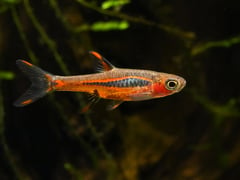
Boraras brigittaeMosquito Rasbora
(Vogt, 1978)
Max length20mm SL0.8in SLTank45 × 30cm18 × 12inTemp20–28°C68–82°FpH4.0–7.0The mosquito rasbora, Boraras brigittae, is a miniature cyprinid that appears to be endemic to southwestern Borneo. It inhabits blackwater streams and pools associated with forest peat swamps, where the water is very soft and acidic. The congener B. urophthalmoides is often traded under its name, but B. brigittae is larger, lacks a distinct dark blotch at the caudal peduncle and has brighter, more uniformly red patterning. Striped males of B. merah have led to speculation that the two are the same species.
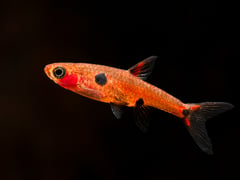
Boraras maculatusDwarf Rasbora
(Duncker, 1904)
Max length25mm SL1.0in SLTank45 × 30cm18 × 12inTemp20–28°C68–82°FpH4.0–6.5The dwarf rasbora, Boraras maculatus, is a miniature cyprinid from Peninsular Malaysia, southern Thailand, eastern Sumatra, Singapore and Bintan. It inhabits blackwater streams and rivers associated with forest peat swamps, where the water is very soft and acidic. Colour pattern varies between populations, some forms showing more intense red than others. It is most similar to B. naevus, in which the red body colouration does not extend into the head.
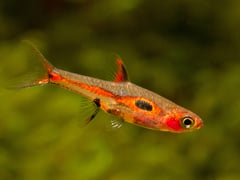
Boraras merah
(Kottelat, 1991)
Max length20mm SL0.8in SLTank45 × 30cm18 × 12inTemp20–28°C68–82°FpH4.0–6.5Boraras merah is a miniature cyprinid from southern Borneo, described from the Jelai Bila river basin near Sukamara in Central Kalimantan, Indonesia. Sometimes sold as the 'phoenix rasbora', it lacks colour in much of the body, with the red pigmentation concentrated around dark markings that tend to form spots or blotches. Fully-striped males have led to speculation that it is the same species as B. brigittae, though Kottelat (2013) argued for two species.

Boraras micros
Kottelat & Vidthayanon, 1993
Max length13mm SL0.5in SLTank45 × 30cm18 × 12inTemp20–28°C68–82°FpH6.0–7.0Boraras micros is a tiny cyprinid from the Mekong basin in northeastern Thailand, recorded in Nong Khai, Udon Thani and Sakon Nakhon provinces. Growing to only 13 mm SL, it inhabits shallow, clear, densely vegetated swamps, marshes, floodplains and rice paddies. Poorly documented and rarely seen in the trade, it has a rather plain pattern, and fish sold as B. micros var. 'red' or 'strawberry rasbora' are always B. maculatus, B. brigittae or B. naevus.
Boraras naevus
Conway & Kottelat, 2011
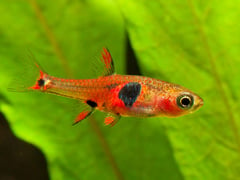
Max length20mm SL0.8in SLTank45 × 30cm18 × 12inTemp20–28°C68–82°FpH5.0–7.0Boraras naevus is a miniature cyprinid known only from the lower Tapi river drainage in Surat Thani province, southern (peninsular) Thailand. Before its description it was traded as B. sp. 'micros', 'red micros', 'Petch Noi' and 'strawberry rasbora', and it is exported only sporadically. It lives in shallow, clear swamps and marshes. Males have an anterior flank blotch much larger than that of females, a feature unique to this species within the genus.
Boraras urophthalmoides
(Kottelat, 1991)
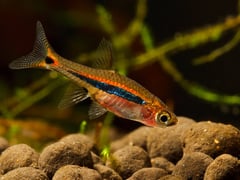
Max length16mm SL0.6in SLTank45 × 30cm18 × 12inTemp20–28°C68–82°FpH6.0–7.0Boraras urophthalmoides is a miniature cyprinid from southern and central Thailand, Cambodia and Vietnam, including the moats of Angkor Wat. It inhabits shallow, clear, vegetated swamps, marshes, floodplains and rice paddies. Some populations develop an orange-red stripe that leads to confusion with B. brigittae, but B. urophthalmoides is smaller, with a distinct round, dark blotch on the caudal peduncle and a long, unbroken lateral stripe. It is sometimes sold as the 'exclamation-point rasbora'.
Botia almorhaeYo-Yo Loach
Gray, 1831
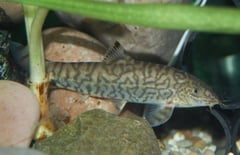
Max length160mm SL6in SLTank120 × 45cm48 × 18inTemp19–27.5°C66–82°FpH6.0–7.5The yo-yo loach, Botia almorhae, is a botiid loach from parts of the Ganges River drainage in northern India and possibly Nepal. It is often called the 'Pakistani' loach, but that name is a misnomer. B. almorhae sensu stricto appears to belong to a group of closely-related species and has possibly never been seen in the aquarium trade, where the most commonly available members seem to be B. lohachata, B. sp. 'Kosi' and B. sp. 'Teesta', plus assorted hybrids.
Botia darioBengal Loach
(Hamilton, 1822)
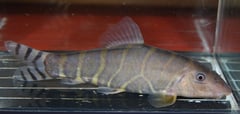
Max length130mm SL5in SLTank120 × 45cm48 × 18inTemp23–26°C73–79°FpH6.0–7.5The Bengal loach, Botia dario, is a botiid loach from the middle to lower Ganges and Brahmaputra drainages in northern India, Bangladesh and Bhutan. Its yellow to golden body carries 7-9 dark bars with thinner, lighter bars between, and its particularly curved head makes it among the most easily recognisable in the genus. Botia macrolineata, described from aquarium fish shipped via Bombay, represents the same species. It is among the botiids produced commercially using hormones.
Botia histrionica
Blyth, 1860
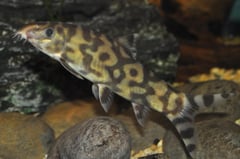
Max length130mm SL5in SLTank120 × 45cm48 × 18inTemp22–28°C72–82°FpH6.0–7.5Known in the trade as the 'Burmese loach', Botia histrionica is a botiid loach from Myanmar, Manipur in India and Yunnan, China. Young fish all carry five solid dark bars on each flank and are often confused with B. kubotai, but in B. histrionica the bars stay solid for longer and the central bar usually forms a 'y' shape. Adult patterning varies considerably between the Ayeyarwady, Salween, Manipur and Ataran forms, and there has been speculation that some represent distinct species.
Botia kubotaiPolka-Dot Loach
Kottelat, 2004
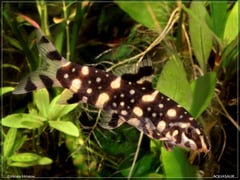
Max length150mm SL6in SLTank120 × 45cm48 × 18inTemp22–28°C72–82°FpH6.0–7.5The polka-dot loach, Botia kubotai, is a botiid loach that appears to be endemic to headwaters of the Salween basin in Myanmar and Thailand. It was traded before it was described and is still sold as 'angelicus', 'Burmese border loach' and 'marbled loach', among other names. Juveniles are often confused with B. histrionica, but the dark bars in B. kubotai split at a young age.
Botia rostrata
Günther, 1868
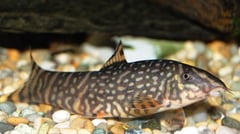
Max length120mm SL5in SLTank120 × 45cm48 × 18inTemp19–27°C66–81°FpH6.0–7.5Botia rostrata is a botiid loach from the lower Ganges and middle to lower Brahmaputra basins in northern India and Bangladesh. Traded as the 'Gangetic loach', 'twin-banded loach' or 'ladder loach', almost all fish sold under the name are B. sp. 'upper Brahmaputra', and B. rostrata sensu stricto is rarely, if ever, available. Juveniles carry 9-10 dark body bars, usually in pairs, which break up to differing extents as the fish grow.
Botia striataZebra Loach
Narayan Rao, 1920
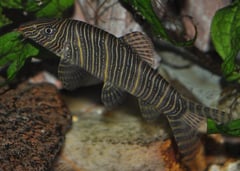
Max length90mm SL3.5in SLTank120 × 30cm48 × 12inTemp21–26°C70–79°FpH6.0–7.5The zebra loach, Botia striata, is a botiid loach from the Krishna River system in southern India, described from the Tunga River in Karnataka. Its yellow to golden body with blue, green, grey or black bars and typically red mouthparts make it one of the most easily recognised in the genus, although the bars break up entirely in some specimens. Given its adult size and peaceable nature it is perhaps the best choice of Botia for the general community.
Botia udomritthirujiEmperor Botia
Ng, 2007
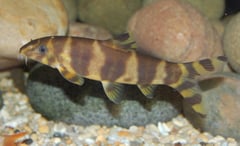
Max length150mm SL6in SLTank120 × 45cm48 × 18inTemp23–28°C73–82°FpH6.0–7.5The emperor botia, Botia udomritthiruji, is a botiid loach known only from the Tanintharyi River drainage in southern Myanmar. Known since 1993, it was occasionally traded as B. sp. 'Tenasserim' before it was described. At first glance it is most easily confused with B. histrionica but keeps its wider vertical bars at all ages, while in B. histrionica the bars become irregular or break up completely as the fish mature.