Every species
Filters
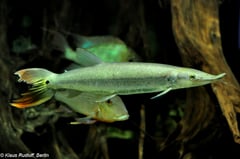
Boulengerella cuvieri
(Spix & Agassiz, 1829)
Max length800mm SL31in SLTanknot recordedTemp22–28°C72–82°FpH5.0–7.5Boulengerella cuvieri is a pelagic ctenoluciid characin from much of the Amazon basin, the Río Orinoco and coastal drainages of the Guianas. The largest officially recorded specimen measured 675 mm, but it appears to grow larger, possibly beyond 800 mm. Given that size and its natural behaviour it is largely unsuitable for the home aquarium. Its entire dorsal-fin base lies ahead of the anal-fin origin, a character shared only with B. lucius and B. xyrekes among ctenoluciids.
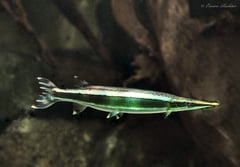
Boulengerella lateristrigaStriped Pike 'Characin'
(Boulenger, 1895)
Max length258mm SL10in SLTank240 × 90cm96 × 36inTemp22–28°C72–82°FpH4.0–7.0The striped pike 'characin', Boulengerella lateristriga, is a ctenoluciid from the rio Negro basin and parts of the upper Río Orinoco. It appears limited to black water rivers and tributaries, where the water is stained darkly with humic acids and the pH can be as low as 3.0 or 4.0. A thin dark stripe from the rear of the eye to the caudal peduncle and dark crossbars on the caudal-fin lobes separate it from the similar B. maculata. It grows to 258 mm SL.
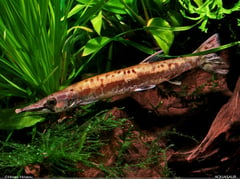
Boulengerella lucius
(Cuvier, 1816)
Max length420mm SL17in SLTanknot recordedTemp22–28°C72–82°FpH4.0–7.0Boulengerella lucius is a large, pelagic ctenoluciid from the central Amazon region in Brazil and the Río Orinoco in Venezuela. Named for its resemblance to the northern pike, it grows to 420 mm and is largely unsuitable for the home aquarium. Juveniles and subadults are sometimes available in the trade, often misidentified as B. maculata. Dark patches between the median caudal-fin rays and random dark spots on the lower flanks separate it from B. cuvieri and B. xyrekes.
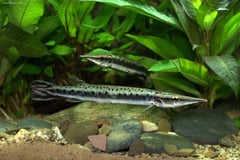
Boulengerella maculata
(Valenciennes, 1850)
Max length329mm SL13in SLTank240 × 90cm96 × 36inTemp22–28°C72–82°FpH5.0–7.5Boulengerella maculata is a pelagic ctenoluciid found throughout much of the Amazon, Orinoco and Tocantins river systems. Colour pattern varies considerably, with some specimens much paler than others, and this may be correlated with water type. Random dark spots on the upper body, and a dark stripe only behind the eye when one is present, separate it from the similar B. lateristriga. It reaches 329 mm SL and needs an aquarium with base dimensions of 240 by 90 cm or more.

Boulengerochromis microlepisEmperor Cichlid
(Boulenger, 1899)
Max length550mm SL22in SLTanknot recordedTemp24–28°C75–82°FpH7.5–9.0The emperor cichlid, Boulengerochromis microlepis, is the only member of its genus and the largest African cichlid, endemic to Lake Tanganyika. A prized food fish around the lake, it grows to 450 to 550 mm and adults are almost entirely piscivorous. Young farm-raised specimens have been readily available in the trade since the mid-2000s, but it is suitable only for public installations or the very largest private aquaria.

Brachychalcinus orbicularisDiscus Tetra
(Valenciennes, 1850)
Max length90mm SL3.5in SLTank120 × 30cm48 × 12inTemp20–27°C68–81°FpH5.0–7.5The discus tetra, Brachychalcinus orbicularis, is a deep-bodied characid generally considered endemic to coastal watersheds of Guyana and Suriname. Recent records suggest it, or a similar congener, may also occur in the Orinoco and Negro drainages. The genus is often referred to collectively as 'silver dollar tetras', and although B. orbicularis is normally said to be the species in the trade, identification is challenging.

Brachygobius aggregatusSchooling Bumblebee Goby
Herre, 1940
Max length44mm SL1.7in SLTank45 × 30cm18 × 12inTemp22–28°C72–82°FpHnot recordedThe schooling bumblebee goby, Brachygobius aggregatus, is a small goby described from the Philippines and recorded from the lower Mekong in Vietnam. The name appears on ornamental trade lists quite often but seems to be routinely misapplied to other species, particularly B. doriae-type fishes. It is very similar to B. kabiliensis, and both are best considered nominal taxa for now since several species might be involved. Small live foods are probably essential.
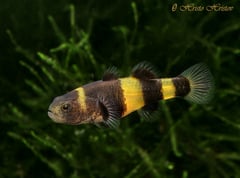
Brachygobius doriaeBumblebee Goby
(Günther, 1868)
Max length35mm SL1.4in SLTank45 × 30cm18 × 12inTemp22–28°C72–82°FpH7.0–8.5The bumblebee goby, Brachygobius doriae, is a small goby from western Borneo and the Natuna Islands, described from Sarawak. Among the more frequently traded members of the genus, it is often misidentified as B. nunus or B. xanthozona and is most easily confused with B. sabanus. It lives in fresh and brackish water in lowland coastal habitats such as mangrove swamps, estuaries and tidal streams. It is best kept in a species-specific set-up.
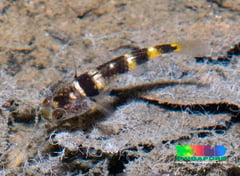
Brachygobius kabiliensisKabili bumblebee goby
Inger, 1958
Max length18mm SL0.7in SLTank45 × 30cm18 × 12inTemp22–28°C72–82°FpHnot recordedThe Kabili bumblebee goby, Brachygobius kabiliensis, is a tiny goby described from the Kabili River in Sabah, northeastern Borneo. Its reported range is disjunct, with records from Brunei, Singapore and the lower Mekong in Vietnam and Cambodia. The name is often misapplied to B. doriae-type fishes in the trade. It lives in fresh and brackish lowland coastal habitats and prefers harder water than some congeners. It grows to just 15 to 18 mm.

Brachygobius mekongensisMekong Bumblebee Goby
Larson & Vidthayanon, 2000
Max length18mm SL0.7in SLTank45 × 30cm18 × 12inTemp22–28°C72–82°FpH5.5–7.5The Mekong bumblebee goby, Brachygobius mekongensis, is a tiny goby from the central and lower Mekong, including the Tonlé Sap system. It is apparently restricted to slow-moving or standing fresh water such as marshes, seasonal swamps and floodplains with dense aquatic vegetation. Narrow, often broken dark bars on a pale background separate it from the most similar species, B. nunus. It is poorly known in the hobby, and other species are sold under its name.

Brachygobius nunus
(Hamilton, 1822)
Max length25mm SL1.0in SLTank45 × 30cm18 × 12inTemp22–28°C72–82°FpHnot recordedBrachygobius nunus is a bumblebee goby described from the Ganges delta near Kolkata, more likely restricted to India, Bangladesh and Sri Lanka. Reports of its wider range vary, and it may also occur in Myanmar. The name is widely misapplied to B. doriae and B. sabanus, which may give a false impression of its availability, though it looks completely different, with four black bands on the body and a black stripe through the eye. It lives in fresh and brackish lowland coastal habitats.
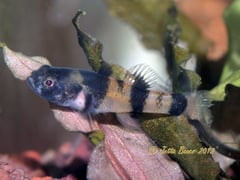
Brachygobius sabanusSabanus Bumblebee Goby
Inger, 1958
Max length27mm SL1.1in SLTank45 × 30cm18 × 12inTemp22–28°C72–82°FpH7.0–8.5The Sabanus bumblebee goby, Brachygobius sabanus, is a small goby described from the Kinabatangan district of Sabah, northeastern Borneo. Among the more frequently traded members of the genus, it is easily confused with B. doriae, but the last one or two rays of its first dorsal-fin are colourless and less than half of the pectoral-fin is black. Its full range is unclear, and populations in Singapore are not thought to be natural. It lives in fresh and brackish lowland coastal habitats.
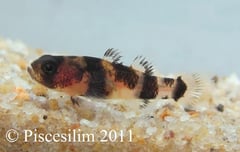
Brachygobius xanthomelas
Herre, 1937
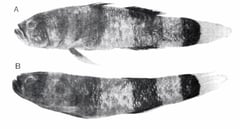
Max length20mm SL0.8in SLTank45 × 30cm18 × 12inTemp22–28°C72–82°FpH7.0–8.5Brachygobius xanthomelas is a small bumblebee goby recorded throughout much of Peninsular Malaysia and southern Thailand. It lives in lowland freshwater swamps, streams and forest peat swamps and, unlike most congeners, does not appear to occur in brackish water. The name is widely misapplied to an unidentified member of the genus, the fish in most online images, which has a dark marking at the front of the first dorsal-fin base where B. xanthomelas is colourless.
Brachygobius xanthozona
(Bleeker, 1849)
Max length38mm SL1.5in SLTanknot recordedTempnot recordedpHnot recordedBrachygobius xanthozona is a bumblebee goby described from Surabaya in eastern Java, Indonesia, and may be endemic to that island. Its name has been widely misapplied in aquarium literature for decades, and fish labelled as such are invariably B. doriae or B. sabanus. With about 50 lateral scales, where congeners have fewer than 30, it is comparatively elongate, and it has four dark bars on the body and an entirely black anal-fin.
Brachyplatystoma capapretum
Lundberg & Akama, 2005
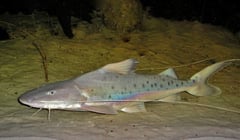
Max length880mm SL35in SLTanknot recordedTemp22–28°C72–82°FpH6.0–8.0Brachyplatystoma capapretum is a large, piscivorous pimelodid catfish found throughout much of the Amazon basin, from near Belém to Iquitos in Peru. The largest recorded specimen measured 880 mm, and it is suitable only for public aquaria and a very small minority of private aquarists. It is very similar to B. filamentosum but smaller, with shorter maxillary barbels, a moderately forked caudal-fin with lobes of equal size, and adults very dark above.
Brachyplatystoma filamentosumPiraíba
(Lichtenstein, 1819)
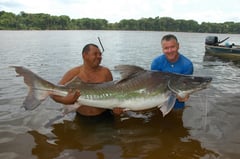
Max length2500mm SL98in SLTanknot recordedTemp22–28°C72–82°FpH6.0–8.0The piraíba, Brachyplatystoma filamentosum, is the largest catfish of the Amazon basin, also found in the Orinoco and river systems of the Guianas. Adults typically measure 2 to 2.5 m and weigh over 150 kg. In the Amazon only fish over around 160 cm are called 'Piraíba', and smaller ones 'filhote'. It is suitable only for public aquaria and a very small minority of private aquarists.
Brachyplatystoma juruenseGold Zebra Catfish
(Boulenger, 1898)
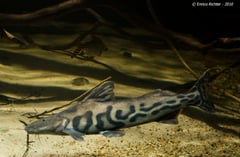
Max length600mm SL24in SLTanknot recordedTemp22–27°C72–81°FpH6.0–7.5The gold zebra catfish, Brachyplatystoma juruense, is a large pimelodid from the middle Amazon and Orinoco basins, described from the rio Juruá. Adults have broad dark vertical, oblique or branching bands on a pale yellowish body and grow to at least 600 mm. It is sometimes confused with B. tigrinum, especially when young, but has a much less defined pattern, a deeper body and shorter barbels. It suits only public aquaria and a very small minority of private aquarists.
Brachyplatystoma platynemaSlobbering Catfish
Boulenger, 1898
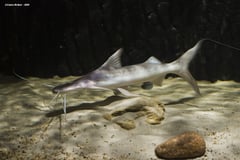
Max length1000mm SL39in SLTanknot recordedTemp22–28°C72–82°FpH6.0–8.0The slobbering catfish, Brachyplatystoma platynema, is a large migratory pimelodid catfish from the Amazon and Orinoco basins. The name refers to its relatively thick barbels, which give the impression that the fish is drooling. It travels considerable distances along deeper, flowing channels, and sexually mature adults have been observed in the upper rio Madeira basin, some 3000 km from the estuary. It grows to 1000 mm SL.
Brachyplatystoma rousseauxiiDourada
(Castelnau, 1855)
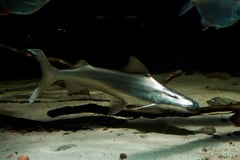
Max length1900mm SL75in SLTanknot recordedTemp22–28°C72–82°FpH6.0–8.0The dourada, Brachyplatystoma rousseauxii, is a large migratory pimelodid catfish from the Amazon and Orinoco drainages and rivers of the Guianas. Juveniles feed in the Amazon delta, while sexually mature adults are found only in the western Amazon. Some populations cover as much as 5500 km during migration from the delta, the longest known in any freshwater fish, and it is heavily fished during its upstream movement. It grows to 1900 mm SL.
Brachyplatystoma tigrinumZebra Shovelnose
(Britski, 1981)
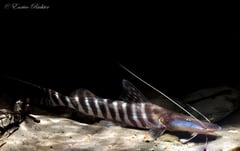
Max length500mm SL20in SLTank1000 × 400cm394 × 157inTemp22–32°C72–90°FpH6.0–7.6The zebra shovelnose, Brachyplatystoma tigrinum, is a pimelodid catfish from the upper Amazon basin in Brazil, Colombia and Peru. Adults appear to be obligate inhabitants of main river channels with strong flow, often around cataracts and rapids, and most aquarium fish are juveniles collected around Iquitos in Peru. It is sometimes confused with B. juruense, especially when young, but has a more well-defined colour pattern, a slenderer body and longer barbels.