Every species
Filters
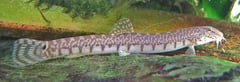
Cobitis koreensis
Kim, 1975
Max length130mm SL5in SLTank100 × 30cm39 × 12inTemp20–24°C68–75°FpH7.0–8.0Iksookimia koreensis is a cobitid loach endemic to Korea, relatively common in river drainages of northern and western South Korea. It is most similar to I. pumila, formerly treated as a subspecies, but has 10 or more dark bars on each flank, saddle-like markings along the back and irregular spots over the upper body. It apparently prefers small, shallow rivers and streams with moderate to fast currents, and needs clean, well-oxygenated water.
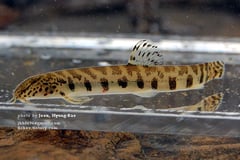
Cobitis pumila
Kim & Lee, 1987
Max length80mm SL3.1in SLTank60 × 30cm24 × 12inTemp20–24°C68–75°FpH7.0–8.0Iksookimia pumila is a small cobitid loach endemic to Korea, known only from the Baek River drainage in the south-west of the country. A dam built in the middle reaches of the river in the late 1990s has undermined its presence at some localities. It is most similar to I. koreensis, of which it was formerly considered a subspecies, but has fewer than 10 bars on each flank and only a few larger, vertically orientated blotches on the upper body.
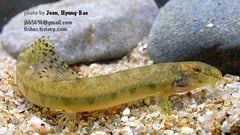
Cobitis yongdokensis
(Kim & Park, 1997)
Max length160mm SL6in SLTank100 × 30cm39 × 12inTemp20–24°C68–75°FpH7.0–8.0Iksookimia yongdokensis is a cobitid loach endemic to Korea, known from four river drainages in the eastern province of Gyeongsangbuk-do. Most similar to I. longicorpus and I. hugowolfeldi, it has 9 to 13 dark vertical bars on the flanks, a small dark spot at the base of the upper caudal-fin lobe and a much smaller lamina circularis in males. It is most often seen in sluggish, shallow habitats with sand or pebble substrates in the mid-to-upper sections of rivers.

Colomesus asellusAmazon Puffer
(Müller & Troschel, 1849)
Max length128mm SL5in SLTank120 × 30cm48 × 12inTemp20–26°C68–79°FpH5.5–8.0The Amazon puffer, Colomesus asellus, is a freshwater puffer found throughout much of the Amazon basin, with records north to Guyana and Venezuela. Also traded as the South American puffer or 'SAP', it is told from congeners by a transverse row of dermal flaps across the chin. It lives mostly in well-oxygenated river habitats, is intolerant of organic waste, and forms loose aggregations, so a group of 6 or more is best, away from the general community.
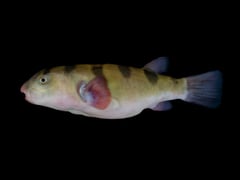
Colomesus psittacusBanded Puffer
(Bloch & Schneider, 1801)
Max length290mm SL11in SLTank180 × 60cm72 × 24inTemp20–26°C68–79°FpH7.0–9.0The banded puffer, Colomesus psittacus, is a large puffer of coastal waters from Colombia and Venezuela through the Guianas to northeastern Brazil. It also occurs in Trinidad and Tobago and the Caribbean islands, and inhabits mangrove swamps, estuaries and the lower reaches of rivers. Growing to 290 mm SL, it is the largest of its genus and has six dark bands across the back. Likely to prove aggressive in all but the largest systems, it is not a popular aquarium fish.
Colomesus tocantinensis
Amaral, Brito, Silva & Carvalho, 2013
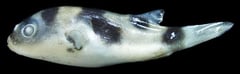
Max length35mm SL1.4in SLTanknot recordedTempnot recordedpHnot recordedColomesus tocantinensis is a small freshwater pufferfish from Brazil, known only from the Tocantins River near Porto Nacional in Tocantins state. The type series measured up to 34.9 mm, though it should grow larger. It is distinguished from C. asellus and C. psittacus by fewer anal and dorsal-fin rays, a ventrally notched opercle, no dermal flaps on the chin, and a pale yellow back with five dark bands.
Colossoma macropomumBlack Pacu
authority not recorded
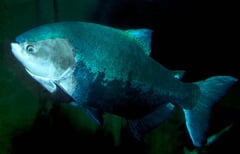
Max length600mm SL24in SLTank300 × 90cm118 × 36inTemp22–28°C72–82°FpH5.5–7.5The black pacu, Colossoma macropomum, is a very large serrasalmid from the Orinoco and Amazon basins in Colombia, Venezuela, Peru, Bolivia and Brazil. Known as the tambaqui in its native countries, it is the second largest scaled fish in the Amazon basin and easily capable of reaching 60 cm in captivity. It is regularly sold as a small juvenile, and releases of outgrown fish have led many wildlife authorities in the US to ban its sale. Wild stocks suffer from gross overfishing in many of its native waters.
Congochromis dimidiatus
(Pellegrin, 1900)
Max length62mm TL2.4in TLTank60 × 30cm24 × 12inTemp22–25°C72–77°FpH6.0–7.0Congochromis dimidiatus is a small cichlid of the central Congo basin in the Republic of the Congo and DR Congo, described from Bangui on the Ubangi. Most older aquarium literature knows it as Nanochromis dimidiatus. Its dark flank stripe runs into the caudal fin, which separates it from C. sabinae. Many museum records were identified before the genus was split, so some may belong to other species.

Congochromis sabinae
(Lamboj, 2005)
Max length70mm SL2.8in SLTank60 × 30cm24 × 12inTemp24–27°C75–81°FpH4.0–6.0Congochromis sabinae is a small cichlid from rainforest streams in the Republic of the Congo, northeast Gabon and northern DR Congo. It was in the hobby before its description under names such as Nanochromis sp. 'Bamanja', 'Genema' and 'Bloody Mary', and continues to be mislabelled N. squamiceps. The dark midlateral stripe stops short of the caudal fin. At the type locality the water was stained reddish brown, with a pH of 4.0.

Copadichromis azureus
authority not recorded
Max length160mm SL6in SLTank150 × 45cm60 × 18inTemp26–28°C79–82°FpH7.5–8.5Copadichromis azureus is an Utaka cichlid endemic to Lake Malawi, found in the southern part of the lake around the Maleri and Mbenji Islands. It shoals in open water around rocky shores and reefs at 20-30 metres. Dozens of colour forms exist, usually sold with the collection locality attached, and it is sometimes seen under the invalid name Haplochromis chrysonotus, which causes confusion with C. chrysonotus. Peaceful even by Copadichromis standards, it should not be kept with Mbuna.

Copadichromis borleyi
authority not recorded
Max length200mm SL8in SLTank150 × 45cm60 × 18inTemp25–29°C77–84°FpH7.5–8.5Copadichromis borleyi is an Utaka cichlid endemic to Lake Malawi, where it shoals over rocky areas and isolated boulders at 5-20 metres. One of the species most commonly encountered in the hobby, it is available in several colour morphs, often divided into yellow and red finned forms and sold with the collection locality attached, such as 'Kadango'. It is also sold under invalid names such as Haplochromis 'red Kadango'. Other Copadichromis should be left out, as they can hybridise.
Copadichromis chrysonotus
authority not recorded
Max length160mm SL6in SLTank150 × 45cm60 × 18inTemp25–29°C77–84°FpH7.5–8.5Copadichromis chrysonotus is an Utaka cichlid endemic to Lake Malawi, collected between Karonga and Monkey Bay in deep, open water. Among Copadichromis it is the best-known open-water spawner. It is not seen often in the hobby, and most fish imported under the name turn out to be C. azureus sold as 'Haplochromis chrysonotus'. Males are paler on the dorsal surface than the uniformly blue C. azureus, while the females are virtually indistinguishable.

Copadichromis ilesi
authority not recorded
Max length175mm SL7in SLTank150 × 45cm60 × 18inTemp25–29°C77–84°FpH7.5–8.5Copadichromis ilesi is an Utaka cichlid endemic to Lake Malawi, collected at Gome, Nkata Bay and Monkey Bay around rocky shores and reefs. Described in 1999, it was previously sold as Copadichromis 'virginalis kajose' and is a close relative of C. virginalis, with which it shoals at Gome Rock. Its females are sandy brown, and males grow larger than C. virginalis and lack the red stripe in the dorsal fin.

Copadichromis virginalis
authority not recorded
Max length130mm SL5in SLTank150 × 45cm60 × 18inTemp25–29°C77–84°FpH7.5–8.5Copadichromis virginalis is an Utaka cichlid endemic to the northern end of Lake Malawi, shoaling in open water around rocky shores and reefs. Numerous colour forms exist and are usually sold with the collection locality attached, such as 'Gold Nkanda'. It shoals alongside the similar C. ilesi at some locations, but males have a red stripe along the dorsal fin and the females are silver. Peaceful even by Copadichromis standards, it should not be combined with Mbuna.
Copeina guttataRed-spotted Tetra
(Steindachner, 1876)
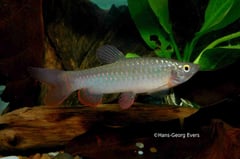
Max length76mm SL3.0in SLTank120 × 30cm48 × 12inTemp20–28°C68–82°FpH4.0–7.5The red-spotted tetra, Copeina guttata, is a lebiasinid from the middle and upper Amazon basin in Brazil, Peru, Ecuador and Colombia. Reaching 76 mm, it needs a tank of at least 120 x 30 cm. The eggs are apparently deposited in a shallow depression dug in the substrate and guarded by the male. Like many fishes from pristine environments it is intolerant of organic pollutants and requires spotless water.
Copella arnoldiSplash Tetra
(Regan, 1912)
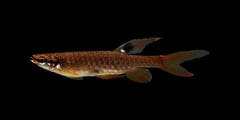
Max length55mm SL2.2in SLTank90 × 30cm36 × 12inTemp20–28°C68–82°FpH4.0–7.5The splash tetra, Copella arnoldi, is a lebiasinid from the lower Amazon basin in Brazil and coastal drainages of Guyana, Suriname and French Guiana. It spawns out of the water: a pair leap together onto overhanging vegetation and cling there while the eggs are laid. Zarske (2011) treats the Guianas populations as C. carsevennensis, restricting C. arnoldi sensu stricto to the lower Amazon, though Mol (2012) considers the two synonymous.
Copella callolepis
(Regan, 1912)
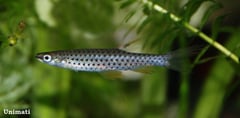
Max length42mm SL1.7in SLTank60 × 30cm24 × 12inTemp20–28°C68–82°FpH4.0–7.0Copella callolepis is a small lebiasinid from the central Amazon region of Brazil, where all recent records come from. It is quite common in the aquarium trade but normally misidentified as C. nattereri or the very similar C. meinkeni. It lacks the dark lateral stripe of C. nattereri, and differs from C. meinkeni in a black triangular marking in the lower caudal-fin lobe and blue-black to dark brownish-red spots.
Copella carsevennensis
(Regan, 1912)
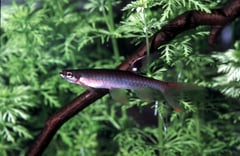
Max length40mm SL1.6in SLTank75 × 30cm30 × 12inTemp20–28°C68–82°FpH4.0–7.0Copella carsevennensis is a small lebiasinid from coastal river systems in Guyana, Suriname, French Guiana and Amapá state, Brazil. It appears in the trade from time to time among wild-caught fishes from the Guianas. Zarske (2011) separated it from C. arnoldi, partly because it lays its eggs among submerged vegetation and not out of the water, though Mol (2012) considers the two synonymous.
Copella eigenmanni
(Regan, 1912)
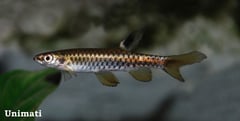
Max length45mm SL1.8in SLTank80 × 30cm31 × 12inTemp20–28°C68–82°FpH4.0–7.0Copella eigenmanni is a small lebiasinid from the Orinoco system in the llanos of Colombia and Venezuela, including the Meta, Caroní and Apure. It turns up in the trade from time to time among wild-caught fishes from the Orinoco basin. Colombian populations were formerly called C. metae until Zarske (2011) synonymised the two. A broad dark stripe runs from the snout to the eye, and the eggs are laid among vegetation and guarded by the male.
Copella meinkeniSpotted Splashing Tetra
Zarske & Géry, 2006
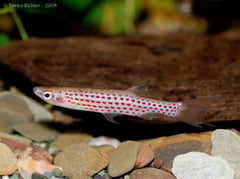
Max length45mm SL1.8in SLTank60 × 30cm24 × 12inTemp20–28°C68–82°FpH4.0–7.0The spotted splashing tetra, Copella meinkeni, is a small lebiasinid from the central Amazon region, with most records from the rio Negro and Orinoco. It has been widely referred to as C. nattereri in aquarium literature, but lacks that species' dark lateral stripe and has 5-6 rows of bright red spots on the body. The similar C. callolepis is also traded. It inhabits forest streams with tea-coloured water and lays its eggs among vegetation.