Every species
Filters
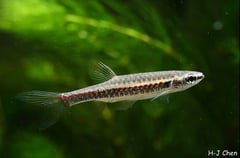
Copella nattereri
(Steindachner, 1876)
Max length45mm SL1.8in SLTank60 × 30cm24 × 12inTemp20–28°C68–82°FpH4.0–7.0Copella nattereri is a small lebiasinid widespread in the middle and upper Amazon drainage in Peru and Brazil. It is sometimes traded as C. sp. 'red line', 'spotted tetra' or C. nigrofasciata, and its name was long applied to C. callolepis and C. meinkeni. Of the three it alone has a dark lateral stripe, and it has no more than three rows of red spots on the flanks. It inhabits forest streams and flooded forest.
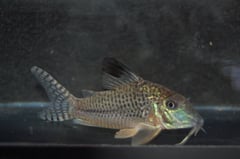
Corydoras acutusBlacktop Cory
Cope, 1872
Max length70mm SL2.8in SLTanknot recordedTemp22–28°C72–82°FpH6.0–7.5The blacktop cory, Corydoras acutus, is an armoured catfish from the upper Amazon basin in Brazil, Peru, Ecuador and possibly Bolivia. It can be confused with three similar fishes known as C024, C077 and C109. C024 and C109 occur thousands of kilometres outside its range, but C077 lives alongside it in the rio Abunã and is only known to differ in growing smaller. Some specimens lack the dark marking in the dorsal fin.
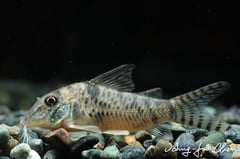
Corydoras aurofrenatusCW005
Eigenmann & Kennedy, 1903
Max length55mm SL2.2in SLTanknot recordedTemp22–26°C72–79°FpH6.0–8.0Corydoras aurofrenatus is an armoured catfish from the Río Paraguay-Paraná system in Paraguay, also recorded in Argentina and Bolivia. It has been traded as C. sp. 'Corrientes' and CW005. Each flank carries two dark blotches, one behind the head and one below the adipose fin, and the caudal-fin lobes are long with the upper more extended. C. ellisae has been treated as a junior synonym, although this appears not to have achieved wide acceptance.
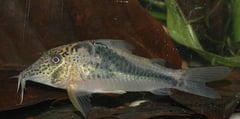
Corydoras fowleriFowler's Cory
Böhlke, 1950
Max length70mm SL2.8in SLTank120 × 45cm48 × 18inTemp20–28°C68–82°FpH5.0–7.5Fowler's cory, Corydoras fowleri, is a long-snouted armoured catfish from the Amazon basin in Peru. Also known as the 'huanta cory' and 'milegros cory', it is often confused with C. coriatae and C. semiaquilus, and aquarium fish are regularly misidentified. Most long-snouted cories grow larger and are more aggressive than other Corydoras, and this one is suitable only for larger community aquaria.
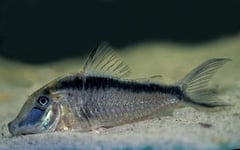
Corydoras narcissusLong-nosed Skunk Cory
authority not recorded
Max length75mm SL3.0in SLTank120 × 30cm48 × 12inTemp23–25°C73–77°FpH6.0–7.0The long-nosed skunk cory, Corydoras narcissus, is an armoured catfish that appears to be endemic to the Rio Purus in Brazil. It lives alongside Brochis arcuata and looks very similar at first glance, but has an elongated snout where that of B. arcuata is much more rounded. Large for a Corydoras at around 75 mm SL, it does best with some water flow in the tank.
Corydoras ourastigmaLong-nosed Smudge Spot Cory
authority not recorded
Max length65mm SL2.6in SLTank60 × 38cm24 × 15inTemp24–26°C75–79°FpH6.0–7.2The long-nosed smudge spot cory, Corydoras ourastigma, is an armoured catfish from the Rio Purus basin in Brazil. It can be confused with Gastrodermus guapore, Hoplisoma caudimaculatum, H. simile and Brochis spectabilis, but is the only one with an obvious long snout. Its smudged caudal blotch resembles that of H. simile but is grey to black. Nothing is recorded of its habitat.
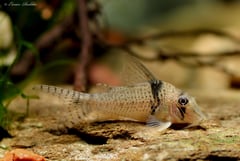
Corydoras pastazensisPastaza Cory
Weitzman, 1963
Max length70mm SL2.8in SLTank90 × 30cm36 × 12inTemp22–28°C72–82°FpH5.0–7.0The Pastaza cory, Corydoras pastazensis, is an armoured catfish from the upper Río Pastaza basin in Ecuador and the ríos Ucayali and Puinahua in Peru. The Río Tigre form was raised to species status as C. orcesi, a decision not followed by all authorities. The two are relatively easy to tell apart: in C. pastazensis the dark vertical bar breaks up or tapers off low on the body, and the body is peppered with numerous small dark spots.
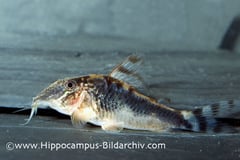
Corydoras semiaquilusPeru Black Cory
authority not recorded
Max length80mm SL3.1in SLTank75 × 30cm30 × 12inTemp22–26°C72–79°FpH6.0–7.0The Peru black cory, Corydoras semiaquilis, is a long-nosed armoured catfish from the western Amazon basin in Peru and Brazil. A few colour forms are available in the trade, sometimes under invalid names such as C. 'huanta' or C. 'milagros'. Males can be somewhat aggressive towards one another, although with sufficient space no real damage should occur, and a group of at least six is best.
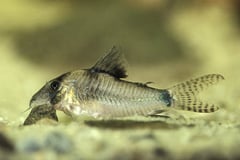
Corydoras septentrionalisNorthern Longnose Cory
authority not recorded
Max length60mm SL2.4in SLTank60 × 38cm24 × 15inTemp22–27°C72–81°FpH6.0–7.5The northern longnose cory, Corydoras septentrionalis, is an armoured catfish from the Rio Orinoco in Venezuela and possibly Colombia. It superficially resembles C. simulatus and C. amapaensis. C. amapaensis has a clear caudal fin, where this species has a noticeably barred one. It is found in main river channels and tributaries.
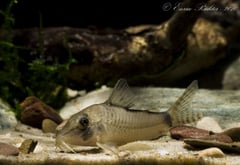
Corydoras simulatus
Weitzman & Nijssen, 1970
Max length53mm SL2.1in SLTanknot recordedTemp20–25°C68–77°FpH6.0–7.0Corydoras simulatus is an armoured catfish known only from the upper Meta watershed in Colombia. It can be identified from most similar-looking congeners by its pair of small rictal barbels. The colour pattern varies considerably with collection locality and some forms have been misidentified as other species, while fish with a dark marking on the sides are sometimes referred to as Corydoras sp. 'olga'.
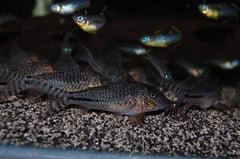
Corydoras sp.C115
authority not recorded
Max length70mm SL2.8in SLTanknot recordedTemp22–28°C72–82°FpH6.0–7.0C115 is an unidentified armoured catfish from the upper Río Madre de Dios in southern Peru, between Manú National Park and Puerto Maldonado. It was traded as both C115 and C116, now thought to be the same species, and fish sold as C. sp. 'Manu' variants may belong here too. It grows to around 70 mm SL and is highly variable in colour pattern, particularly in the extent of dark pigmentation on the front of the body.

Corynopoma riiseiSwordtail Characin
authority not recorded
Max length65mm SL2.6in SLTank75 × 38cm30 × 15inTemp22–28°C72–82°FpH6.0–7.0The swordtail characin, Corynopoma riisei, is an unusual tetra from northern Venezuela, the Villavicencio area of Colombia and the island of Trinidad. Males have caudal glands that release pheromones to attract females, plus gill glands found in only a handful of glandulocaudinids, and females are inseminated by the males. Mainly a surface dweller, it needs open swimming space and a group of at least 6-8, since males can squabble.
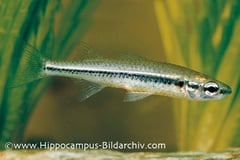
Craterocephalus stercusmuscarumFly-specked Hardyhead
(Günther, 1867)
Max length70mm SL2.8in SLTank76 × 30cm30 × 12inTempnot recordedpHnot recordedThe fly-specked hardyhead, Craterocephalus stercusmuscarum, is an atherinid endemic to Australia. It ranges from the Northern Territory to southern Queensland and forms large shoals over barren sand, mud or clay in streams, rivers, lakes and ponds. Skittish and rarely seen in the trade outside Australia, it does far better in a shoal of at least 8-10. Genetic differences between neighbouring populations are in some cases large enough to suggest several distinct species.

Crenicara latruncularium
authority not recorded
Max length90mm SL3.5in SLTank90 × 38cm36 × 15inTemp24–28°C75–82°FpH6.0–7.0Crenicara latruncularium is a South American cichlid from the Rio Guaporé in western Brazil and the Rio Mamoré in Bolivia. Fairly peaceful unless a pair is breeding, it can be kept with tetras, rasboras, small catfish and other small peaceful fish. Spawning takes place in a cave, and the female guards it and will drive away any fish that come near, including the male.
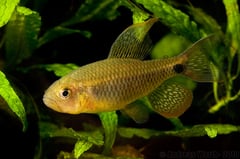
Crenuchus spilurusSailfin Characin
Günther, 1863
Max length70mm SL2.8in SLTank75 × 30cm30 × 12inTemp20–28°C68–82°FpH4.0–6.5The sailfin characin, Crenuchus spilurus, is a crenuchid from much of the Amazon and Orinoco drainages and coastal rivers of the Guianas. The only described member of its genus, it varies considerably in colour pattern and morphology across that range. It lives in tea-stained forest streams, and its timid, predominantly benthic nature means it does not always make an ideal community fish. Males guard eggs laid on the roof of a small cave, often formed from leaf litter.

Crossocheilus atrilimesSiamese Algae Eater
Kottelat, 2000
Max length75mm SL3.0in SLTank120 × 30cm48 × 12inTemp20–26°C68–79°FpH6.0–7.5Crossocheilus atrilimes is one of several near-identical cyprinids traded as the Siamese algae eater, native to the Mekong and Chao Phraya drainages. Telling it apart from C. langei and the undescribed C. sp. 'citripinnis' takes a combination of characters, including a black stripe running to the tip of the caudal fin that broadens and pales when the fish spar. A shoaling fish of flowing streams, it needs spotless, well-oxygenated water and a group of six or more.

Crossocheilus burmanicus
Hora, 1936
Max length120mm SL5in SLTank150 × 45cm60 × 18inTemp20–26°C68–79°FpHnot recordedCrossocheilus burmanicus is a cyprinid from Myanmar plus northeastern India and western Thailand, in rivers draining to the Irrawaddy and Salween. It lives in clear, flowing streams over boulders, pebbles, gravel and sand, browsing the biofilm on submerged surfaces. Its dark lateral stripe does not extend into the caudal fin, which separates it from the fish traded as 'Siamese algae eater' or 'SAE'.

Crossocheilus cobitis
(Bleeker, 1854)
Max length52mm SL2.0in SLTank100 × 30cm39 × 12inTemp20–26°C68–79°FpHnot recordedCrossocheilus cobitis is a cyprinid ranging from the Mekong drainage in Laos, Vietnam and Thailand south to Sumatra, Borneo and Java. Primarily a lowland species, it lives in the turbid lower reaches of rivers over mud, close to submerged logs and similar objects. Given its wide range it has probably reached the trade as the invalid 'Crossocheilus siamensis', and it is likely to represent a group of similar-looking, closely related species.
Crossocheilus elegans
Kottelat & Tan, 2011
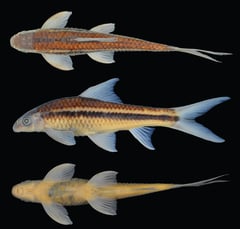
Max length110mm SL4in SLTank150 × 45cm60 × 18inTemp20–25.5°C68–78°FpHnot recordedCrossocheilus elegans is a cyprinid known only from the Segama and Kinabatangan river systems in Sabah, northern Borneo. It is mostly collected in or near the riffles of fast-flowing, rocky headwater hill streams. A pale yellowish brown stripe between the dark brown back and the blackish midlateral stripe separates it from other black-striped Crossocheilus, and before its description it was referred to as Epalzeorhynchos kalliurus and C. cobitis.
Crossocheilus langeiSiamese Algae Eater
Bleeker, 1860
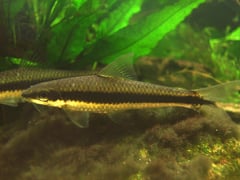
Max length150mm SL6in SLTank150 × 45cm60 × 18inTemp20–26°C68–79°FpH6.0–7.5Crossocheilus langei is a cyprinid from Borneo, Peninsular Malaysia and Thailand, one of several near-identical fish sold as the Siamese algae eater. The trade name 'Crossocheilus siamensis' used for these fish is not valid. C. langei can be told apart by a dark blotch in front of the anal fin and a lateral line running straight through the dark body stripe.