Every species
Filters
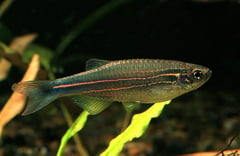
Danio kerriBlue Danio
Smith, 1931
Max length45mm SL1.8in SLTank80 × 30cm31 × 12inTemp18–26°C64–79°FpH6.5–7.5The blue danio, Danio kerri, is a small cyprinid from islands and the adjacent mainland of south-western Thailand. It was described from Phang Nga province and has since been recorded from Phuket, Ko Lanta, Langkawi, Krabi and Ranong. Base body colour is powdery-blue in the north of its range and more yellowish in the south, with pinkish-yellow lateral stripes. It inhabits clear forest streams over rocks and gravel, and can be hard to find in aquarium shops.

Danio kyathitOrange-Finned Danio
Fang, 1998
Max length45mm SL1.8in SLTank90 × 30cm36 × 12inTemp16–26°C61–79°FpH6.5–7.5The orange-finned danio, Danio kyathit, is a small cyprinid from the upper Irrawaddy (Ayeyarwady) River drainage in northern Myanmar. Its body patterning varies, with the lateral stripes solid in some specimens and wavy or broken into spots in others, and the striped form was recovered as genetically distinct from the spotted one. Striped fish resemble D. rerio but have much longer barbels and red to orange fins. Very peaceful, it seems most comfortable at 16 to 26 °C.

Danio margaritatusCelestial Pearl Danio
(Roberts, 2007)
Max length21mm SL0.8in SLTank45 × 30cm18 × 12inTemp20–26°C68–79°FpH6.5–7.5The celestial pearl danio, Danio margaritatus, is a miniature cyprinid from the Salween drainage in Shan State, eastern Myanmar. First marketed as 'Galaxy Rasbora' after its discovery in 2006, it became one of the most hyped fishes the hobby has known, and Myanmar banned exports in 2007 after reports of overfishing. Intensive commercial breeding means specimens with spotted fins or deformities are now common in the ornamental trade.
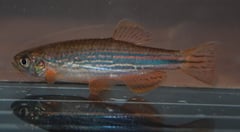
Danio meghalayensis
Sen & Dey, 1985
Max length80mm SL3.1in SLTank120 × 45cm48 × 18inTemp16–21°C61–70°FpH6.5–7.5Much of Meghalaya consists of forested hills which receive a great deal of rainfall and many of its waters flow swiftly. This species typically inhabits high elevation (> 1000 m amsl) streams running over rocky, boulder-strewn substrates with few aquatic plants, although at some localities the flow may be more sluggish with riparian vegetation providing shade.

Danio nigrofasciatusDwarf Spotted Danio
(Day, 1870)
Max length40mm SL1.6in SLTank60 × 30cm24 × 12inTemp18–26°C64–79°FpH6.0–7.5The dwarf spotted danio, Danio nigrofasciatus, is a small cyprinid endemic to central Myanmar, on both sides of the Bago Yoma range. It inhabits streams, minor rivers, ponds, ditches and rice paddies, many of them seasonal. A spotted anal-fin separates it most easily from similar species such as D. rerio and D. kyathit. Very peaceful but rather timid, it does best alone or with similarly sized species that enjoy similar conditions.

Danio rerioZebra Danio
(Hamilton, 1822)
Max length50mm SL2.0in SLTank90 × 30cm36 × 12inTemp18–25°C64–77°FpH6.0–8.0The zebra danio, Danio rerio, is a small cyprinid from India and Bangladesh, found mostly in slow or still pools and mature rice paddies. Peaceful, hardy and inexpensive, it has been mass-produced for many years and quality stock can be hard to find. The spotted 'leopard danio' is a spontaneous mutation of the striped form that also occurs in the wild.

Danio roseusRosy Danio
Fang & Kottelat, 2000
Max length55mm SL2.2in SLTank90 × 30cm36 × 12inTemp18–25°C64–77°FpH6.0–7.5The rosy danio, Danio roseus, is a small cyprinid from the Mekong basin in northern Thailand and Laos, also recorded in northern Myanmar. Colourful, hardy and usually cheap, it has proved very popular and is sometimes sold as 'purple passion danio'. It is very similar to D. albolineatus sensu stricto but has a slimmer body, shorter rostral barbels and no dark stripes on the rear half of the body. Many fish in the hobby are thought to be hybrids of the two.

Danio sp. 'hikari'Hikari Danio
authority not recorded
Max length65mm SL2.6in SLTank120 × 30cm48 × 12inTemp18–26°C64–79°FpH6.5–7.5The hikari danio, Danio sp. 'hikari', is a probable undescribed cyprinid from the Tanintharyi River drainage in southern Myanmar. First available in 2002, males and females were sold as 'Danio sp. hikari yellow' and 'D. sp. hikari blue'. DNA testing showed them to be one species, distinct from the very similar D. kerri, in which the central body stripe ends at the caudal peduncle. Only one population of D. kerri was sampled, so it could still be a colourful form of that species.

Danio sp. 'TW01'Black-barred Danio
authority not recorded
Max length65mm SL2.6in SLTank120 × 30cm48 × 12inTemp18–26°C64–79°FpH6.0–7.5The black-barred danio, Danio sp. 'TW01', is a cyprinid apparently discovered near the coastal town of Gwa in Rakhine State, western Myanmar. It remains unclear whether it is an undescribed species or a geographical form of D. feegradei, which it resembles apart from lacking pale spots on the body. A dark marking on the caudal peduncle separates it from the superficially similar 'Inlecypris' maetaengensis and 'I.' shanensis.

Danio tinwiniGold Ring Danio
Kullander & Fang, 2009
Max length30mm SL1.2in SLTank45 × 30cm18 × 12inTemp18–26°C64–79°FpH6.5–7.5The gold ring danio, Danio tinwini, is a tiny cyprinid from the Mogaung Chaung, an Irrawaddy tributary in Kachin State, northern Myanmar. Seen in the trade since 2003, it has been sold as 'Danio sp. TW02', 'D. sp. fire ring', 'D. sp. gold ring' and 'D. sp. spotted', among other names. Smaller than the similar D. kyathit and D. nigrofasciatus, it has spotted unpaired fins and much shorter barbels. Adults measure just 20 to 30 mm, so tankmates need choosing with that in mind.

Danionella dracula
Conway & Rüber, 2009
Max length17mm SL0.7in SLTank45 × 30cm18 × 12inTemp20–26°C68–79°FpH6.5–7.5Danionella dracula is a miniature cyprinid known only from the Mogaung Chaung, a tributary of the Ayeyarwady in Kachin State, northern Myanmar. Males carry a row of tooth-like processes in the jaws ending in a large fang-like pair, a structure unique among cypriniform fishes according to current knowledge. It grows to around 17 mm SL, has been sold as Danionella sp. 'neon green', and is best kept alone in a school of a dozen or more.

Danionella priapus
Britz, 2009
Max length16mm SL0.6in SLTank45 × 30cm18 × 12inTemp18–24°C64–75°FpH6.0–8.0Danionella priapus is a miniature cyprinid known only from the Jorai River, a Sankosh tributary in the Brahmaputra drainage of West Bengal, India. Males have a conical projection of the genital papilla forming a funnel between the pelvic fins, a feature that may be unique within the Cypriniformes. Referred to as D. sp. 'Jorai River' before its description, it grows to 16 mm SL and was collected from a sluggish, densely vegetated stream alongside Dario dario.

Danionella translucida
Roberts, 1986
Max length11mm SL0.4in SLTank45 × 30cm18 × 12inTemp18–24°C64–75°FpH6.0–8.0Danionella translucida is a miniature, almost transparent cyprinid from a handful of streams draining the Bago Yoma range in Myanmar. Adults measure only 9 to 11 mm SL, and it has been referred to as 'micro glassfish' in the ornamental trade. It inhabits wide, low-altitude streams with turbid water, and it is best kept alone in a school of a dozen or more.

Darienheros calobrensisRedspot Cichild
(Meek & Hildebrand, 1913)
Max length250mm SL10in SLTank120 × 45cm48 × 18inTemp22–27°C72–81°FpH6.5–7.5The redspot cichlid, Darienheros calobrensis, is a large cichlid native to coastal rivers draining Panama's Pacific slope. It lives mostly in lakes, ponds and slow parts of rivers, swimming among the crevices of submerged rocky walls and banks. It has been placed in Cichlasoma and Amphilophus, and is occasionally listed under Astatheros. A belligerent, territorial species, it can share a tank with other large cichlids only in a very large aquarium.

Dario darioScarlet Badis
(Hamilton, 1822)
Max length20mm SL0.8in SLTank45 × 30cm18 × 12inTemp18–26°C64–79°FpH6.5–8.5The scarlet badis, Dario dario, is a tiny badid from tributaries of the Brahmaputra in West Bengal and Assam, India. Among the smallest percoid fishes known, it grows to 20 mm SL and is a popular choice for 'nano' aquaria. Males are the only Dario with seven iridescent blue vertical bars on the flanks, and rival males can be very aggressive towards one another in confined spaces.
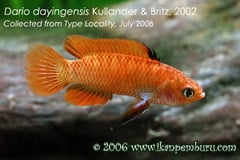
Dario dayingensis
Kullander & Britz, 2002
Max length35mm SL1.4in SLTank45 × 30cm18 × 12inTemp20–24°C68–75°FpH6.0–7.5Dario dayingensis is a small badid from a tributary of the Daying River in the Irrawaddy drainage of Yunnan Province, China. Known for some years before its description, it was identified as Badis dario but is much closer to D. hysginon. It has been maintained by a handful of private collectors, and given its rarity the emphasis should be on captive reproduction, with the fish kept alone.

Dario hysginon
Kullander & Britz, 2002
Max length20mm SL0.8in SLTank45 × 30cm18 × 12inTemp20–24°C68–75°FpH6.5–7.5Dario hysginon is a tiny badid endemic to Myanmar, known from streams near Myitkyina in Kachin State and from nearby Lake Indawgyi. Traded as 'red melon Dario' or 'flame red Dario', it reaches around 20 mm in males and 15 mm in females. The barred form sold as Dario sp. 'Myanmar' is officially a colour form of this species, but it grows larger and the two will not hybridise in aquaria.

Dario kajal
Britz & Kullander, 2013
Max length20mm SL0.8in SLTank45 × 30cm18 × 12inTemp16–24°C61–75°FpH6.5–7.5Dario kajal is a tiny badid from the Meghna drainage, described from the Jaintia Hills of Meghalaya, India, and also found in Bangladesh. It was referred to as Dario sp. 'Jaintia Hills' or D. sp. 'Bangladesh' before its description, and its name alludes to its prominent orbital stripes. Males have bars arranged in pairs on the upper half of the body, and given its rarity it is best kept alone with the emphasis on captive reproduction.

Dario tigrisBlack Tiger Dario
Britz, Kullander & Rüber, 2022
Max length35mm SL1.4in SLTank45 × 30cm18 × 12inTemp20–24°C68–75°FpH7.0–9.0The black tiger Dario, Dario tigris, is a small badid from mountain streams south of Mogaung in Kachin State, northern Myanmar. First available to hobbyists in 2005, it was sold as Dario sp. 'Myanmar', D. sp. 'pyjamas' or 'fire red tiger badis' until Britz, Kullander and Rüber described it in 2022. It had been treated as a colour form of D. hysginon, but it grows appreciably larger, its females are distinguishable, and the two will not hybridise in aquaria.

Dario urops
Britz, Ali & Philip, 2012
Max length28mm SL1.1in SLTanknot recordedTempnot recordedpHnot recordedDario urops is a badid from the Western Ghats of southwestern India, recorded from the Valapattanam and upper Cauvery systems in Karnataka and Kerala. Unlike the rest of the genus it occurs in southwestern India, grows to at least 28 mm SL, and has a conspicuous black eye spot on the caudal peduncle. Though described in 2012, it was first collected in the 19th century, when Day recorded Badis dario from 'Wynaad'.