Every species
Filters

Cyphotilapia frontosaHumphead Cichlid
(Boulenger, 1906)
Max length255mm SL10in SLTank240 × 60cm96 × 24inTemp23–27°C73–81°FpH8.0–9.0The humphead cichlid, Cyphotilapia frontosa, is a large cichlid endemic to the northern portion of Lake Tanganyika. Known in the hobby as 'frontosa' or 'front', it grows to 255 mm SL and is gregarious, forming a dominance hierarchy in groups of at least five. Populations are usually labelled by locality to preserve pure bloodlines, and forms referred to as 'Blue Zaire' belong to its only congener, C. gibberosa.

Cyphotilapia gibberosa
Takahashi & Nakaya, 2003
Max length255mm SL10in SLTank240 × 60cm96 × 24inTemp23–27°C73–81°FpH8.0–9.0Cyphotilapia gibberosa is a large cichlid endemic to southern Lake Tanganyika, with a hump on the forehead and broad vertical body bands. Until its description in 2003 the genus was considered monotypic, and forms referred to as 'Blue Zaire' are sometimes misidentified as C. frontosa. A gregarious maternal mouthbrooder, it grows to 255 mm SL and forms a dominance hierarchy in groups of at least five.

Cyprichromis leptosomaSardine Cichlid
(Boulenger, 1898)
Max length125mm SL5in SLTank120 × 45cm48 × 18inTemp24–27°C75–81°FpH7.8–9.0The sardine cichlid, Cyprichromis leptosoma, is a peaceful open-water cichlid endemic to Lake Tanganyika. In nature it congregates in shoals of several thousand, feeding on zooplankton, and it occurs in several geographical morphs, each in blue and yellow-tailed forms. Fish sold as C. leptosoma sp. 'Jumbo' grow larger than the 'true' leptosoma and are likely a different species, and none of these forms should be housed together because they can hybridise.
Cyprichromis microlepidotusSmallscale Cyprichromis
(Poll, 1956)
Max length110mm SL4in SLTank120 × 45cm48 × 18inTemp24–27°C75–81°FpH7.8–9.0The smallscale Cyprichromis, Cyprichromis microlepidotus, is an open-water cichlid endemic to Lake Tanganyika, mostly at the northern end of the lake. Quite a rarity in the hobby, it lives in huge mixed groups with other Cyprichromis species and the similar Paracyprichromis. Several geographical variants exist, each with a yellow and a blue-tailed form, and they should never be mixed in the aquarium because they will interbreed.
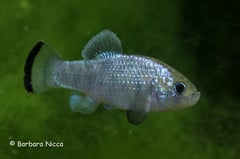
Cyprinodon alvareziPotosí Pupfish
Miller, 1976
Max length60mm SL2.4in SLTank60 × 30cm24 × 12inTemp17–26°C63–79°FpH7.0–8.0The Potosí pupfish, Cyprinodon alvarezi, is a pupfish from a single isolated spring near El Potosí in Nuevo León state, northern Mexico. It has been extinct in nature since the late 1990s, after the spring-fed pond at La Hediondilla dried up through extraction of its water for irrigation and other human uses. The species now exists only in captivity, and its preservation means it is not recommended for the community fish keeper.
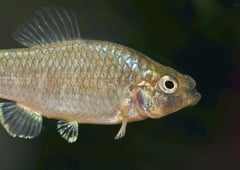
Cyprinodon brontotheroidesDurophage Pupfish
Martin & Wainwright, 2013
Max length36mm SL1.4in SLTanknot recordedTempnot recordedpHnot recordedThe durophage pupfish, Cyprinodon brontotheroides, is a pupfish endemic to six hypersaline lakes on San Salvador Island in the Bahamas. A specialised predator of hard-shelled invertebrates, particularly gastropods and ostracods, it has a shortened upper jaw and a protruding nasal region, and no other Cyprinodon species is adapted to hard-shelled prey. It occurs alongside C. variegatus in all six lakes and with C. desquamator in four of them.
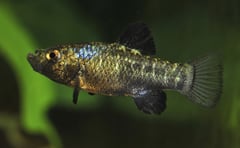
Cyprinodon desquamatorScale-eating pupfish
Martin & Wainwright, 2013
Max length31mm SL1.2in SLTanknot recordedTempnot recordedpHnot recordedThe scale-eating pupfish, Cyprinodon desquamator, is a pupfish endemic to six hypersaline lakes on San Salvador Island in the Bahamas. A specialised lepidophage, it takes approximately half its diet as the scales of other fishes, and its large supra-terminal jaws and elongate body are adapted to a fast biting action. No other Cyprinodon species feeds on fish scales, and it lives alongside C. variegatus in all six lakes.
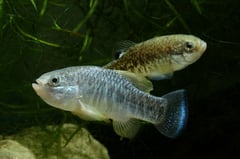
Cyprinodon julimesJulimes Pupfish
De la Maza-Benignos & Vela-Valladores, 2009
Max lengthnot recordedTank60 × 30cm24 × 12inTempnot recordedpHnot recordedThe Julimes pupfish, Cyprinodon julimes, is known only from a geothermal spring in the middle Río Conchos basin, Chihuahua state, northern Mexico. The water there fluctuates between 38 and 48 °C, and the spring is considered one of the hottest environments inhabited by fish in the world. Its closest relatives are C. eximius and C. pachycephalus.
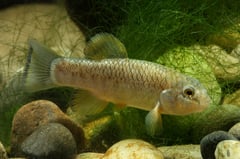
Cyprinodon pachycephalus
Minckley & Minckley, 1986
Max length45mm SL1.8in SLTank60 × 30cm24 × 12inTempnot recordedpHnot recordedCyprinodon pachycephalus is a pupfish endemic to the thermal spring of San Diego de Alcalá and its distributaries in Chihuahua state, northern Mexico. The springs produce water at a constant 43.8 °C, cooling downstream, and in the lower part of the system it forms natural hybrids with the congener C. eximius.
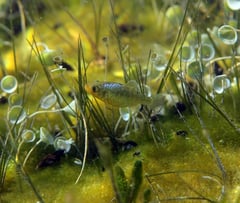
Cyprinodon variegatusSheepshead 'Minnow'
Lacepède, 1803
Max length50mm SL2.0in SLTank60 × 30cm24 × 12inTempnot recordedpHnot recordedThe sheepshead 'minnow', Cyprinodon variegatus, is a pupfish ranging from the northeastern U.S.A. to northeastern Mexico, the Bahamas and Antilles. It tends to be most common in brackish to hypersaline environments such as coastal salt marshes, lagoons and estuaries. On San Salvador Island in the Bahamas it appears to be the parent of a group of species living in sympatry and exploiting diverse but specific resources.
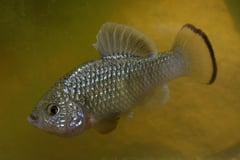
Cyprinodon veronicaeCharco Palma Pupfish
Lozano-Vilano & Contreras-Balderas, 1993
Max length50mm SL2.0in SLTank60 × 30cm24 × 12inTempnot recordedpHnot recordedThe Charco Palma pupfish, Cyprinodon veronicae, is a pupfish known only from the spring Ojo de Agua Charco Azul in Nuevo León, Mexico. The Bolsón de Sandia spring system has been dry since the late 1990s because of water extraction by local communities, and all four Cyprinodon species described from it are now considered extinct in the wild. Nuptial males are violaceous blue.

Cyrtocara mooriiMalawi Blue Dolphin
authority not recorded
Max length250mm SL10in SLTank150 × 38cm60 × 15inTemp25–29°C77–84°FpH7.5–8.8The Malawi blue dolphin, Cyrtocara moorii, is a large, peaceful cichlid endemic to Lake Malawi, found mainly over shallow sandy areas. Formerly named Haplochromis moorii, it shoals in nature and follows substrate-sifting species such as Fossorochromis rostratus to feed on morsels stirred up from the sand. Males reach at least 25 cm, and it should not be kept with boisterous species such as mbuna.

Danio aesculapiiPanther Danio
Kullander & Fang, 2009
Max length30mm SL1.2in SLTank60 × 30cm24 × 12inTemp22–27°C72–81°FpH6.9–7.1The panther danio, Danio aesculapii, is a small cyprinid endemic to the Rakhine Yoma (Arakan mountains) of western Myanmar. It continues to be traded under names such as 'Danio sp. pantheri', 'D. sp. hieroglyph' and 'D. sp. TW03'. Six or seven brown vertical bars on the front of the body and two rows of small brown spots behind them set it apart from congeners. One of the smaller members of the genus at 25 to 30 mm, it inhabits seasonal streams and pools.

Danio albolineatusPearl Danio
(Blyth, 1860)
Max length55mm SL2.2in SLTank90 × 30cm36 × 12inTemp16–25°C61–77°FpH6.0–8.0The pearl danio, Danio albolineatus, is a small cyprinid recorded from Myanmar and Indochina south to Peninsular Malaysia and Sumatra. Colour and patterning differ between localities, and doubts remain whether it is a single species or a group of closely related fish. Wild examples are rare in the trade, with most produced commercially in South East Asia or eastern Europe, and some of the fish traded are likely to be hybrids with D. roseus.

Danio chopraeGlowlight Danio
Hora, 1928
Max length30mm SL1.2in SLTank80 × 30cm31 × 12inTemp16–26°C61–79°FpH6.0–8.0The glowlight danio, Danio choprae, is a small cyprinid from northern Myanmar, apparently restricted to the Mogaung Chaung system. Available in the trade since around 2003, it quickly became one of the most popular small danionins in the hobby, and commercial breeding means wild fish are hard to come by. It closely resembles D. flagrans, and the spelling 'choprai' seen in some sources is not the accepted one.
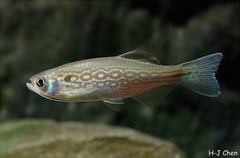
Danio dangilaMoustached Danio
(Hamilton, 1822)
Max length130mm SL5in SLTank120 × 45cm48 × 18inTemp16–24°C61–75°FpH6.5–7.5The moustached danio, Danio dangila, is a cyprinid from the Ganges and Brahmaputra drainages, with most records from Nepal, India and Bangladesh. The common name refers to its exceptionally long barbels, and despite its apparent abundance in nature it remains uncommon in the hobby. Its constant activity can upset slow-moving or timid tankmates, so it suits larger tanks with similarly-sized fishes, and adult size appears to vary by population from 60 to 130 mm.

Danio erythromicron
(Annandale, 1918)
Max length20mm SL0.8in SLTank60 × 30cm24 × 12inTemp20–24°C68–75°FpH7.0–8.0Danio erythromicron is a miniature danionin from Lake Inle and its surrounding watershed in Shan State, eastern Myanmar. Fully grown at just 20 mm, it is sold under trade names including 'emerald dwarf danio' and 'cross-banded dwarf rasbora'. It will not do well in acidic water, and there is limited evidence that it has been hybridised with D. margaritatus and the offspring sold as females of that species.

Danio feegradeiYoma Danio
Hora, 1937
Max length60mm SL2.4in SLTank120 × 45cm48 × 18inTemp18–25°C64–77°FpH6.5–7.5The Yoma danio, Danio feegradei, is a cyprinid considered endemic to the western slopes of the Rakhine Yoma in western Myanmar. Seen in the hobby since around 2005, it is traded under names such as 'Danio sp. Yoma', 'D. sp. gold laser' and 'D. sp. rocket'. The spot-like markings on the flanks vary, and some specimens lack them entirely. It inhabits small, seasonal forest streams, and its constant activity suits it to larger tanks with similarly sized fishes.

Danio flagransNorthern Glowlight Danio
Kullander, 2012
Max length35mm SL1.4in SLTank80 × 30cm31 × 12inTemp16–24°C61–75°FpH6.0–7.0The northern glowlight danio, Danio flagrans, is a small cyprinid known only from a handful of streams near Putao in far northern Myanmar. It has reached the hobby in limited numbers, also traded as 'Danio sp. Putao', 'D. putaoensis' or 'D. cf. choprae'. It looks very similar to D. choprae and is told apart by its more slender body, longer barbels and an almost always present lateral line.

Danio jaintianensis
(Sen, 2007)
Max length45mm SL1.8in SLTank80 × 30cm31 × 12inTemp18–23°C64–73°FpH6.0–7.0Danio jaintianensis is a small cyprinid known only from the Jaintia Hills of Meghalaya, in the Brahmaputra system of northeastern India. It is likely to be restricted to small, slower-moving hill streams with gravel and rocky substrates and thick marginal vegetation. It is best kept in an unheated tank and tends to struggle above 25 °C for long periods. Its temperature needs and rarity make it hard to recommend for the general community.