Every species
Filters
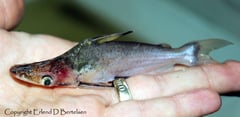
Ageneiosus ucayalensisDuck Catfish
Castelnau, 1855
Max length290mm SL11in SLTank180 × 60cm72 × 24inTemp22.5–28°C73–82°FpH5.5–7.5The duck catfish, Ageneiosus ucayalensis, is an auchenipterid catfish described from Peru and recorded across the Amazon, Orinoco and Guianas. Body patterning apparently varies with locality, and fish from black water habitats, particularly on the Guiana Shield, tend to be darker. Growing to around 290 mm SL and capable of taking large prey, it is safe only with similarly sized catfishes or large pelagic characins, mostly a combination for public aquaria.
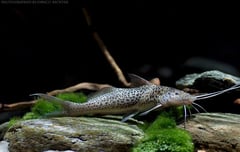
Aguarunichthys torosusBolt Catfish
Stewart, 1986
Max length346mm SL14in SLTanknot recordedTempnot recordedpHnot recordedThe bolt catfish, Aguarunichthys torosus, is a pimelodid catfish known only from the Río Marañón in the upper Amazon basin of Peru. It probably also occurs in some tributaries draining into Peru from Ecuador. Also traded as 'Jello Band' or 'Yellow Band' catfish, it eats fishes small enough to fit in its mouth and is aggressively territorial towards conspecifics, so is best kept singly among larger, ideally fluvial, species.
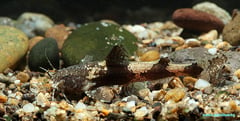
Akysis hendricksoniHendrickson's Stream Catfish
Alfred, 1966
Max length50mm SL2.0in SLTank45 × 30cm18 × 12inTemp16.5–24°C62–75°FpH6.0–7.2Hendrickson's stream catfish, Akysis hendricksoni, is a small akysid catfish from much of Peninsular Malaysia and the extreme south of Thailand. One of the few members of the family exported for the hobby, it grows to around 50 mm SL and spends some of its time buried in sand with only the eyes showing. Colour pattern varies with locality, and like many fishes from running water it is intolerant of organic pollutants and needs spotless water.

Akysis longifilisSittaung Stream Catfish
Ng, 2006
Max length53mm SL2.1in SLTank45 × 30cm18 × 12inTemp16.5–24°C62–75°FpH6.0–7.5The Sittaung stream catfish, Akysis longifilis, is a small akysid catfish known from the Sittaung River system in southern Myanmar. One of the few members of the family exported for the hobby, it has noticeably long nasal and maxillary barbels and two saddle-shaped light markings between the dorsal and caudal fins. The sympatric A. portellus is very similar, and differs mainly in its shorter adipose fin base and smaller mouth.
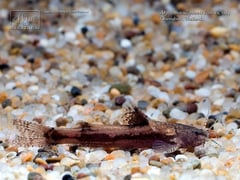
Akysis maculipinnisSpotfin Stream Catfish
Fowler, 1934
Max length35mm SL1.4in SLTank45 × 30cm18 × 12inTemp16.5–24°C62–75°FpH6.0–7.5The spotfin stream catfish, Akysis maculipinnis, is a small akysid catfish from Chanthaburi Province in eastern Thailand. Its range apparently extends into Cambodia. Among the smaller members of the family at around 35 mm SL, it has been exported for the hobby. It spawns above the substrate in flowing water with no parental care, and the adults are avid egg-eaters, so the eggs must be protected if fry are to be raised.

Akysis portellusSmallmouth Stream Catfish
Ng, 2009
Max length43mm SL1.7in SLTank45 × 30cm18 × 12inTemp16.5–24°C62–75°FpH6.0–7.5The smallmouth stream catfish, Akysis portellus, is a small akysid catfish from the Sittaung River system in southern Myanmar. One of the few members of the family exported for the hobby, it grows to around 43 mm SL. It closely resembles the sympatric A. longifilis, and differs in its shorter adipose fin base, smaller mouth and more rounded head when viewed from above.

Akysis prashadiIndawgyi Stream Catfish
Hora, 1936
Max length62mm SL2.4in SLTank45 × 30cm18 × 12inTemp16.5–24°C62–75°FpH6.0–7.2The Indawgyi stream catfish, Akysis prashadi, is an akysid catfish from Lake Indawgyi and the upper Ayeyarwady drainage in northern Myanmar. It has also been recorded from the Lokchao river in Manipur, India. At up to 62 mm SL it ranks among the largest in the genus, and though it has been exported for the hobby it is by no means common.
Akysis pulvinatusKra Stream Catfish
Ng, 2007
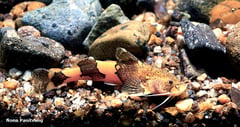
Max length30mm SL1.2in SLTank45 × 30cm18 × 12inTemp16.5–23.5°C62–74°FpH6.0–7.2The Kra stream catfish, Akysis pulvinatus, is a small akysid catfish from southern Thailand. Known from streams on the western side of the Kra Isthmus and the upper Tapi basin, it grows to around 30 mm SL and has been exported for the hobby on an extremely limited basis. It most resembles A. vespa, and differs in its longer adipose fin base, deeper caudal peduncle and a caudal fin with the lower lobe longer than the upper.

Akysis variusVariable Stream Catfish
Ng & Kottelat, 1998
Max length40mm SL1.6in SLTank45 × 30cm18 × 12inTemp16.5–24°C62–75°FpH6.0–7.5The variable stream catfish, Akysis varius, is a small akysid catfish from the Mekong drainage in Laos, Thailand and Cambodia. The number of serrations on its pectoral spine varies, and in contrast to other Akysis with serrated spines, the larger specimens examined had fewer or none. Members of the genus live almost exclusively in swiftly flowing streams and rivers over sand, gravel and rocks.

Akysis vespaOrange-Banded Stream Catfish
Ng & Kottelat, 2004
Max length31mm SL1.2in SLTank45 × 30cm18 × 12inTemp16.5–23.5°C62–74°FpH6.0–7.5The orange-banded stream catfish, Akysis vespa, appears endemic to headwaters of the Salween basin on the border between Myanmar and Thailand. One of the few members of the family exported for the hobby, it is also sold as 'wasp catfish' or 'orange micro bumblebee catfish'. Its yellow markings normally form wide bands, a pattern rarely seen in congeners, and the yellow on the snout extends to the base of the nasal barbels.

Akysis vespertinusWestern Stream Catfish
Ng, 2008
Max length35mm SL1.4in SLTank45 × 30cm18 × 12inTemp16.5–24°C62–75°FpH6.0–7.5The western stream catfish, Akysis vespertinus, is an akysid catfish known only from the Ann Chaung river system in Rakhine State, western Myanmar. Exceptionally rare in the aquarium trade, it has a narrow snout that makes the head look triangular, and two light, saddle-shaped markings between the dorsal and caudal fins. The region holds several other locally endemic fishes, including Danio aesculapii, and the species seems likely to occur more widely there.

Alestopetersius brichardiCherry Red Congo Tetra
Poll, 1967
Max length80mm SL3.1in SLTank120 × 30cm48 × 12inTemp20–28°C68–82°FpH5.0–7.0The cherry red Congo tetra, Alestopetersius brichardi, is an alestid from the middle Congo and tributaries such as the Busira and Ruki in DR Congo. It has also been sold under the misapplied names A. nigropterus and A. ansorgii. Adult males develop extended median caudal-fin rays, with a broad dark lateral stripe running from behind the eye to their tip, and the species is lively and somewhat skittish but generally peaceful.

Alestopetersius caudalisYellow-Tailed Congo Tetra
(Boulenger, 1899)
Max length60mm SL2.4in SLTank120 × 30cm48 × 12inTemp22–26°C72–79°FpH5.0–7.5The yellow-tailed Congo tetra, Alestopetersius caudalis, is an alestid from the lower Congo region, recorded upriver as far as the Irebu channel. Also traded as the 'yellow-finned', 'yellowtail' or 'blue Congo' tetra, it is occasionally bred commercially, though not on the scale of its better-known relative Phenacogrammus interruptus. Adult males develop extended median caudal-fin rays, and the narrow dark lateral stripe broadens markedly on the caudal fin.

Alestopetersius nigropterusAfrican Rainbow Tetra
Poll, 1967
Max length60mm SL2.4in SLTank120 × 30cm48 × 12inTemp22–26°C72–79°FpH5.0–7.0The African rainbow tetra is an alestid from the Congo River system around Kinshasa, DR Congo, normally traded as Alestopetersius nigropterus. Neither that name nor A. cf. ansorgii, the other it is sold under, appears to be correct: the true A. nigropterus is endemic to Lake Mai-Ndombe and little or not exported, and A. ansorgii is a synonym of Nannopetersius ansorgii. Lively and somewhat skittish but generally peaceful, it suits a larger community aquarium.

Alestopetersius smykalaiBlue Diamond Tetra
Poll, 1967
Max length60mm SL2.4in SLTank120 × 30cm48 × 12inTemp20–28°C68–82°FpH5.0–7.0The blue diamond tetra, Alestopetersius smykalai, is an alestid from the Imo and Niger drainages in Nigeria. The only member of its genus found outside the Congo system, it has a prominent dark, roughly diamond-shaped marking on the caudal peduncle, and adult males lack extended median caudal-fin rays. Very rare in the hobby, it is considered Vulnerable by the IUCN because of rainforest loss, dams and habitat degradation in the Niger delta.
Alfaro cultratusKnife Livebearer
(Regan, 1908)
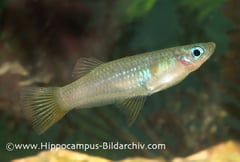
Max length75mm SL3.0in SLTanknot recordedTemp24–28°C75–82°FpH6.0–8.0The knife livebearer, Alfaro cultratus, is a poeciliid from rivers, streams, ditches and backwaters in Costa Rica, Nicaragua and Panama. The common name comes from a keel of modified, paired scales running from the base of the anal fin to the caudal fin. Exceptionally hardy and adaptable, it can be aggressive, especially towards conspecifics, and breeds readily in the aquarium.

Allenbatrachus grunniensFreshwater Toadfish
(Linnaeus, 1758)
Max length300mm SL12in SLTanknot recordedTemp23–28°C73–82°FpH7.5–9.0The freshwater toadfish, Allenbatrachus grunniens, is a euryhaline toadfish from the Ganges delta in India and Bangladesh east to the Philippines. It is relatively common in the hobby and, contrary to popular belief, not venomous, but its dorsal and opercular spines can pierce the skin, so it needs netting with extreme caution. It rarely does well when kept in freshwater for prolonged periods.

Altolamprologus calvusCalvus Cichlid
(Poll, 1978)
Max length138mm SL5in SLTank91 × 46cm36 × 18inTemp24–27°C75–81°FpH7.5–9.0The calvus cichlid, Altolamprologus calvus, is a laterally compressed predatory cichlid endemic to the rocky shores and islands of Lake Tanganyika. Its shape lets it enter crevices in the rockwork to prey on eggs, fry and small fish, and its thick scales have serrated edges. Several colour forms from different parts of the lake are regularly available and should be kept apart so they do not hybridise. Wild fish are sensitive to changes in water chemistry.

Altolamprologus compressicepsCompressed Cichlid
(Boulenger, 1898)
Max length125mm SL5in SLTank120 × 45cm48 × 18inTemp24–28°C75–82°FpH8.0–9.0The compressed cichlid, Altolamprologus compressiceps, is a substrate-spawning cichlid endemic to Lake Tanganyika, where it lives among rocky rubble. Its colour pattern varies with locality, and many forms are traded under their own names, such as 'Burundi red fin' and 'black cheek'. Populations should be kept apart and labelled with their collection locality to avoid hybridisation. A smaller, shell-dwelling fish traded as A. sp. compressiceps 'shell' appears to be an undescribed species.

Amatitlania myrnae
(Loiselle, 1997)
Max length♂ 100 · ♀ 80mm SL♂ 3.9 · ♀ 3.1in SLTank90 × 30cm36 × 12inTemp23–26°C73–79°FpH7.0–8.5Cryptoheros myrnae is a Central American cichlid from the Atlantic slope of Costa Rica and Panama. It was collected from a river with clear, shallow, swiftly flowing water over sand. Moderately aggressive, especially when breeding, it spawns in caves and breeds quite easily. Males are larger and more brightly coloured, and a spawning female turns black on her lower half with a large copper-coloured spot.