Every species
Filters

Amatitlania nanolutea
(Allgayer, 1994)
Max length65mm SL2.6in SLTank90 × 30cm36 × 12inTemp23–26°C73–79°FpH5.0–7.5Amatitlania nanolutea is a small Central American cichlid endemic to the Guarumo river basin in northwestern Panama. Sometimes called the 'yellow convict', it lives in well-oxygenated, moderate to fast-flowing lowland streams. It is not as aggressive as some others in the genus, though territorial when breeding. A substrate-spawner forming temporary pair bonds, both sexes turn bright yellow during courtship.

Amatitlania nigrofasciataConvict Cichlid
(Günther, 1867)
Max length150mm SL6in SLTanknot recordedTemp24–28°C75–82°FpH6.0–8.0The convict cichlid, Amatitlania nigrofasciata, is a Central American cichlid native from Guatemala to Panama. One of the most ubiquitous fish in the hobby, it is hardy and very easily bred, but aggressive and territorial, becomes violent when breeding and is best kept in a species tank. Pink, long-finned and marbled forms exist, and it has been introduced to several countries including the USA and Australia.
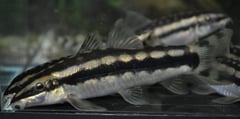
Ambastaia nigrolineataBlack-Lined Loach
(Kottelat & Chu, 1987)
Max length80mm SL3.1in SLTank90 × 30cm36 × 12inTemp20–25°C68–77°FpH6.5–7.5The black-lined loach, Ambastaia nigrolineata, is a botiid loach from the Mekong drainage in southern China and Laos, and the Nan River in Thailand. It resembles its only congener A. sidthimunki but has a solid dark lateral stripe and another along the dorsal mid-line, with the vertical bars between them much less prominent. In Thailand it is considered endangered and appears in the national Red Book of threatened species.
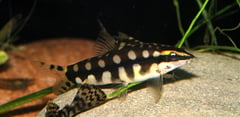
Ambastaia sidthimunkiDwarf Chain Loach
(Klausewitz, 1959)
Max length60mm SL2.4in SLTank80 × 30cm31 × 12inTemp20–30°C68–86°FpH5.5–7.5The dwarf chain loach, Ambastaia sidthimunki, is a small botiid loach from the Mae Klong basin in western Thailand and the Ataran drainage in Myanmar. Older records from the Yom River, Laos and Cambodia refer to A. nigrolineata. Gregarious, it should be kept in a group of at least five or six and preferably ten or more, and reports conflict on whether it stays peaceful with sedentary or long-finned fishes.
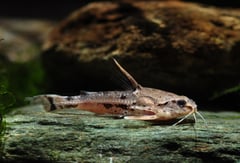
Amblydoras nauticusMarbled Talking Catfish
(Cope, 1874)
Max length75mm SL3.0in SLTank60 × 30cm24 × 12inTemp23–28°C73–82°FpH5.5–7.5The marbled talking catfish, Amblydoras nauticus, is a small doradid catfish from Peru, described from Nauta in the Peruvian Amazon. It is often still sold as A. hancockii, a name now considered a synonym of Platydoras hancockii. Hardy and tolerant of a wide range of water conditions, it is secretive and rarely seen by day. It makes audible sounds by grinding its pectoral spines in their sockets and by resonating the swim bladder, and its spines tangle easily in nets.

Amblypharyngodon chulabhornaePrincess Carplet
Vidthayanon & Kottelat, 1990
Max length40mm SL1.6in SLTank90 × 30cm36 × 12inTemp18–28°C64–82°FpH6.0–8.0The princess carplet, Amblypharyngodon chulabhornae, is a small cyprinid from Thailand and the Mekong system in Laos, Vietnam and Cambodia. It favours wetlands and marginal zones with little water movement and plenty of aquatic and floating vegetation,. Almost unknown in the hobby, it turns up as occasional bycatch among shipments of other fishes. A very peaceful schooling fish, it should be kept in a group of at least 8 to 10.

Amblyrhynchichthys micracanthus
Ng & Kottelat, 2004
Max length200mm SL8in SLTanknot recordedTempnot recordedpHnot recordedAmblyrhynchichthys micracanthus is a riverine cyprinid from the Mekong catchment in Laos, Thailand, Cambodia and Vietnam, and the Chao Phraya system. It moves into inundated forest during the wet season, and wild fish feed on periphyton, plankton and benthic algae. Older records of A. truncatus from mainland Indochina all refer to this species, which has a straighter snout profile, a shorter dorsal-fin spine and fewer gill rakers.
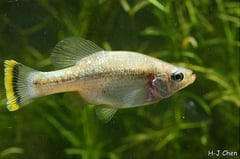
Ameca splendensButterfly Goodeid
Miller & Fitzsimons, 1971
Max length90mm SL3.5in SLTank90 × 30cm36 × 12inTemp20–25°C68–77°FpH7.0–8.0The butterfly goodeid, Ameca splendens, is a livebearer from the Río Ameca drainage in Jalisco, Mexico, and the neighbouring Sayula valley. Often referred to as extinct in the wild, it still survives at a few localities, and strong captive populations exist in the hobby. As in other goodeids, the developing young are nourished by a structure known as the trophotaenia. Males can be quite aggressive, and it is better kept in a species set-up.
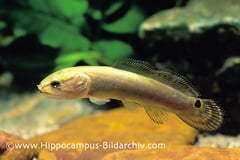
Amia calvaBowfin
Linnaeus, 1766
Max length900mm SL35in SLTank180 × 60cm72 × 24inTemp15–24°C59–75°FpH6.0–7.5The bowfin, Amia calva, is the sole remaining member of the family Amiidae, from south-eastern Canada and the north-eastern USA. It breathes atmospheric air through a highly vascularised organ and can aestivate in wet ground during drought. A temperate predator growing to around 900 mm, it needs a very large tank of its own, and its sharp teeth and readiness to bite make it a dangerous species to own. Captive specimens over 30 years old are known.

Amphilophus citrinellusMidas Cichlid
(Günther, 1864)
Max length350mm SL14in SLTanknot recordedTemp21–26°C70–79°FpH6.0–8.0The midas cichlid, Amphilophus citrinellus, is a large cichlid from Nicaragua and Costa Rica, found in lakes, ponds and slow stretches of rivers. It is often confused with the red devil, A. labiatus, but has a bigger nuchal hump and a more thick-set build. One of the most belligerent cichlids, it needs careful handling with any tankmate, including its own kind. Intentional hybridisation with other species has given rise to the parrot cichlid and the flowerhorn.

Amphilophus labiatusRed Devil Cichlid
(Günther, 1864)
Max length350mm SL14in SLTanknot recordedTemp22–28°C72–82°FpH6.0–8.0The red devil cichlid, Amphilophus labiatus, is a large cichlid endemic to Lakes Nicaragua and Managua in Nicaragua, living near submerged rocks. It is often confused with the midas cichlid, A. citrinellus, and the two have been hybridised in the hobby so much that a purebred fish of either can be hard to find. Wild fish are mostly grey, and the colour forms in the trade come from breeding those with orange or red patterning. It is one of the most aggressive cichlids kept.
Amphilophus trimaculatusThree Spot Cichlid
(Günther, 1867)
Max length400mm SL16in SLTank122 × 38cm48 × 15inTemp23–30°C73–86°FpH7.0The three spot cichlid or trimac, Amphilophus trimaculatus, is a large cichlid from western Mexico, Guatemala and El Salvador. It lives mainly in sluggish waters of the Pacific coastal plains, among roots, branches and vegetation over mud and sand. A fairly aggressive fish that grows to around 40 cm, it is believed to be one of the species used to create the flowerhorn hybrid, and both parents guard the eggs and fry. It is still often sold as Cichlasoma trimaculatum.

Anabas testudineusClimbing Perch
(Bloch, 1792)
Max length200mm SL8in SLTanknot recordedTemp15–30°C59–86°FpH5.5–8.0The climbing perch, Anabas testudineus, is a labyrinth fish found from Pakistan and Sri Lanka east to southern China, Indonesia and Singapore. It lives in almost every kind of lowland water from rice paddies to main river channels, and can cross several hundred metres of land provided it stays moist. Its taxonomy is confused, and additional taxa probably exist. Its size and predatory nature make it unsuitable for the general community.
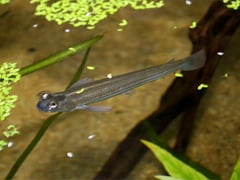
Anableps anablepsFour-Eyed Fish
(Linnaeus, 1758)
Max length260mm SL10in SLTank150 × 45cm60 × 18inTemp25–31°C77–88°FpH7.5–9.0The four-eyed fish, Anableps anableps, is a viviparous fish of brackish mangrove coasts in north-eastern South America, from Venezuela to Brazil. Each eye is split horizontally, with two corneas and two pupils, so it can see above and below the water at the same time. It moves in and out with the tides, and in aquaria it needs brackish water, shallow depth and a large surface area, with a group of at least six in a tank no smaller than 150 x 45 cm.

Anatolichthys anatoliaeAnatolian Toothcarp
(Leidenfrost, 1912)
Max length55mm SL2.2in SLTank120 × 30cm48 × 12inTemp2–30°C36–86°FpH7.0–8.5The Anatolian toothcarp, Anatolichthys anatoliae, is a small killifish from central and western Anatolia in Turkey. The most widely distributed of the Anatolian species, it lives in fresh and mildly saline waters, and around Lake Tuz several populations have disappeared through pollution and water extraction. It needs a cold winter period, and given its conservation status it is best kept on its own, in a group with two or three females to each male.
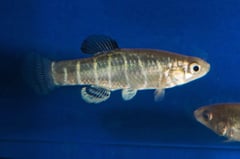
Anatolichthys danfordiiDanford's Toothcarp
(Boulenger, 1890)
Max length50mm SL2.0in SLTank120 × 30cm48 × 12inTemp10–30°C50–86°FpH7.0–8.5Danford's toothcarp, Anatolichthys danfordii, is endemic to Turkey, in the middle and lower Kızıl, lower Yeşil and upper Seyhan river systems. It has a confused history, having been treated as a synonym of both A. sophiae and A. fasciatus, and A. chantrei is now known to be a junior synonym of it. Colour and pattern vary with locality, and forms such as 'Soysallı' and 'Kırşehir' are labelled to preserve bloodlines.
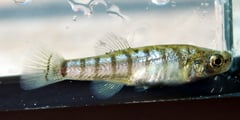
Anatolichthys saldaeSalda Toothcarp
(Akşiray, 1955)
Max length50mm SL2.0in SLTank120 × 30cm48 × 12inTemp6.5–22°C44–72°FpH8.0–10.0The Salda toothcarp, Anatolichthys saldae, is endemic to Lake Salda in the Turkish Lakes region of southwestern Anatolia, Turkey. Lake Salda is a highly alkaline, magnesium-rich soda lake. The fish has an elongated, slender body, an angular lower jaw and reduced scalation that varies between individuals. It has been considered Critically Endangered by the IUCN since 1996.
Anatolichthys sureyanusBurdur Toothcarp
(Neu, 1937)
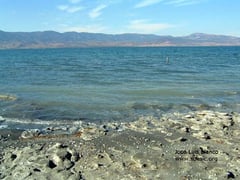
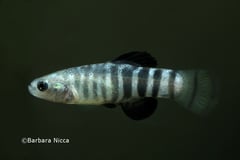
Max length50mm SL2.0in SLTank120 × 30cm48 × 12inTemp5–22°C41–72°FpH8.0–10.0The Burdur toothcarp, Anatolichthys sureyanus, is endemic to Lake Burdur in the Turkish Lakes region of southwestern Anatolia, Turkey. The only fish in this extremely alkaline, saline lake, it has a slender body, an angular lower jaw and variable scalation. It has also gone by A. transgrediens, A. burdurensis and A. burduricus, and appears twice on the IUCN Red List as a result.
Anatolichthys transgrediensAcı Toothcarp
(Ermin, 1946)
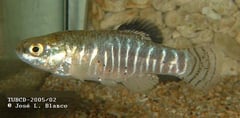
Max length50mm SL2.0in SLTanknot recordedTempnot recordedpH8.0–10.0The Acı toothcarp, Anatolichthys transgrediens, is endemic to the Lake Acı basin in the Turkish Lakes region of southwestern Anatolia, Turkey. The lake's extreme chemistry and fluctuating level mean it is mostly found in fresh and slightly brackish springs around the margins. In scalation, body form and jaw it is intermediate between A. anatoliae and A. splendens/sureyanus. It has been considered critically endangered by the IUCN since 1996.
Anatolichthys villwockiSakarya Toothcarp
(Hrbek & Wildekamp, 2003)
Max length60mm SL2.4in SLTank120 × 30cm48 × 12inTemp2–30°C36–86°FpH6.5–8.5The Sakarya toothcarp, Anatolichthys villwocki, is endemic to the Sakarya River basin, including Lake Çavuşçu, in western central Turkey. Formerly treated as a form of A. anatoliae, it has been shown to be the sister group to all other Anatolian Aphanius. It occupies habitats from clear, spring-fed freshwater to hypersaline Lake Çavuşçu, and colour and pattern vary with locality.